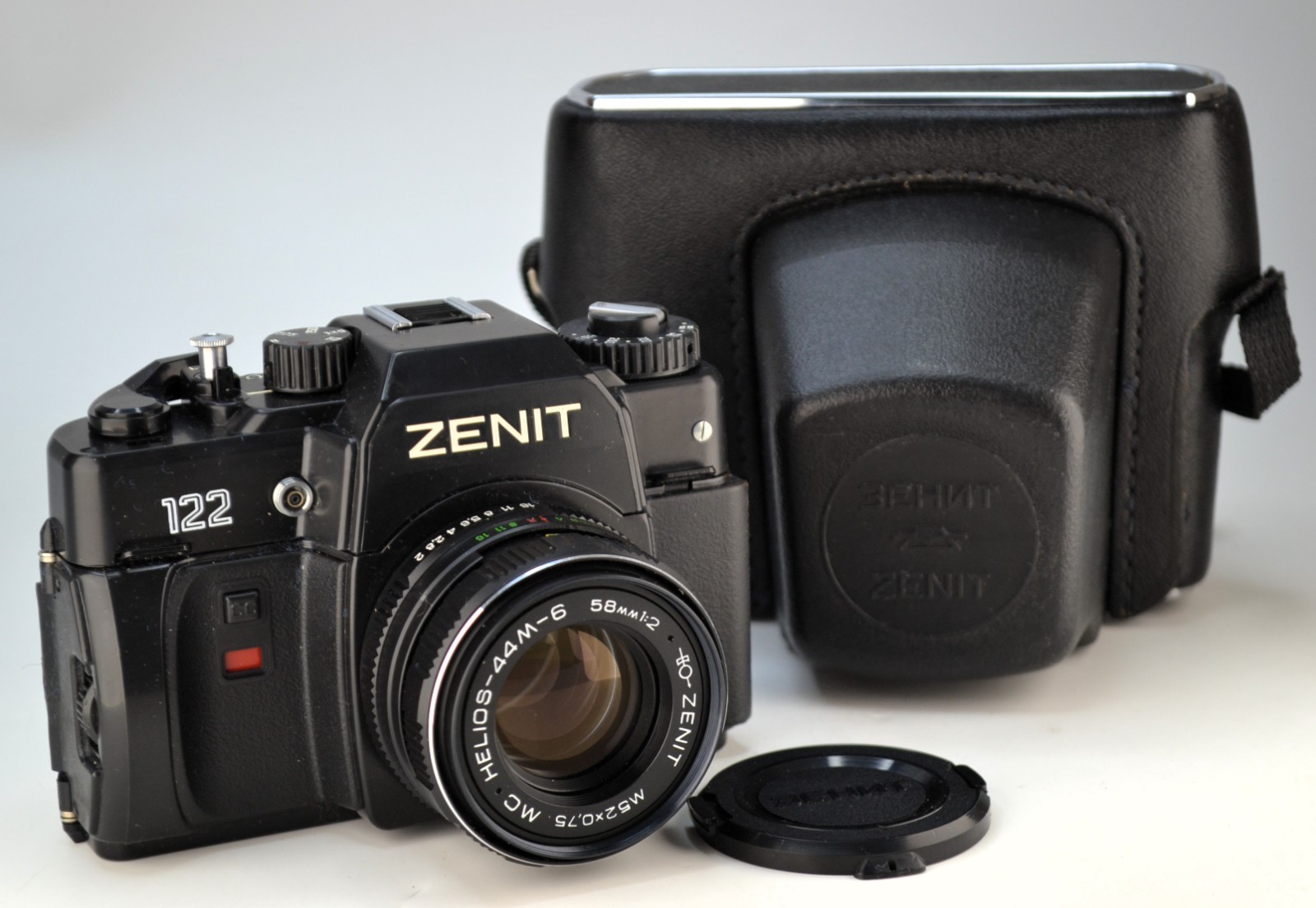
ZENIT 122
Designed primarily for export markets, it represents one of the final iterations in the long-running Zenit SLR series, combining traditional Soviet-era mechanical construction with modest electronic enhancements for improved usability.
Overview
The Zenit 122 was introduced during a period of significant political and economic transition in the former Soviet Union. As domestic demand for film cameras declined due to the rise of compact point-and-shoot models and early digital technology, KMZ shifted focus toward exporting mechanically robust, budget-friendly SLRs to Western markets. The Zenit 122 was positioned as an entry-level manual-focus SLR, targeting photography students, hobbyists, and travelers seeking a durable, no-frills camera capable of producing high-quality results with interchangeable lenses.
Built around the M42 screw-mount lens system—also known as the Praktica thread mount—the Zenit 122 retains compatibility with a vast ecosystem of vintage lenses from manufacturers such as Carl Zeiss Jena, Pentacon, and Helios. Unlike earlier Zenit models that relied entirely on mechanical shutters and manual metering via external selenium cells, , marking a modest step toward modernization. Despite these upgrades, the camera maintains a predominantly mechanical shutter mechanism with electronic timing control, preserving its reliability even when the battery is depleted—though at a fixed shutter speed.
Within the Zenit lineage, the 122 sits near the end of the M42-mount production line, succeeding models like the Zenit-TTL and Zenit-12. It reflects KMZ’s effort to extend the life of proven mechanical designs while incorporating minimal electronics to meet contemporary expectations. Though not a high-end professional tool, the Zenit 122 served as a practical bridge between classic Soviet engineering and late-20th-century photographic standards.
Specifications
| Specification | Value |
| Type | 35mm Manual Focus SLR |
| Film Format | 35mm (135 cartridge) |
| Years Produced | |
| Lens Mount | M42 (screw thread) |
| Shutter | Vertically-traveling metal focal-plane shutter; speeds 1–1/1000 sec, B, X-sync at 1/30 sec |
| Metering | |
| Exposure Modes | Manual exposure only; stop-down metering via AE lever |
| Viewfinder | Fixed pentaprism, 0.95x magnification, 92% coverage; split-image rangefinder spot with microprism collar |
| Dimensions | |
| Film Advance | Manual lever (70° throw), single-stroke |
| Frame Counter | Automatic reset (up to 36 exposures) |
| Battery | |
| Flash Sync | Hot shoe and PC terminal; X-sync at 1/30 sec |
| Self-Timer | Mechanical delay (8–12 sec), lever-activated |
| Accessories | Accepts standard M42 filters, standard tripod socket (1/4"-20) |
Key Features
- TTL Center-Weighted Metering: Utilizes a silicon photodiode sensor for accurate exposure readings through the lens, displayed via a match-needle system in the viewfinder.
- Hot Shoe & PC Sync Terminal: Full electronic flash compatibility with both modern flash units and studio strobes.
- Stop-Down Metering: Allows use of non-automatic M42 lenses by metering at the selected aperture via AE lever.
- Mechanical Backup at 1/30 sec: Shutter remains functional at 1/30 sec even without battery power.
- Export-Oriented Design: Features English labeling, metric/imperial dual scales, and improved finish compared to domestic-market variants.
Historical Context
The Zenit 122 was launched in 1990, coinciding with the final years of the Soviet Union and the beginning of widespread economic liberalization in Eastern Europe. KMZ did face economic challenges in the late 1980s and 1990s, but the Canon AE-1 (1976–1984) and Pentax K1000 (1976–1997) were not direct competitors to any late Soviet SLR due to market and distribution differences. This comparison should be rephrased to reflect limited export competition. To survive, the factory pivoted to exporting simplified, rugged SLRs to Europe, North America, and Asia, where they were marketed as affordable alternatives for film photography enthusiasts.
Unlike contemporaries from Japan and Germany, the Zenit 122 did not feature aperture-priority automation, autofocus, or multi-mode exposure systems. Instead, it emphasized mechanical durability, ease of repair, and compatibility with a wide range of manual lenses. Its main competitors included the Pentax Spotmatic series (discontinued but still popular), the Fujica ST series, and the Praktica PLC2. While technologically outdated by 1990s standards, the Zenit 122 found a niche among budget-conscious photographers, film educators, and those interested in vintage lens experimentation.
Despite its limitations—such as lack of open-aperture metering and relatively slow maximum shutter speed—the Zenit 122 remained in production for over a decade due to low manufacturing costs and steady demand in developing markets and among collectors. Its longevity underscores the enduring appeal of mechanical SLRs in an increasingly automated world.
Collectibility & Value
Today, the Zenit 122 is considered a modestly collectible camera, primarily valued for its historical significance as one of the last mass-produced M42 SLRs from Russia. Its collectibility is enhanced by its role as a transitional model—bridging Soviet industrial heritage with post-Cold War export strategies.
When purchasing a Zenit 122, buyers should verify shutter functionality across all speeds, check for mirror lag or sticking, and inspect the light seals, which commonly degrade after decades. The CdS or silicon meter cell may fail or drift over time, though replacement or recalibration is possible. The camera uses common AA batteries, making it more practical than mercury-battery-dependent predecessors. Common issues include worn shutter curtains, stiff film advance levers, and inaccurate metering due to aging components. However, due to its modular design and widespread parts availability, the Zenit 122 is relatively easy to service with basic tools.
Similar Cameras
- Pentax Spotmatic F (1973–1976) – Iconic M42 SLR with TTL metering and superior build quality.
- Praktica PLC2 (1972–1975) – East German M42 SLR with similar metering and mechanical design.
- Fujica ST705 (1979–1982) – Advanced M42 model with open-aperture metering and smoother ergonomics.
- Zenit-EM (1972–1984) – Earlier Soviet SLR with aperture-priority automation, less refined than the 122.
- Cosina CT-1 (1985) – Late-era M42-compatible SLR with modernized features and higher build precision.
Repair & Maintenance
The Zenit 122 operates on a single AA battery (1.5V), which powers the TTL meter and electronic shutter timing. Without power, the camera defaults to a mechanical 1/30 sec shutter speed, allowing basic functionality. The most common maintenance issues involve degraded foam light seals around the film chamber, which should be replaced to prevent film fogging. Shutter calibration may drift over time, particularly at slower speeds, and periodic cleaning of the mirror box and focusing screen is recommended.
Repair is generally straightforward due to the camera’s mechanical simplicity and widespread parts availability. However, replacement shutter curtains and meter cells may require sourcing from specialty vendors. Lubrication of the film advance and rewind mechanisms is advised every few years to maintain smooth operation. As with all M42 cameras, care should be taken when mounting lenses to avoid cross-threading. Overall, the Zenit 122 is a durable, serviceable camera that rewards basic maintenance with reliable performance.
eBay Listings



As an eBay Partner, we earn from qualifying purchases. This helps support our independent vintage technology research.
Related Models
- Zenit 12 (1983–1994)
- Zenit 3M (1962-1970)
- Zenit B (1968-1973)
- Zenit E (1965–1982)
- Zenit EM (1972-1985)
- Alpa 6 (1948-1953)
- Agfa Agfaflex
- Agfa Ambiflex
- Agfa Easy
- Agfa Futura Af zoom