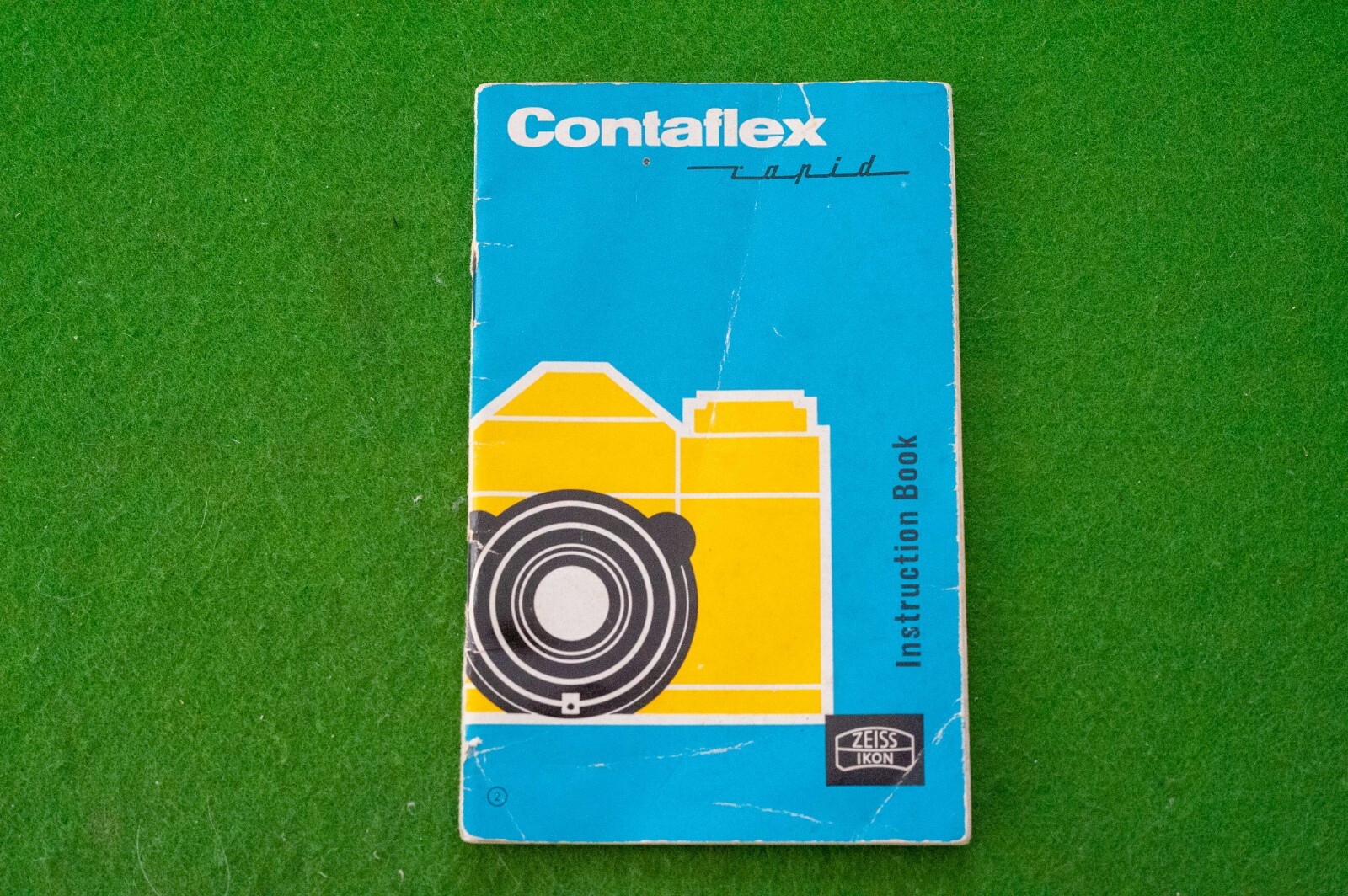
ZEISS IKON CONTAFLEX RAPID
The Zeiss Ikon Contaflex Rapid is a 35mm single-lens reflex (SLR) camera introduced in 1958 as an advanced variant of the original Contaflex line. It has a rapid lever wind and a removable magazine back. Both made it quicker and easier to use for amateur and professional photographers who wanted precision in a compact SLR.
Overview
Zeiss Ikon released the Rapid in 1958. It was the second model in the Contaflex SLR series, after the original Contaflex (1953) and before the Super and Super B models. It was built at the Zeiss Ikon factory in Stuttgart, Germany, and aimed at advanced amateur and semi-professional photographers who wanted a reliable, high-quality 35mm SLR with interchangeable lenses. The interchangeability comes through a proprietary lens module system, not a conventional bayonet mount.
The big change on the Rapid was the rapid lever wind, which replaced the earlier knob-wind system. It advances the film and cocks the shutter faster. Handling and shooting speed improved, and operation came closer to contemporary SLRs like the Exakta VX and Praktica FX series. The magazine back system lets you change film quickly without threading it. That kind of flexibility was rare for the time.
The camera has a fixed Zeiss Tessar 45mm f/2.8 lens mounted in an interchangeable front panel, which is a hallmark of the early Contaflex design. The lens is technically "interchangeable," but only a limited number of modules were ever produced, including the Pro-Tessar 85mm f/4 and Pro-Tessar 55mm f/4. Both required separate viewfinder adjustments because of their different focal lengths. The focal-plane shutter runs from 1 to 1/500 second plus B, and it is synchronized for both M and X flash types via PC terminals.
The Rapid also added a built-in, coupled selenium light meter, a notable upgrade over earlier non-metered models. The meter reading shows in the viewfinder as a pair of needles, for match-needle manual exposure control. With metering, rapid wind and modular optics together, it was one of the most advanced compact SLRs of the late 1950s. The proprietary system limited third-party support and long-term adaptability.
Specifications
| Specification | Value |
| Type | Single-Lens Reflex (SLR) |
| Film Format | 35mm (135 cartridge) |
| Years Produced | 1958–1965 |
| Lens Mount | Proprietary front lens module (Tessar 45mm f/2.8 standard) |
| Shutter | Focal-plane cloth shutter, 1 – 1/500 sec + B; X & M flash sync |
| Metering | Built-in coupled selenium cell meter (center-weighted) |
| Exposure Modes | Manual only (match-needle in viewfinder) |
| Viewfinder | Fixed pentaprism with ground-glass screen, split-image rangefinder spot, and exposure needle display |
| Dimensions | Approx. 140 × 85 × 100 mm; Weight: ~850 g (with lens) |
Key Features
- Rapid lever wind mechanism – Enabled fast, smooth film advance and shutter cocking in a single stroke, improving shooting speed over knob-wind predecessors.
- Removable magazine back – Allowed for quick film changes in daylight; film could be pre-loaded into cassettes for efficient workflow.
- Integrated selenium light meter – Coupled to the exposure system with in-viewfinder needle indication, eliminating the need for external meters.
- Interchangeable lens modules – Supported Pro-Tessar 85mm f/4 and 55mm f/4, though with limited availability and manual viewfinder adjustments.
- Flash synchronization – Dual X and M sync terminals with automatic switching based on flashbulb type.
Historical Context
The Rapid launched while 35mm SLRs were moving from niche technical tools to mainstream photographic instruments. Its main competitors were the Exakta VX (Germany), Praktica FX (East Germany) and the emerging Japanese SLRs like the Asahi Pentax (1957). Against those, the Rapid was a more compact and refined alternative. Zeiss Ikon built it around precision optics, mechanical reliability and user convenience.
The Rapid had trouble in the marketplace. Its proprietary lens system hindered adoption, especially as Japanese manufacturers began offering SLRs with standardized bayonet mounts and broader lens ecosystems. The selenium meter's sensitivity also degrades over time, a common issue with pre-CdS metering systems. Still, the Rapid was well-regarded for its build quality, optical performance and ergonomic improvements. It was a direct predecessor to the Contaflex Super (1960), which introduced a leaf shutter and Copal shutter mechanism.
Collectibility & Value
Today the Contaflex Rapid is sought after by collectors of vintage German cameras, particularly those interested in how SLR technology developed. Working units with a clean meter and smooth shutter typically sell for between $400 and $700, depending on lens configuration and provenance. Models with rare Pro-Tessar modules or original accessories (such as magazine backs or lens hoods) can exceed $900 at auction.
Before buying a Contaflex Rapid, inspect the selenium meter. Darkening or cracking means reduced or failed metering. Test the focal-plane shutter at all speeds for consistency, since cloth curtains are prone to wear and uneven travel. The lever wind must operate smoothly without binding, and the film advance should reliably index frames. The magazine back, if present, should seal properly to prevent light leaks. The internal meter linkage and shutter mechanism are complex, so repairs should go only to technicians experienced in vintage German SLRs.
Similar Cameras
- Exakta VX (Ihagee, Germany) – Early 35mm SLR with interchangeable lenses and flash sync; knob wind, slightly bulkier form.
- Praktica FX 2 (Pentacon, East Germany) – Rugged M42-mount SLR with rapid wind and B shutter; popular alternative in Europe.
- Asahi Pentax AP (Japan, 1957) – Introduced the pentaprism and M42 thread mount; pivotal in popularizing the modern SLR layout.
- Kine Exakta VX – Predecessor to the Exakta line; manual wind, excellent build, but less refined ergonomics.
- Contaflex I (Zeiss Ikon) – Direct predecessor with knob wind and no meter; simpler but foundational to the series.
Repair & Maintenance
The Rapid needs no batteries. The selenium cell meter works without external power, but it cannot be easily recalibrated or replaced if degraded. Common problems are sluggish or sticky shutter speeds (especially 1/30 and 1/60 sec), worn lever wind gears and misaligned meter needles. The focal-plane shutter curtains are delicate and prone to pinholes or tears, particularly if the camera has been stored with the shutter cocked. Regular maintenance should include cleaning the mirror box, inspecting the film pressure plate and verifying the film take-up tension. The magazine back and internal meter linkage are complex, so disassembly should be done only by qualified technicians familiar with Zeiss Ikon's proprietary mechanisms. Lubrication must be minimal and precise to avoid migration onto shutter curtains or meter cells.
eBay Listings
As an eBay Partner, we earn from qualifying purchases. This helps support our independent vintage technology research.
Related Models
- Zeiss Contax
- Zeiss Ikonta
- Zeiss Contaflex Alpha (1957-1959)
- Zeiss Contaflex Beta (1957-1959)
- Zeiss Contaflex I (1953-1958)
- Alpa Alnea 7 (1952)
- Alpa Prisma Reflex
- Agfa 254
- Agfa ActionCam (1995)
- Agfa Agfaflex