VOIGTLANDER BESSAMATIC
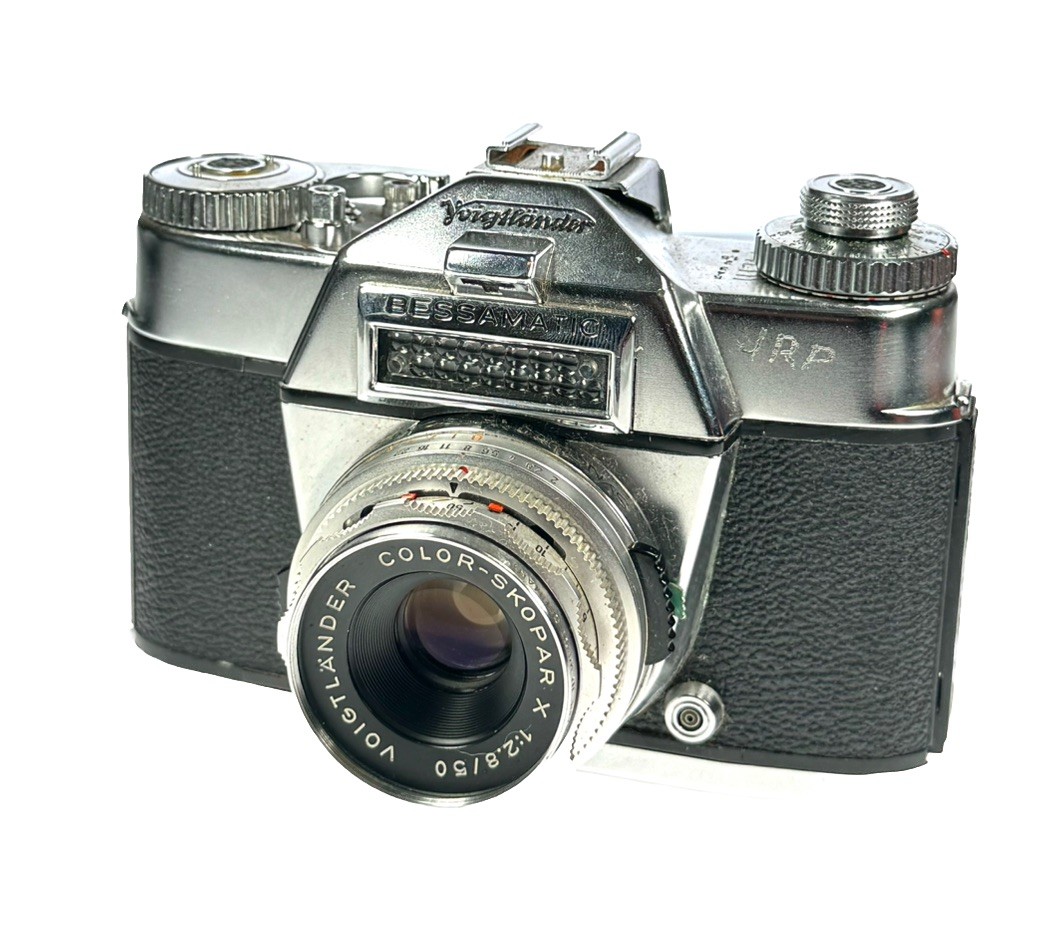
The Voigtlander Bessamatic is a 35mm single-lens reflex (SLR) camera introduced in 1958. It had a through-the-lens (TTL) exposure metering system and an unusual leaf shutter design. Most SLRs of the era used a focal-plane shutter. The Bessamatic put a behind-the-lens leaf shutter inside the interchangeable lenses, which gave flash synchronization at all shutter speeds.
Overview
The Bessamatic launched while manufacturers were moving from rangefinders to SLRs, because buyers wanted more precise composition and through-the-lens viewing. It was a high-end amateur and semi-professional SLR, aimed at photographers who wanted SLR versatility and good optics in a compact 35mm body. It was among the early SLRs with through-the-lens exposure metering, though not fully coupled in the modern sense. The meter read through the actual taking lens, so it accounted for filters and lens extensions.
The camera was part of Voigtlander's strategy to compete with established names like Zeiss Ikon and newcomer Asahi Pentax in the growing SLR market. It was succeeded by the Super Bessamatic (1960), then the Ultramatic (1965), which introduced open-aperture metering and other refinements.
The Bessamatic line was modular. Each lens carried both the optical elements and the leaf shutter mechanism, which synchronized with the camera body's exposure meter and aperture control. That allowed flash sync at all speeds, a major advantage over focal-plane shutter SLRs limited to 1/30s or 1/60s sync. The cost was a maximum shutter speed of 1/500s, and a need for precise mechanical coupling between lens and body, which added complexity and cost.
Specifications
| Specification | Value |
| Type | Single-Lens Reflex (SLR) |
| Film Format | 35mm (135 cartridge) |
| Years Produced | 1958–1969 |
| Lens Mount | Voigtlander Deckel (Bessamatic bayonet) |
| Shutter | Leaf shutter (in lens), speeds 1s – 1/500s, B, X-sync |
| Metering | Through-the-lens (TTL) cadmium sulfide (CdS) meter, center-weighted |
| Exposure Modes | Manual exposure with stop-down metering |
| Viewfinder | Fixed pentaprism, eye-level, with central split-image focus aid and microprism collar |
| Dimensions | Approx. 140 × 90 × 95 mm; weight ~650 g (body only) |
Key Features
- Leaf shutter in interchangeable lenses: Enabled flash synchronization at all shutter speeds (X-sync at 1/500s), a rare capability in SLRs of the period.
- Through-the-lens (TTL) exposure metering: One of the first production SLRs with a coupled TTL CdS meter, improving exposure accuracy.
- Modular lens system: Each lens contained its own shutter and aperture mechanism, allowing independent operation but requiring precise mechanical alignment.
- Integrated hot shoe and sync terminal: Provided flexible flash connectivity with full sync compatibility across all speeds.
- Interchangeable focusing screens: Available in limited variants, though most models shipped with a standard split-image/microprism screen.
Historical Context
The Bessamatic came out in 1958, when SLR technology was changing fast. The Asahi Pentax (1957) had already shown that a pentaprism SLR with a focal-plane shutter worked, while Zeiss Ikon's Contaflex line offered leaf shutter SLRs in 35mm. Voigtlander went with a hybrid: the compactness and flash-sync advantages of a leaf shutter, with the compositional accuracy of an SLR. That put it in direct competition with the Contaflex Super series and the Kodak Retina Reflex.
The Bessamatic had problems. The leaf shutter limited maximum speed and made for more complex, expensive lenses than focal-plane shutter systems. The CdS meter needed a 1.35V mercury battery, now obsolete, which complicates modern use. The camera was well-received for build quality and optical performance, especially with lenses like the Color-Skopar and Apo-Lanthar. It still struggled to dominate the market because of its higher price and mechanical complexity.
By the mid-1960s the industry had moved decisively to focal-plane shutters and open-aperture metering, and the Bessamatic's design was increasingly niche. Voigtlander introduced the Super Bessamatic in 1960, which improved viewfinder brightness and metering, then the Ultramatic in 1965, which added open-aperture metering. Production ceased in 1969 as Japanese manufacturers like Nikon and Canon solidified their dominance in the SLR market.
Collectibility & Value
The Voigtlander Bessamatic is a sought-after collectible among vintage camera enthusiasts, particularly those interested in the evolution of SLR technology and German engineering. In good working condition, prices typically range from $200 to $500. Rarer variants, such as the Bessamatic Super with the f/2 Ultron lens, command higher values. Fully functional metering and smooth shutter operation are the key factors in valuation. Many units suffer from degraded CdS cells or sticky shutters from dried lubricants.
Check the lens shutter blades for oil or corrosion, test all speeds (especially 1/500s), and verify that the meter responds under varying light. The original battery compartment was designed for PX625 1.35V mercury cells. It often needs modification to accept modern substitutes like WeinCells or zinc-air batteries, which can affect meter accuracy. Lenses should be free of haze, fungus, and separation, with smooth aperture and focusing rings. Original boxes, manuals, and accessories add desirability, particularly for complete sets.
Similar Cameras
- Zeiss Ikon Contaflex Super B (1959–1965): German SLR with leaf shutter, TTL metering, and interchangeable lenses.
- Kodak Retina Reflex IV (1960–1963): High-quality leaf shutter SLR with Schneider and Rodenstock lenses.
- Rolleiflex SL35 (later models): Though focal-plane, shared Voigtlander’s reputation for precision.
- Praktica FX3 (1966): East German SLR with more conventional focal-plane shutter and M42 mount.
- Asahi Pentax Spotmatic (1964): Pioneered TTL metering with open-aperture design, becoming the benchmark for future SLRs.
Repair & Maintenance
The Bessamatic requires a 1.35V mercury battery (PX625) for its CdS meter, now obsolete. Modern replacements include WeinCell 1.35V or adapters for 1.5V alkaline with voltage regulation. Shutter maintenance is critical. Lubricants in the leaf shutters often degrade, causing slow speeds or misfires. A professional CLA (clean, lubricate, adjust) is recommended every 10-15 years. The Deckel mount's mechanical linkage for aperture and shutter cocking is precise but prone to misalignment if lenses are swapped roughly. Viewfinder seals may degrade, causing internal fogging, and focusing screens can yellow over time. Because the shutter, lens and body are so tightly integrated, repairs should be handled by technicians experienced with vintage German SLRs.
eBay Listings


As an eBay Partner, we earn from qualifying purchases. This helps support our independent vintage technology research.
Related Models
- Voigtlander Bessa
- Voigtlander Ultramatic (1962-1968)
- Voigtlander Vitessa (1950-1960)
- Voigtlander Vito B (1954-1960)
- Voigtlander Vito II (1949-1954)
- Alpa Alnea 7 (1952)
- Alpa Prisma Reflex
- Agfa 254
- Agfa ActionCam (1995)
- Agfa Agfaflex