ROLLEIFLEX T
The Rolleiflex T is a twin-lens reflex from Franke & Heidecke, built from 1958 to 1976. It shoots 6x6cm on medium format film. It dropped the frills of the high-end models but kept the all-metal construction and precise mechanics. It had no meter. Students, hobbyists and purists who wanted reliability over automation bought it.
Overview
Rolleiflex launched the T in 1958. Professionals still bought the flagship 2.8F and 3.5F, with their f/2.8 lenses. Amateurs and learners wanted something simpler, sturdier and cheaper. The T gave them a downgrade in optics and features, but not in build. It used the same mechanical backbone as its siblings and delivered the classic TLR experience: waist-level framing, smooth film advance and sharp 6x6 negatives, without the premium price.
The T skipped the Xenotar and Planar glass and wore Carl Zeiss Tessar 75mm f/3.5 lenses on both top and bottom. They are slower, but still optically superb for a budget model. The layout is the usual TLR one: fixed lens pair, mechanical shutter, and rack-and-pinion focusing through the right-side knob. No electronics, no batteries. Production ran for nearly two decades, even as 35mm SLRs began to dominate.
Specifications
| Specification | Value |
| Type | Twin-Lens Reflex (TLR) |
| Film Format | 6x6cm (120 roll film) |
| Years Produced | 1958–1976 |
| Lens Mount | Fixed Carl Zeiss Tessar 75mm f/3.5 (both taking and viewing lenses) |
| Shutter | Compur-Rapid shutter, speeds 1 – 1/500 sec, B |
| Aperture Range | f/3.5 to f/22 |
| Metering | None (uncoupled meter required) |
| Exposure Modes | Manual only (shutter speed and aperture set manually) |
| Viewfinder | Waist-level finder with pop-up hood, ground glass screen |
| Focusing | Manual rack-and-pinion, via knob on right side |
| Film Advance | Manual knob wind with automatic frame counter indexing |
| Flash Sync | PC terminal with X-sync only, up to 1/30 sec |
| Dimensions | Approx. 105 x 105 x 215 mm (w/ hood down) |
| Weight | Approx. 950 g (body only) |
Key Features
- Carl Zeiss Tessar 75mm f/3.5 lenses (both taking and viewing): A masterpiece of optical efficiency—compact, sharp, and contrast-rich, even if not as fast as the Planar or Xenotar.
- Compur-Rapid shutter with speeds from 1 to 1/500 sec and B: Fully mechanical, buttery-smooth, and built to last decades with proper care.
- Fully manual operation with no built-in meter: Forces you to master exposure, making it a favorite among zone system practitioners and film purists.
- Durable all-metal construction with classic Rolleiflex build quality: Feels substantial in the hands, ages gracefully, and shrugs off daily wear.
- Simple, intuitive controls and film handling: Load, wind, focus, shoot—no menus, no modes, no distractions. Perfect for learning medium format.
Historical Context
By the late 1950s, medium format TLRs were still the go-to for portrait studios and street photographers, but 35mm rangefinders and early SLRs were gaining ground. Rollei's answer was to keep the build and simplify the optics. The T wasn't meant to compete with the 2.8F. It was meant to open the door. The Tessar design was proven, celebrated for its clarity and low cost, and it let Rollei offer a real Rolleiflex without the premium tooling or assembly time.
Competitors like the Yashica-Mat 124 G and Minolta Autocord packed in more features, and some even had built-in meters. The Rolleiflex T didn't play that game. It sold on reputation, build and German engineering. Photographers who valued repairability, simplicity and mechanical precision found that enough.
Collectibility & Value
Today the Rolleiflex T is a common way into medium format. It lacks the cult status of the 2.8F, but it isn't forgotten. It is a genuine Rolleiflex without the fragility or fuss. As of 2024, working examples trade between $300 and $500, and mint units, especially those with clean lenses and crisp shutters, climb toward $800. Cameras with haze, fungus or sticky mechanisms often go for parts or restoration.
If you're buying one, test every shutter speed, especially 1/500 and 1 second, for consistency. Check the bellows for pinholes or light leaks, and inspect both lenses for separation or internal haze. The focusing knob should turn smoothly, without slop or resistance. The T is entirely mechanical, so it is easy to service: no batteries, no circuits. Original parts can be scarce, but a skilled TLR technician can bring most units back to life. For anyone starting out in 6x6cm film, it is a low-risk choice.
Similar Cameras
- Yashica-Mat 124 G – Features a faster f/3.5 lens, built-in CdS meter, and similar 6x6cm format; produced 1970–1986.
- Minolta Autocord III – Twin-lens reflex with f/3.5 lenses, known for compact size and reliable Copal shutter; produced 1961–1966.
- Rolleicord Vb – A contemporary budget TLR from Rollei itself, using a Zeiss Triotar f/3.5 lens and simpler construction.
- Kowa Teen 8mm f/3.5 – A lesser-known Japanese TLR with excellent optics and solid build, produced 1960s–70s.
- Mamiya C220 – Interchangeable lens TLR system offering greater flexibility, though larger and heavier than the Rolleiflex T.
Repair & Maintenance
With no electronics and no battery, the Rolleiflex T is all mechanical. Shutter, film advance and focus are driven by gears and springs. That means longevity, but not immortality. Shutter lubricants dry out over time, especially in the high-speed range, and the Compur-Rapid mechanism can develop inconsistencies. The film advance is sturdy, but misalignment in the indexing gears can cause frame spacing problems. Bellows may crack or develop pinholes after decades of use.
A CLA (Clean, Lubricate, Adjust) every 5 to 10 years keeps it running well. The Compur-Rapid shutter is fully serviceable, though it demands precision work. Lens issues like haze, separation and fungus are the real dealbreakers, and since the lenses are fixed, they need professional disassembly. The TLR community is strong, and parts, while not abundant, are findable.
eBay Listings

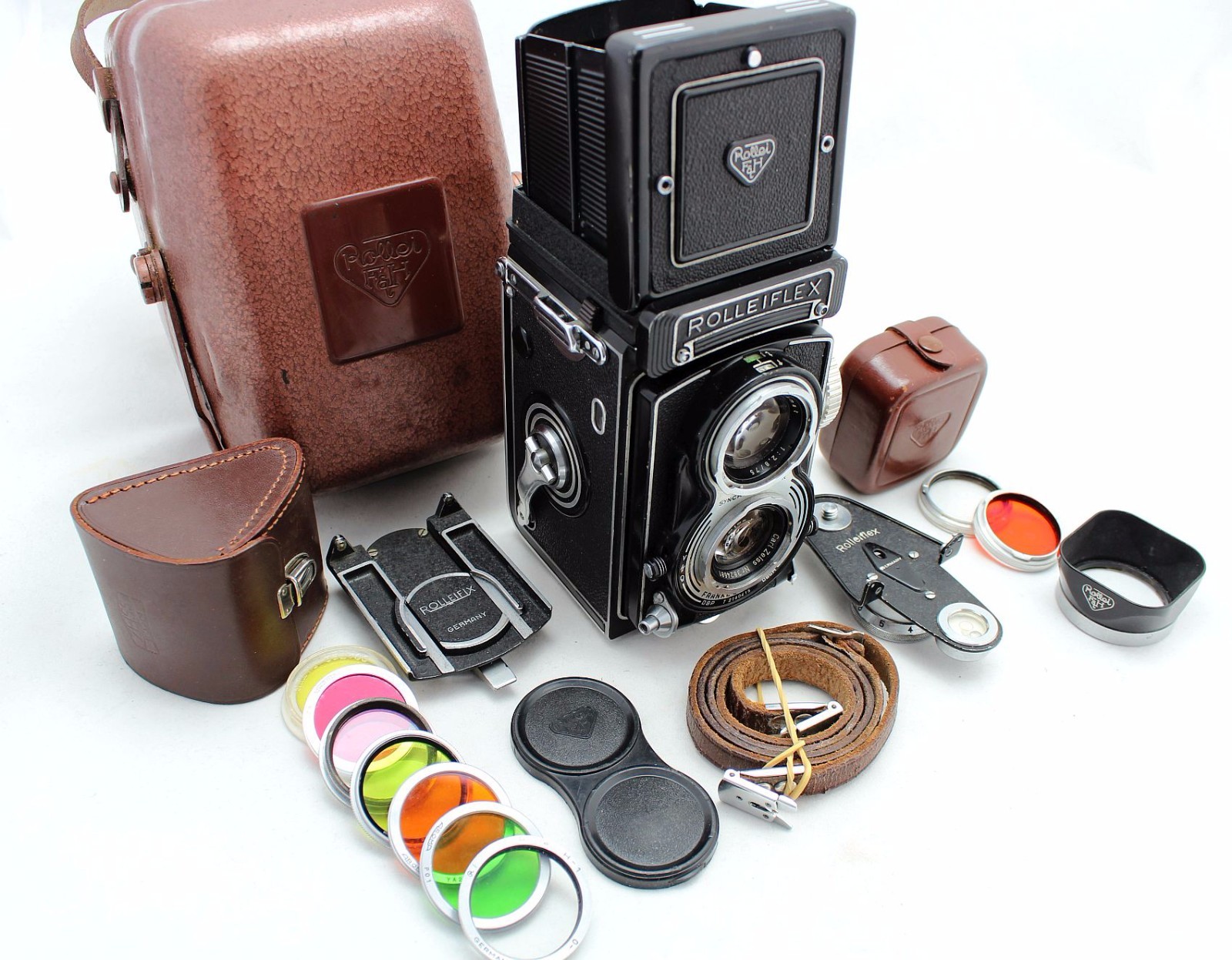


As an eBay Partner, we earn from qualifying purchases. This helps support our independent vintage technology research.
Related Models
- Rollei 2.8F (1960-1981)
- Rollei 35 (1966-1981)
- Rollei Rolleicord V (1954–1957)
- Rollei Rolleicord Va (1957–1962)
- Rollei Rolleicord Vb (1962-1976)
- Alpa Alnea 7 (1952)
- Alpa Prisma Reflex
- Agfa 254
- Agfa ActionCam (1995)
- Agfa Agfaflex