Nikon D80 (2006)
At 20 oz., it balances in the hand like a well-worn tool—light enough to forget, solid enough to trust.
Overview
The Nikon D80 isn't a revolution. It’s a refinement, a distillation. Announced on August 9, 2006, it arrived not with fanfare but with quiet confidence, slipping into Nikon’s DSLR lineup as the spiritual successor to the beloved D70 series. Built around the same 10.2MP Sony ICX493AQA sensor found in the pro-grade D200, the D80 offered a rare trick: professional image quality wrapped in a consumer-friendly body. It wasn’t just borrowing parts—it inherited the D200’s color science, its tonal depth, its ability to render a scene with a richness that belied its price point. The result? A camera that, at launch, delivered flagship-like image quality at a fraction of the cost.
Owners report it felt like stepping into a familiar coat—one cut from lighter fabric. The construction is entirely plastic, and not the grippy kind. Reviewers at the time noted the "hard, slippery plastic" of the body and control dials, a trade-off for keeping weight down to 575 grams. It lacks the heft of magnesium alloy, but that also means it won’t drag you down on long walks. The rear layout follows Nikon’s familiar DSLR logic: a 4-position navigation button, a multi-selector that moves only in the four cardinal directions (no diagonal nudging), and a customizable FUNC button that lets shooters tweak settings without diving into menus. The 2.5-inch LCD, while modest by today’s standards, was praised for its clarity and depth—described as "almost three-dimensional" in early reviews, offering a sharp preview of the D200’s larger screen.
Despite its plastic bones, the D80 shares more with the D200 than just a sensor. It carries over the same shutter mechanism, rated for speeds from 30 seconds to 1/4000 second in 1/3 or 1/2 EV steps, plus Bulb mode for long exposures. The X-sync speed sits at 1/200 second, making it viable for studio flash work with standard strobes. A pop-up flash is built in—handy for fill or emergencies, though serious shooters would pair it with a Speedlight. The camera speaks USB 2.0 Hi-Speed, which was standard for the era, and ships with Nikon’s now-archaic PictureProject software for basic image management. It’s a complete package, one designed to get users shooting quickly, not wrestling with compatibility.
Specifications
| Manufacturer | Nikon |
| Image sensor | 10.2MP |
| Continuous shooting speed | 3 FPS |
| Weight | 20 oz. (575g) |
| LCD screen size | 2.5" |
| USB interface | USB 2.0 Hi-Speed |
| Included software | PictureProject |
| Shutter speed range | 30 s to 1/4000 s and Bulb |
| X-sync speed | 1/200 s |
| Built-in flash | Yes (pop-up) |
Key Features
10.2MP Sensor from the D200
The heart of the D80’s appeal lies in its sensor—the Sony ICX493AQA, the same 10.2MP chip used in the Nikon D200. This wasn’t just a spec sheet win; it meant identical color rendition, dynamic range, and noise performance. For photographers stepping up from entry-level DSLRs, the jump in image quality was immediately apparent. Skin tones stayed natural, shadows held detail, and high-ISO performance (though not documented in the fact sheet) was considered solid for its time. The sensor gave the D80 a credibility that outpaced its price, making it a favorite among enthusiasts who wanted pro-level output without the pro-level cost.
Plastic Body with D200 Ergonomics
The D80 borrows the D200’s control layout and viewfinder size, but wraps them in the lighter, plastic chassis of the D70 series. This makes it significantly more portable, but also more prone to wear. The "hard, slippery plastic" exterior offers little grip, especially in cold or wet conditions. While it lacks weather sealing and the tactile feedback of metal dials, the placement of the FUNC button and the four-way multi-selector keeps core functions within easy reach. It’s a design that prioritizes accessibility over durability, a trade-off that made sense for its target audience: hobbyists and semi-pros who wanted power without bulk.
3 FPS Continuous Shooting with Reliable Buffer
Capable of 3 frames per second, the D80 isn’t built for sports or wildlife, but it handles casual action with ease. Whether capturing kids at play or a dog mid-leap, the 3 FPS rate is sufficient for most non-professional scenarios. The buffer depth—though not specified—was reportedly robust enough for bursts of JPEGs without significant lag, a nod to its D200 lineage. Paired with responsive autofocus (details not in the fact sheet), it made the D80 a competent all-rounder, especially when matched with fast primes or the popular 18-200mm zoom.
Historical Context
The D80 emerged in a pivotal year for digital photography—2006, when DSLRs were transitioning from luxury items to mainstream tools. Positioned between the consumer D70/D70s and the prosumer D200, it filled a critical gap. It wasn’t just a successor to the D70s; it was a reimagining, packing higher-end internals into a familiar form. The D200 had already proven that Nikon could deliver professional features to advanced amateurs, and the D80 extended that philosophy downward. At a launch price of $999 for the body only, it offered exceptional value, effectively giving buyers 90% of the D200’s image quality at less than half the cost. It was, as one reviewer put it, "a decent middle of the road camera"—but one that punched far above its weight.
Collectibility & Value
Originally priced at $999 for the body only in November 2006, the D80 was a premium offering in the consumer DSLR space. Today, its value has predictably plummeted. Listings show body-only units selling for as little as $63.99, with well-maintained examples fetching up to $200. While not a collector’s item in the traditional sense, it remains a functional and affordable entry point into Nikon’s F-mount ecosystem. However, age has introduced reliability concerns. Common issues include the dreaded "Err" message—often tied to shutter mechanism failure or lens communication problems—and a tendency for the mirror to stick. The "R09" error and failure of the shutter to cycle are frequently cited in repair forums. As a first troubleshooting step, owners are advised to remove and reattach the lens to ensure a clean connection, though deeper issues typically require professional servicing.
eBay Listings


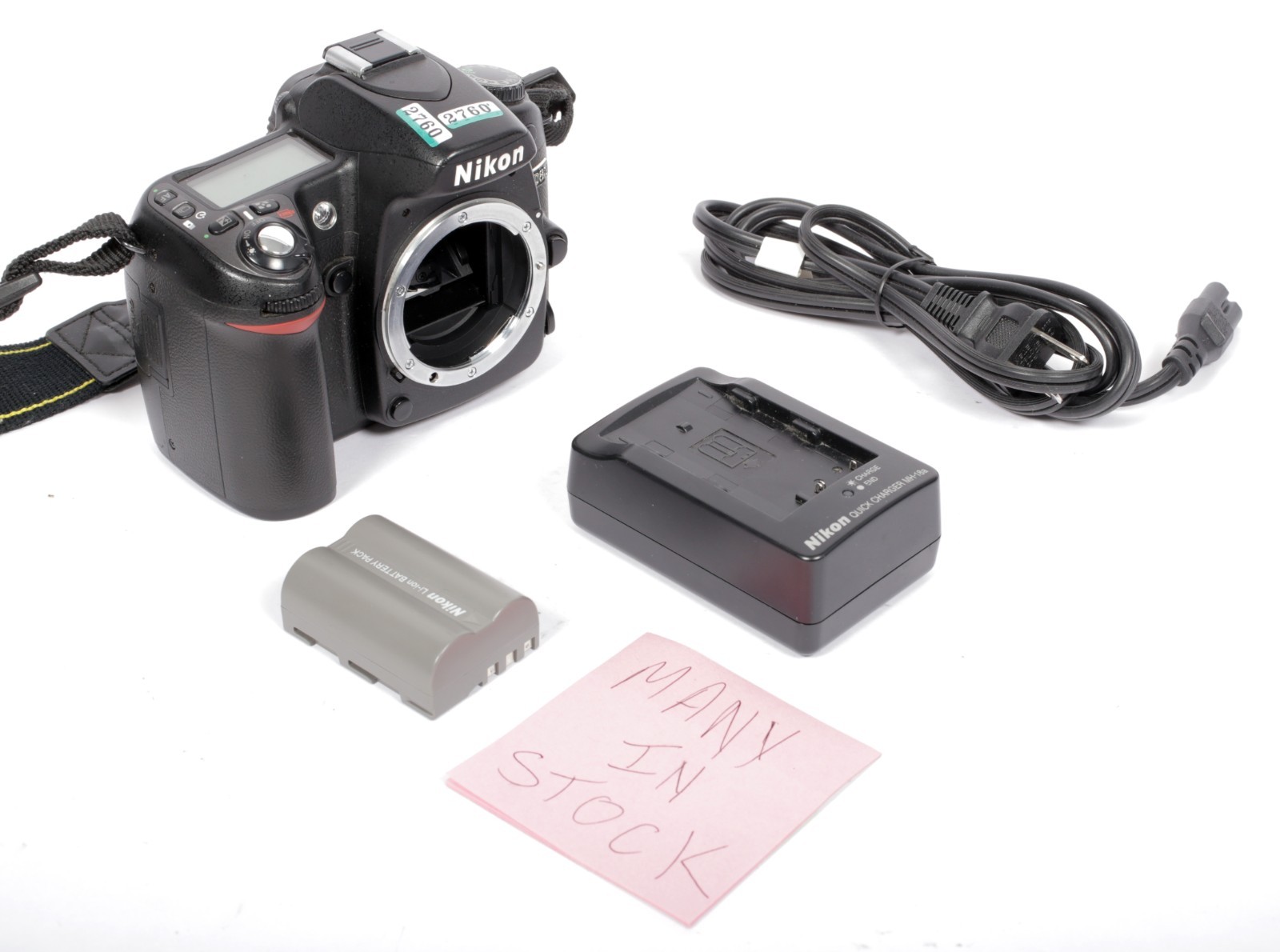

As an eBay Partner, we earn from qualifying purchases. This helps support our independent vintage technology research.