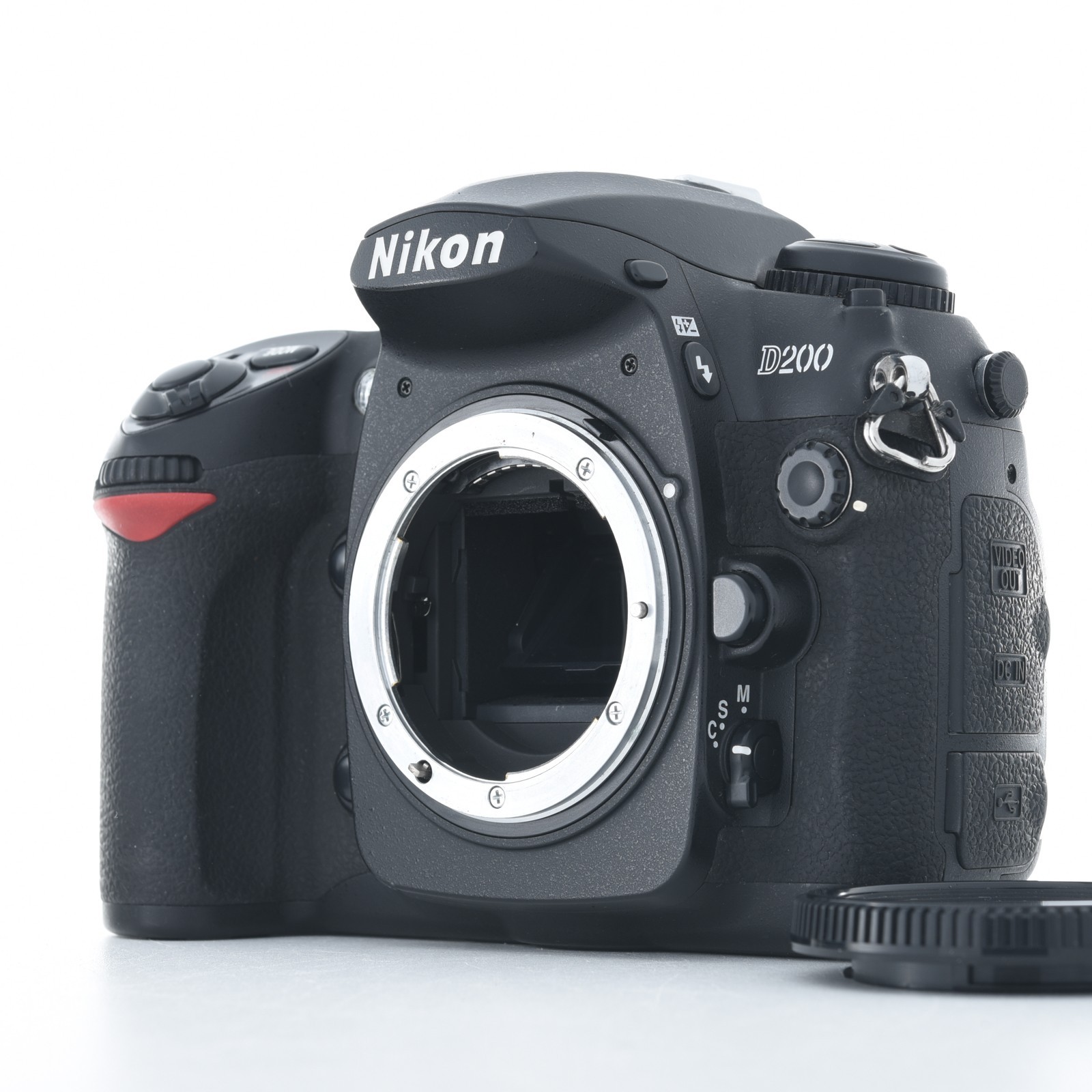
Nikon D200 (2005)
A weather-sealed magnesium body with a CCD sensor. The prosumer DSLR that made semi-pro affordable.
Overview
Nikon announced the D200 on November 1, 2005. It sat between the consumer D70/D80 series and the flagship D2 series. It succeeded the D100, and the D300 eventually succeeded it. Nikon's own literature calls it a 10.2 effective megapixel digital single-lens reflex camera. The number is repeated across most documentation, but at least one review source pegs the sensor at 10.0 megapixels, so treat 10.2 as the working figure.
Collectors want the D200 for the combination of a CCD sensor and a professional-grade chassis. Sources describe it as a unique mix of a CCD sensor with a strict colour filter array. People are digging these cameras out of drawers for that in 2026. The rendering is different from what a modern CMOS body gives you, and plenty of shooters still use one regularly despite owning far newer gear. It's regarded as a classic digital SLR that brought semi-professional features to an accessible price point.
The headline numbers are honest ones. The body is magnesium alloy and weather-sealed, with additional dust and moisture sealing adding to its strength. It shoots at 5 FPS, and in burst mode it can capture up to 37 high-quality JPEGs or 22 RAW-NEF images at that rate. Startup is a claimed 15 milliseconds. DXOMARK gives the sensor an overall score of 64. That won't impress anyone in 2026, but it's a fair reflection of what a 2005 APS-C CCD could do.
Key Features
10.2 MP CCD Sensor with Strict Colour Filter Array
The sensor is the reason people still seek these bodies out. It's a 10.2 megapixel CCD on an APS-C (1.5x) sensor, and the CCD-plus-strict-CFA combination produces a look that CMOS shooters have spent two decades trying to emulate in software. The documentation disagrees slightly on resolution - 10.2 MP in most sources, 10.0 megapixels in at least one - but either way, horizontal image size runs 3,872 pixels, a step up from the 3,008 pixels of the D50/D70/D70s generation. ISO runs 100-1600, expandable to a Hi-1 setting equivalent to ISO 3,200.
Multi-CAM 1000 11-Point Autofocus
The autofocus module is the Multi-CAM 1000, an 11-point system with one cross-type sensor. Focus modes cover single-servo AF, continuous-servo, and manual with electronic rangefinder. It's a step above what Nikon's entry-level bodies offered at the time, though independent comparisons note that both the D200 and its contemporaries improved on entry-level AF while falling well short of the top of the line. Owners report slow autofocus specifically with telephoto lenses, so keep that in mind if you plan to shoot long.
Weather-Sealed Magnesium Alloy Body
Nikon's own description is blunt about the construction: advanced technologies and mechanisms housed within a rugged, lightweight magnesium alloy chassis, with dust and moisture sealing on top. At 920 g (2.02 lbs) it is not a light camera, and it doesn't pretend to be. People called it a proper professional-grade body, and one comparison goes so far as to say it surpassed the F100 in several respects.
Nikon F Mount with Aperture Indexing Ring
The mount is Nikon F, described in some documentation as an F DX mount. It's compatible with AF Nikkor lenses including G- and D-type. There's a focus motor in the lens mount, so it will focus older AF Nikkor lenses, and an aperture indexing ring around the mount allows automatic exposure with non-autofocus lenses. That makes the D200 a useful platform for shooting pre-AF glass, which not every DSLR of the era could claim.
3D Color Matrix Metering II and Four-Channel Histogram
Metering is handled by Nikon's 3D Color Matrix Metering II. The camera displays a four-channel YRGB histogram - one channel each for luminance, red, green, and blue, rather than a single combined graph.
2.5-Inch LCD and 0.94x Pentaprism Viewfinder
The rear screen is a 2.5-inch, 230,000-dot unit. By 2026 standards it's basic. The viewfinder is an optical pentaprism with 0.94x magnification and 95% coverage, and that part still holds up. A 95% finder is not a 100% pro finder, but it's close enough that framing is predictable.
EN-EL3e Battery and Real-World Endurance
The camera runs on the Nikon EN-EL3e lithium-ion battery. Battery life was a point of discussion at the time, with real-world usage reported as less than the manufacturer's claim. Anyone buying a used body in 2026 should know the cells in these packs are now two decades old, and even a healthy camera will need fresh batteries.
Historical Context
The D200 followed three and a half years after Nikon's first prosumer digital SLR, the D100. The market had changed substantially in between. Nikon's second attempt at a small semi-pro DSLR was, by most accounts, a massive success. Initial demand was high, continuing a pattern of limited availability seen with its predecessor. It was manufactured from 2005 to 2007 before being discontinued, and the D300 replaced it.
The D200 is probably more closely related to Nikon's pro line of cameras like the D2X than to their consumer cameras like the D100, D70s, and D50. It incorporates much of the image processing and feature set of the higher-end D2X into a more compact body, and it carries improved image-processing circuits over what came before.
Collectibility & Value
Original pricing was $1,699.95 USD, 1,299 GBP (1,106 GBP ex VAT), or 1,610 EUR. That was real money in 2005. Today the market has collapsed, as it does for two-decade-old digital cameras. Used prices run roughly €129 to £250 for body-only or kit configurations, and eBay completed sales over the past twelve months range from $108 to $262 with a median of $172 across 178 sales. The October 2026 market snapshot shows a high of $313, a low of $70, a latest sale of $212, and volume around 22 units a month. Recent listings have sat at $139, $250, $79.99, and $140.
Know the failure modes before you buy. Owners and market reports list power switch malfunctions, mode dial lock-ups, a "fEE error," "Corduroy Banding" in images, aperture issues, shutter speed display errors, slow autofocus with telephoto lenses, and cloudy or speckled viewfinders potentially linked to the focusing screen. None of these are universal. Many units are still functioning flawlessly, and owners describe it as a reliable old favorite workhorse. The banding and the fEE error are the ones to test for before money changes hands.
People are still digging these up to play with their CCD sensors, and it makes a great budget platform to learn photography on today. Shooters who own the latest and greatest cameras still reach for the D200 regularly because the output straight out of the box is satisfying. It was praised for its durability, image quality, and color rendition when new.
Market Value
┌──────────────────────────────────────────────────────────────────────────┐
│ NIKON D200                                                      Nov 2026 │
├──────────────────────────────────────────────────────────────────────────┤
│ High      $313                                    Latest            $212 │
│ Median    $172                                    Trend                — │
│ Low       $70                                     Volume          ~22/mo │
├──────────────────────────────────────────────────────────────────────────┤
│   $400 ┤                                                                 │
│        │                                                                 │
│        │                                                 .           . . │
│   $250 ┤.                             .             ... .....  .      .. │
│        │                      .                       ... ......   .  ...│
│        │.        .                           .      .. .... ....      .. │
│        │                                   .      .  ...........      ...│
│    $50 ┤ .         .                                    ....   .      .  │
│        ├─────────────────────────────────────────────────────────────────│
│    vol │▁▁       ▁ ▁          ▁       ▁    ▁ ▁    ▁ ▁▃▄▄█▇▅▄▅▂▃▄   ▁ ▁▄▃▁│
│        └─────────────────────────────────────────────────────────────────│
│         2025-12                      2026-04                      2026-08│
└──────────────────────────────────────────────────────────────────────────┘
eBay completed sales. Excludes accessories, parts, and non-working units. Hover points for details.
eBay Listings
Recently sold on eBay: $108–$262 (median $172, based on 178 completed sales, past 12 months)



As an eBay Partner, we earn from qualifying purchases. This helps support our independent vintage technology research.
Related Models
- Nikon D100 (2002)
- Nikon D2X
- Nikon D300
- Nikon D3000
- Nikon D300s
- Alpa Alnea 7 (1952)
- Alpa Prisma Reflex
- Agfa 254
- Agfa ActionCam (1995)
- Agfa Agfaflex