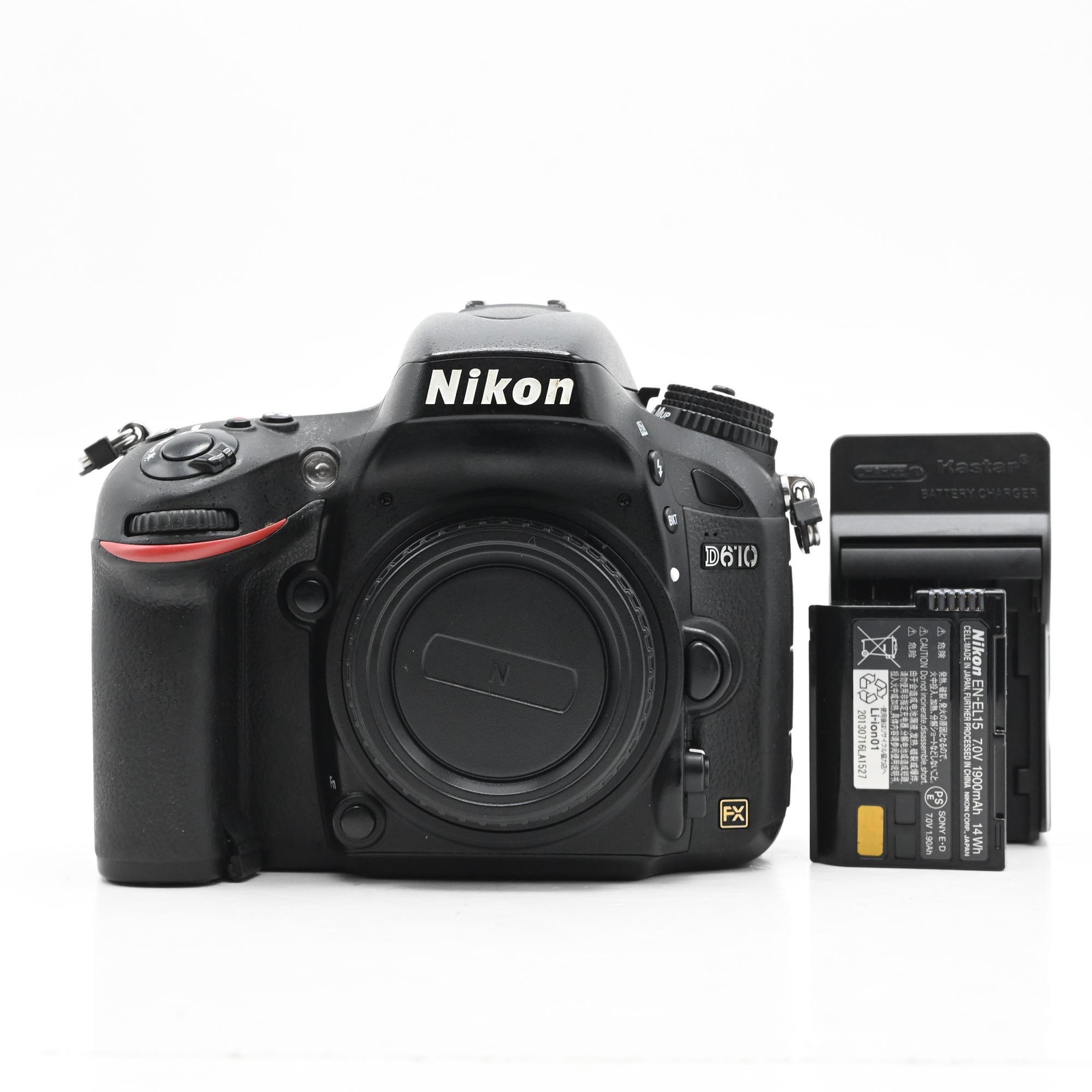
Nikon D610 (2013)
At 851 grams, it sits in the hand like a full-frame promise—solid, serious, and surprisingly affordable.
Overview
The Nikon D610 isn’t flashy, but it doesn’t need to be. Introduced in October 2013, this full-frame DSLR was Nikon’s least expensive entry into the professional-grade sensor market, built to bring high-resolution imaging within reach of advanced amateurs and working photographers on a budget. It slots in as a minor but meaningful update to the troubled D600, addressing one of its predecessor’s most criticized limitations: continuous shooting speed. Where the D600 managed 5.5 frames per second, the D610 pushes to a cleaner 6 FPS—just enough to matter when chasing action. It also adds a Quiet Continuous (Qc) mode, allowing 3 FPS with reduced mirror slap, a subtle but appreciated refinement for event or theater shooters who need discretion.
Video shooters get 1080p HD recording, though frame rates aren’t documented in available specs. The dual SD card slots offer flexibility for overflow or backup, a rarity at its price point. But the real story is the sensor’s low-light capability—ISO stretches from 100 to 6,400 as standard, expandable down to ISO 50 and up to 25,600 (Hi-2), giving shooters serious latitude in dim environments.
Yet it’s not without compromise. The autofocus system, while competent in good light, stumbles in very dim conditions—so dim that reading printed text becomes difficult. According to Ken Rockwell, that’s the primary reason one might consider stepping up to the D750. Otherwise, the D610 holds its ground, even outpacing the higher-resolution D800 in burst speed. It works with every Nikon auto- or manual-focus lens since 1977, and with a built-in AF motor and aperture feeler, it handles AI and AI-S manual-focus lenses with ease—just not in all exposure modes. In Aperture-priority (A) and Manual (M), it’s fully functional, making it a favorite among film-era lens collectors.
Specifications
| Manufacturer | Nikon |
| Model | D610 |
| Type | Full-frame DSLR |
| Resolution | 24.3 MP |
| Sensor Size | Full-Frame |
| ISO Sensitivity (Standard) | ISO 100 ~ 6,400 |
| ISO Sensitivity (Expanded) | ISO 50 ~ 25,600 |
| Continuous Shooting Speed | 6 FPS |
| Quiet Continuous (Qc) Shutter Mode | 3 FPS |
| Shutter Speed Range | 30 - 1/4000 sec |
| Flash Sync Speed | 1/200 |
| Video | 1080p HD video |
| LCD Screen | 3.2 inches with 921,000 dots |
| Dimensions | 141 x 113 x 82 mm (5.55 x 4.45 x 3.23″) |
| Weight | 851 g (30.0 oz) with battery and card |
| Storage | 2-SD cards |
| Autofocus System | CAM4800 AF |
| Features | Built-in HDR, electronic horizon |
Key Features
24.3 MP Full-Frame Sensor with Expanded ISO
The D610’s 24.3 MP full-frame sensor is its centerpiece, delivering detail and tonal gradation that rival more expensive models. Standard ISO ranges from 100 to 6,400, with expansion to ISO 50 (L-1) and up to 25,600 (Hi-2), making it surprisingly capable in low light—though noise becomes evident at the upper extremes. The sensor also enables automatic correction for lateral color fringing, lens distortion, and corner light falloff, particularly with AF-D, AF-I, AF-S, and G lenses, reducing post-processing needs.
6 FPS Continuous Shooting and Quiet Continuous Mode
Boosted from the D600’s 5.5 FPS, the D610’s 6 FPS burst rate gives it an edge in action photography. The addition of a 3 FPS Quiet Continuous (Qc) mode dampens mirror noise, ideal for situations where silence matters—weddings, performances, or candid street work. This mode doesn’t match the speed of pro bodies like the D4 or D5, but it’s sufficient for most non-sports applications.
Compatibility with Nikon Lenses Since 1977
Thanks to its built-in AF motor and aperture feeler, the D610 works with every Nikon auto- or manual-focus lens made since 1977. It supports full functionality with AF, AF-I, AF-D, and AF-S lenses. With AI and AI-S manual-focus lenses, it operates in Aperture-priority (A) and Manual (M) modes, appealing to photographers who own vintage glass and want seamless integration.
Electronic Horizon and Built-in HDR
The electronic horizon, displayed in the viewfinder and on the LCD, helps maintain level compositions—especially useful in architectural or landscape work. The built-in HDR mode captures two exposures and blends them in-camera, offering a quick way to extend dynamic range without post-processing, though results can be hit-or-miss depending on subject motion.
Historical Context
The Nikon D610 was released in October 2013 as a refined successor to the D600, which had faced criticism for dust and oil issues on the sensor. Marketed as Nikon’s least expensive full-frame DSLR, it carried an original price of $2,000. Its release marked a shift toward making full-frame technology more accessible, paving the way for later models like the D750.
Collectibility & Value
However, as of May 2016, the body only sold for $1,497 with free goodies. The camera remains functional for enthusiasts and budget full-frame shooters, but its value is primarily utilitarian rather than collectible. Common issues include dust and oil spots on the sensor—a legacy concern carried over from the D600—though sources like Roger Cicala found the D610 exhibited a more typical level of dust compared to its predecessor. Maintenance may require sensor cleaning or servicing, and spare parts availability is undocumented.
eBay Listings


As an eBay Partner, we earn from qualifying purchases. This helps support our independent vintage technology research.