Nikon D6
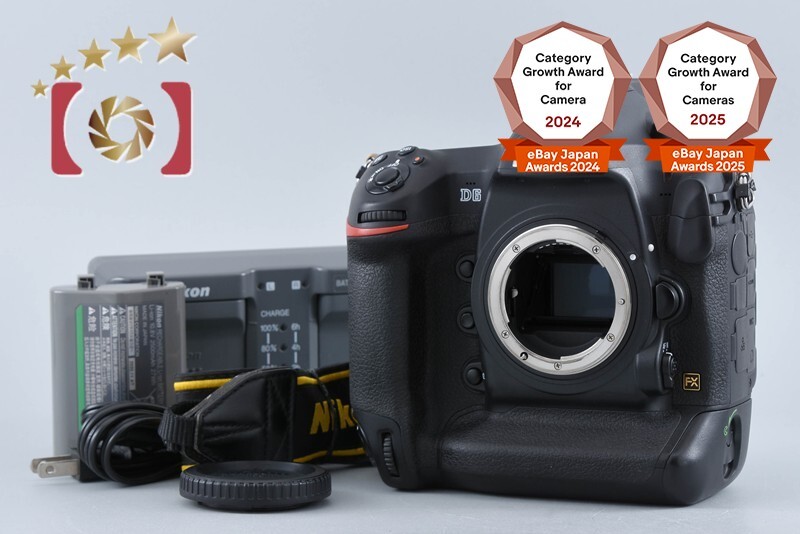
The Nikon D6 is the company's flagship professional DSLR. It succeeds the D5 and is aimed squarely at sports and newspaper photographers. List price was roughly $6,500 - Nikon's own page settled on $6,496.95 for the body, with a kit version including the 24-70mm f/2.8E ED VR lens at $7,896.95. Production years aren't documented in the sources gathered here.
The D6 is a refinement of the D5 formula, not a clean-sheet redesign. Thom Hogan put it bluntly, calling it "a D5++ rather than a real makeover for the digital age." The core specs bear that out: the same 20.8MP FX-format CMOS sensor resolution as its predecessor, paired with the newer EXPEED 6 processor. The big improvements are in autofocus and connectivity. The AF module has 105 cross-type points, all sensitive to f/8, with a dedicated AF processor and a new deep-learning algorithm. The center point is rated down to -4.5 EV for low-light work. Continuous shooting runs at 14 fps with full AF/AE tracking, and the buffer handles 200+ 14-bit RAW frames. The shutter unit is rated for 400,000 cycles.
Around the imaging core, the D6 is a modern pro body. It has dual CFexpress/XQD card slots, a 3.2-inch 2.36-million-dot touchscreen LCD, and a pentaprism viewfinder with 100% coverage and 0.72x magnification. The body weighs 1450g with battery and cards (dimensions 160 × 163 × 92mm). Native ISO runs 100-102400, expandable to 50-3,280,000. Video is 4K UHD at up to 30p with 4:2:2 10-bit HDMI output. The D6 builds in 802.11ac Wi-Fi and Bluetooth, so there's no need for the separate WT-6 transmitter, and it adds a gigabit Ethernet port. There's no built-in GPS. Battery life is rated at 3,580 shots per CIPA with the EN-EL18c pack.
Reception was generally positive but measured. Photography Life called it "the best sports camera for fast action," praising AF accuracy. It noted the lack of true USB-C and a stiff exposure compensation dial as minor gripes. DPReview found the autofocus "extremely capable and very accurate" but said the resolution is low by modern standards and video is "only adequate." Ken Rockwell's assessment was that performance is outstanding but the price is excessive for most shooters, and he flagged a fixed rear screen with noticeable touch lag. The consistent criticism across reviews was video autofocus. Several sources noted it hadn't been meaningfully updated and remained a weak point next to the stills performance.
The D6 is likely the last of Nikon's true flagship DSLRs. It came at the end of a line that ran through the D5, D4, and D3. Contemporary advertising in Audio (May 1983, p.91) shows the kind of mail-order retail environment in which high-end camera gear was sold during the era.
- 20.8MP FX-format CMOS sensor, EXPEED 6 processor
- 14 fps continuous shooting, 200+ frame RAW buffer
- 105-point all-cross-type AF, center point to -4.5 EV
- 4K UHD video to 30p, 4:2:2 10-bit HDMI out
- Dual CFexpress/XQD slots, built-in Wi-Fi/Bluetooth, gigabit Ethernet
- EN-EL18c battery, 3,580-shot CIPA rating
eBay Listings


As an eBay Partner, we earn from qualifying purchases. This helps support our independent vintage technology research.