Agfa PB 20 (c.1934–1939)
A 6x9 folding camera whose model name is really a film size, and whose variants tell three different stories.
Overview
The Agfa PB 20 is a camera where the paperwork is more confusing than the machine. The name "PB 20" doesn't describe the camera at all. It describes the film. PB20 was Agfa Ansco's designation for what the rest of the world called 620 roll film, and the "PB 20 designation for the film size is equivalent to 620 film," as Art Deco Cameras puts it. So when a listing says "Agfa PB 20," it gives the format first and the model second. That's why the same family of cameras shows up under a half-dozen names: Readyset, Plenax, Antar, Chief, Pioneer, and Viking, all built around the same 6x9 folding body and the same 620 spool.
It's a retractable bellows camera in the classic pre-war idiom: unfold it, pull the standard forward on its struts, frame through a small finder, and shoot. What makes the PB 20 interesting to collectors isn't any single specification — it's that the same body was sold at several different trim and feature levels, and the differences between them are more than cosmetic.
Key Features
6x9 on 620 Roll Film
The PB 20 shoots 6cm x 9cm negatives on 620 roll film. That's a big frame, the same nominal size as 120, just on a thinner spool with a smaller center core. The Plenax variant's manual spells out the yield: "takes 8 pictures 2 1/4 X 3 1/4 inches or 16 pictures 1 5/8 x 2 1/4 inches on PB20 roll film." That's eight exposures per roll full-frame, sixteen if you mask down. For a 1930s amateur camera, eight album-size negatives per roll was a reasonable trade. You gave up frame count and got contact prints you didn't have to enlarge. Manualzz describes the Plenax as "a 2 1/4 x 3 1/4 inch camera that takes 8 pictures on a roll of film," which is the same machine described from the print size outward.
The catch, and it's a real one in 2026, is the film itself. 620 is discontinued. Shooters respool 120 onto 620 spools or modify the camera's supply chamber, and neither is a job for someone who's never handled a folding camera before. The PB 20 is a camera to own and occasionally shoot, not a daily user.
Folding Bellows Body
The PB 20 is a retractable bellows camera, in Prezi's phrase. The lens and shutter ride on a folding standard that collapses into the body for transport. Camerapedia describes it as a "folding camera for type PB20 roll film (620)." Closed, it's a flat, pocketable slab. Open, it's a proper 6x9 camera with a bellows that needs to be light-tight after eighty-odd years. Every folding camera of this era lives or dies on the condition of its bellows, and the PB 20 is no exception. Pinholed corners and stiff, cracking pleats are the norm at this age.
Variant-Specific Lenses and Shutters
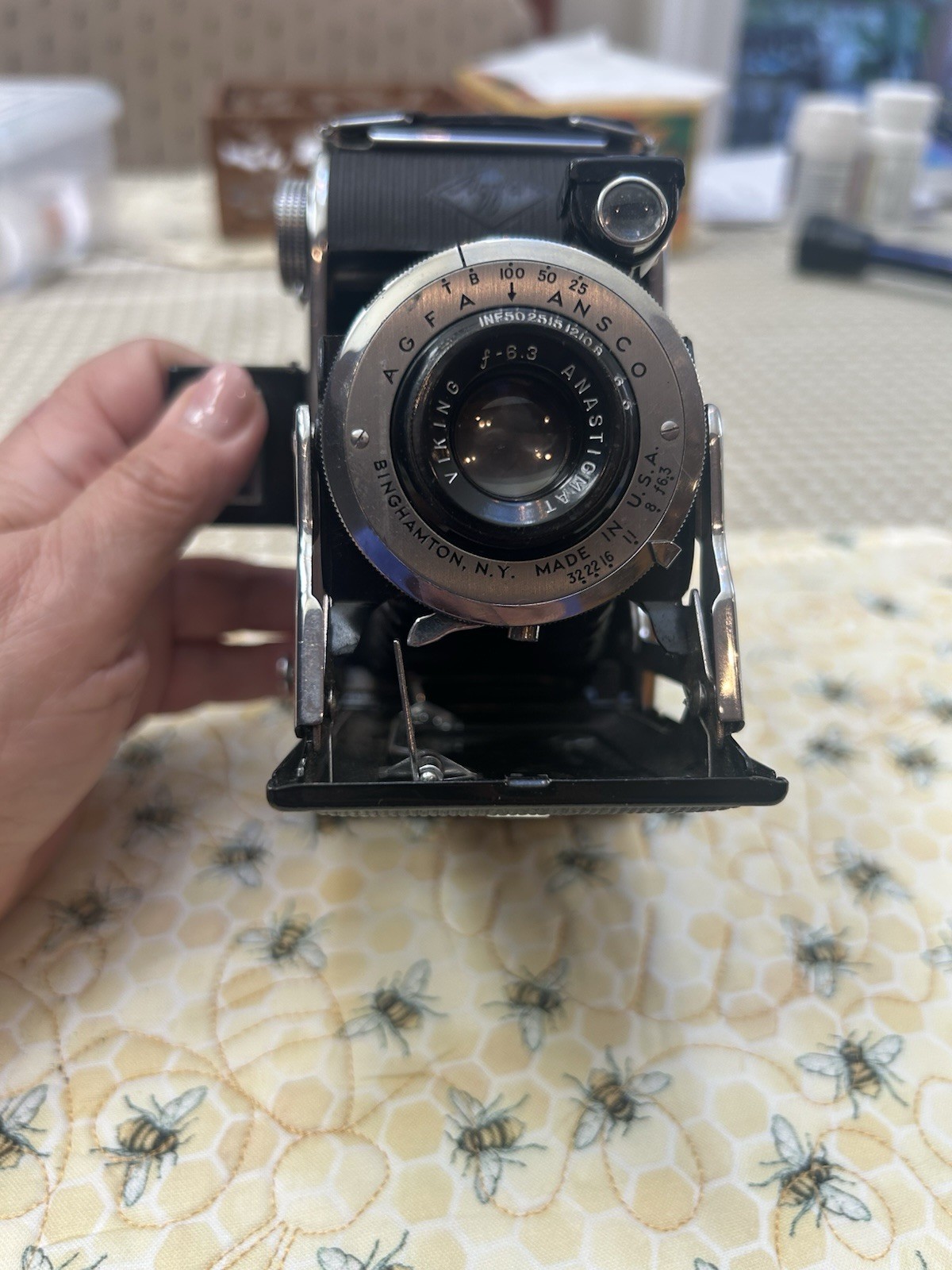
Here's where the PB 20 family gets genuinely interesting, because the specs differ by variant and the sources are careful to say which is which. The Plenax variant carries a "Tripar rectilinear lens" per Manualzz, paired with what that source calls "a range of shutter speeds." The Viking variant, by contrast, is listed with an f7.7 lens — "f7.7 Lens" and "F7.7" in the butkus.org listings. And the Readyset sits at the bottom of the range with "fixed focus, single speed shutter and fixed aperture," again per Prezi.
That's three different cameras wearing the same PB 20 badge. A fixed-focus, fixed-aperture Readyset is a point-and-shoot in the most literal sense. You frame it and hope. A Plenax with a rectilinear lens and a multi-speed shutter gives the photographer real control. The Viking's f7.7 aperture is slow, but Art Deco Cameras describes the Viking as "a nicely-finished, higher-spec version of Agfa Ansco's other 6x9 PB 20 folders," and specifically calls out its body shutter release as a distinguishing feature. A body-mounted release reduces the shake you get from stabbing at a lens-mounted lever.
The Viking's Chrome Trim
Art Deco Cameras notes the Viking "has good quality chrome finishes," and schneidan.com calls it "the high-end, top-finish model of the PB20 6x9 folding camera series." The Viking was the top of the line, the one Agfa Ansco dressed up and equipped properly. If a collector is going to own one PB 20, most would tell you to hold out for the Viking.
Historical Context
Agfa Ansco Corporation operated out of Binghamton, New York, and the PB 20 was one of its mainstream 6x9 folders. Prezi describes the line as "sophisticated Agfa PB20 Readyset still cameras manufactured by Agfa Ansco Corporation in Binghamton, New York, USA." Flickr places the camera as "probably during the 1930s," and Pinterest pins the Readyset specifically to c1934-1939. Production years for the Viking and Plenax variants aren't confirmed in the available documentation.
Agfa Ansco listed the same basic camera under Readyset, Plenax, Antar, Chief, Pioneer, and Viking names, and the butkus.org manual index, the source that gives most of these variants, doesn't state the relationship between them. What the sources do establish is that the Viking sat at the top of the range and the Readyset at the bottom, with the Plenax somewhere in between on lens and shutter spec. Beyond that, the hierarchy is an open question.
Collectibility & Value
PB 20s turn up in the "Agfa Vintage Folding Cameras" category on eBay with some regularity, and sellers consistently describe them as "Very collectible." The listings that get attention are the ones with condition claims attached: "NEAR MINT TESTED," "Original Agfa PB-20 Readyset Folding Camera w/ Box & Manual NOS Vintage," and "In original, totally unused condition." A Pioneer variant listing carries the seller's note "In original, totally unused condition, as is. Very collectible." Box, manual, and unused condition drive the price, not the camera's photographic capability.
There's no confirmed original price for the PB 20 itself. There are no current market prices with dates, no documented common failures, and no spare parts availability information. Because the names overlap so heavily and the sources don't always agree on which spec belongs to which variant, a PB 20 sold as one thing may well be another. Buy on condition, inspect the bellows, and ask for the lens engraving, the shutter type, and whether there's a body release.
eBay Listings



As an eBay Partner, we earn from qualifying purchases. This helps support our independent vintage technology research.
Related Models
- Chinon CP-7m
- Contax ST
- Exakta EDX 3
- Exakta HS-40
- Exakta VX 1000 (1967–1970)
- Exakta VX 500 (1970)
- Exakta VX
- Fujica Fujicarex II (1963-)
- Fujica ST601
- Fujica STX-2 (1985-)