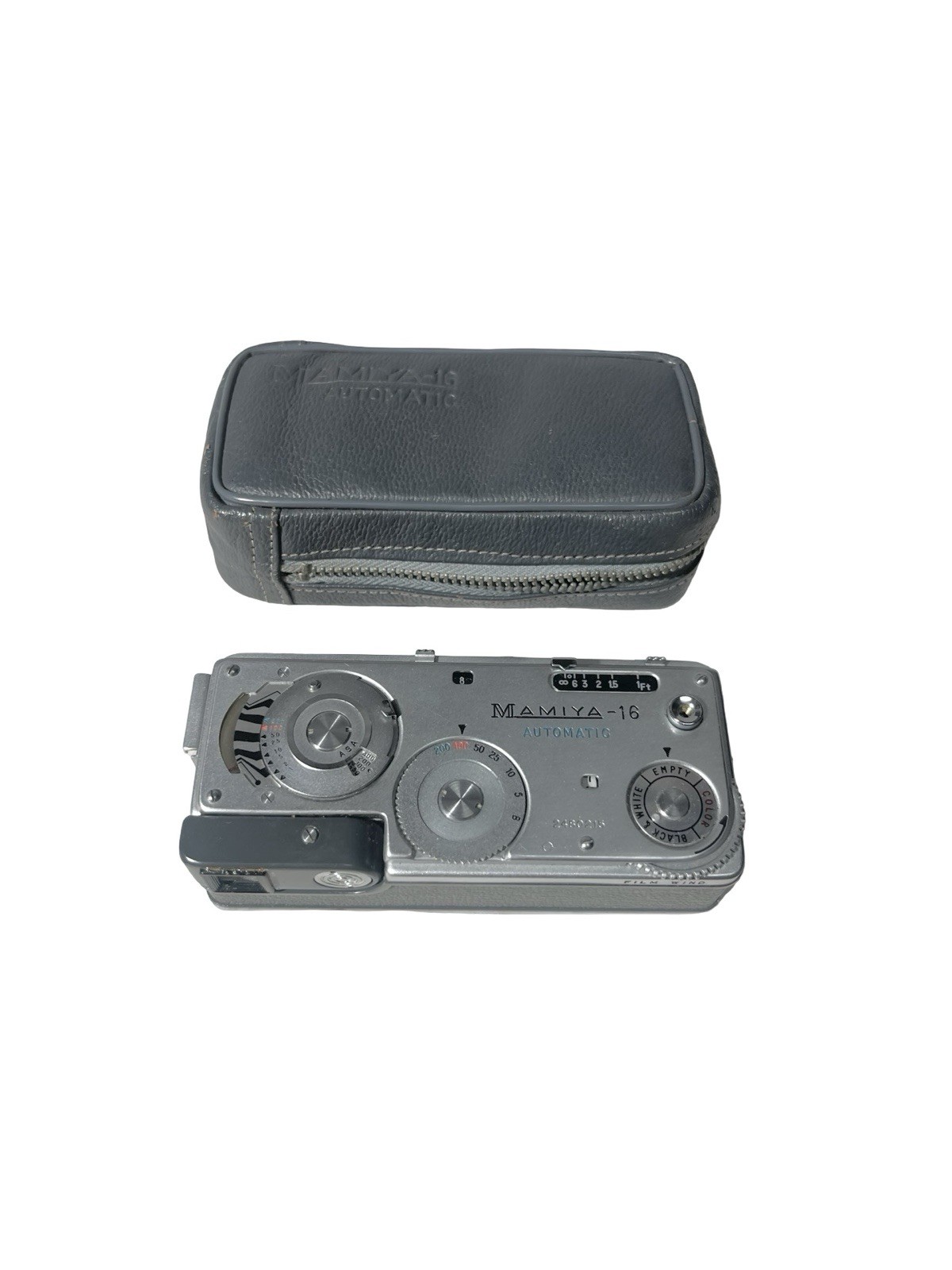
Mamiya 16 Automatic (1959)
The Mamiya 16 Automatic is a subminiature viewfinder camera introduced in August 1959. It shoots 10×14mm images on 16mm film. It belongs to a line of 16mm cameras Mamiya produced for roughly thirteen years, from 1949 to 1962. The 16 Automatic is essentially a Mamiya Super 16 with a built-in selenium meter added to the right-hand side of the body. The meter took the space where the earlier model's slide-out viewfinder lived, so Mamiya replaced it with an optical finder that folds flat against the back of the body when not in use - a pop-up rear viewfinder.
The lens is a Mamiya-Sekor 25mm f/2.8, three elements in three groups, with an aperture range of f/2.8 to f/16. Shutter speeds run from B and 1/2 to 1/200 second. Focusing is by zone, based on subject distance. There's a sliding yellow filter built in, plus flash sync and a tripod socket. The all-metal body is finished in silver, and the whole thing weighs about 270g. Sources disagree on exposure control. One describes automatic aperture setting driven by the selenium meter, while another describes manual exposure settings. The ASA selector covers ASA 10-1600.
Mamiya's 16mm series sold well enough to go through several iterations - Super 16, Type II, Type III, and then the 16 Automatic, arriving a decade after the first model. In the USA, the 16 Automatic was listed in 1960 at $69.95. That was double the price of the Minolta 16I and Mamiya 16 Super II (both $39.95) and two years ahead of the Minolta 16 EE. A relabeled version was sold in Germany under the Revue name. One shop listing describes the camera as "a solid, subminiature camera - while a bit on the boxy side, it does boast an all metal construction and an excellent Mamiya-Sekor 25mm f/2.8 lens." De Wit Cameras described it as a beautifully made, quality camera with no significant signs of use in the example they examined.
Surviving documentation is thin in places — no dimensions, no original price beyond that 1960 US listing, no production volumes, and no serial number ranges are recorded. The manual exists and is available from a few sources, but most of what's known about this camera comes from a handful of dealer listings and collector pages rather than period press. What's consistent across all of them: it's a well-built little 16mm camera with a good lens, and it's the automatic-metered evolution of Mamiya's earlier Super 16.
- Lens: Mamiya-Sekor 25mm f/2.8 (3 elements / 3 groups)
- Aperture: f/2.8 – f/16
- Shutter: B, 1/2 – 1/200 sec
- Film: 16mm, 10×14mm frame
- Meter: built-in selenium, ASA 10–1600
- Focus: zone focusing
- Extras: sliding yellow filter, flash sync, tripod socket
- Weight: 270g
eBay Listings



As an eBay Partner, we earn from qualifying purchases. This helps support our independent vintage technology research.