Kodak Petite (1929–1933/34)
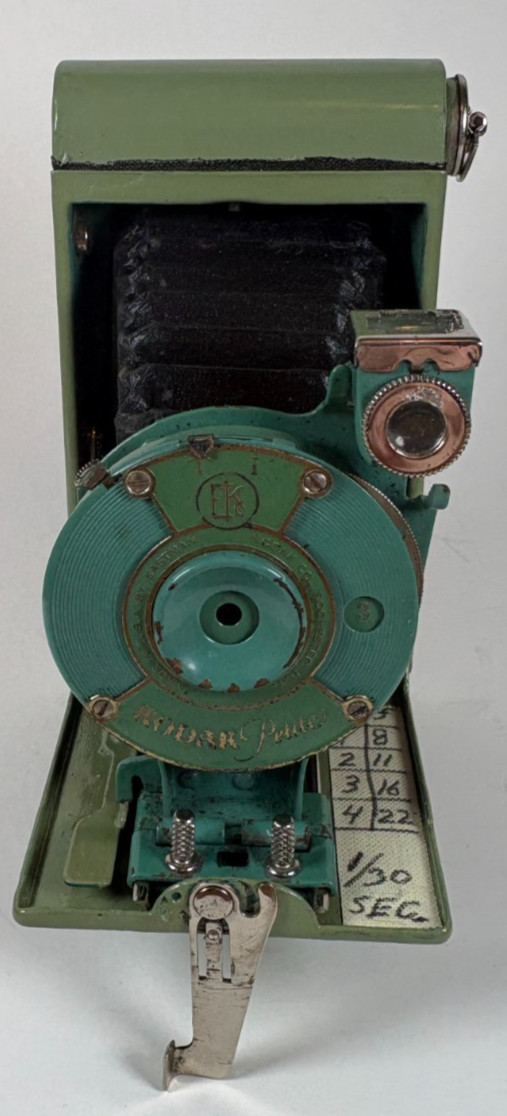
A compact Art Deco camera designed for women, produced as a colored variant of the Vest Pocket Kodak Model B.
Overview
Kodak made the Petite from 1929 to 1934 and sold it mainly to women, with an Art Deco look to match. It is a colored version of the Vest Pocket Kodak Model B. The body has a diamond-pattern covering and came in five colors: green, blue, gray, lavender, and old rose. One known variant has a turquoise and purple step-pattern faceplate and colored bellows, which collectors want. Walter Dorwin Teague designed it. It uses 127 film and has a meniscus lens, a single-speed rotary shutter and a "T" (Time) exposure setting.
Specifications
| Film Format | 127 |
| Lens | Meniscus lens |
| Shutter | Single-speed (+T) rotary shutter |
| Aperture Settings | f/8, f/16, f/32, f/64 |
| Color Variants | Green, blue, gray, lavender, old rose; turquoise & purple step pattern |
| Film Number | Al27 |
Design
Select color variants, including the turquoise and purple one, have a step-pattern faceplate along with the diamond-pattern body covering. The bellows are noted for their distinctive coloring, and collectors like them. The camera has no lens or body movements. The design favors compactness and style over technical flexibility. Don't use alcoholic solvents on the camera or the carrying case.
Context
Kodak introduced the Petite in 1929 as part of a marketing push aimed mainly at women, in an era when consumer goods were styled in Art Deco. The Kodak Coquette, introduced in 1930, is a related product. It packaged a Petite camera with a matching lipstick and compact.
Market
A green Kodak Petite with its original bellows was listed for $195.00 in recent years. Instruction manuals are available through archival sites including cameramanuals.org, pacificrimcamera.com, and butkus.org.
eBay Listings



As an eBay Partner, we earn from qualifying purchases. This helps support our independent vintage technology research.