Kodak Flash Bantam (1947)
A compact strut-folding camera for 828 roll film, introduced as the flash-equipped version of the original Bantam.
Overview
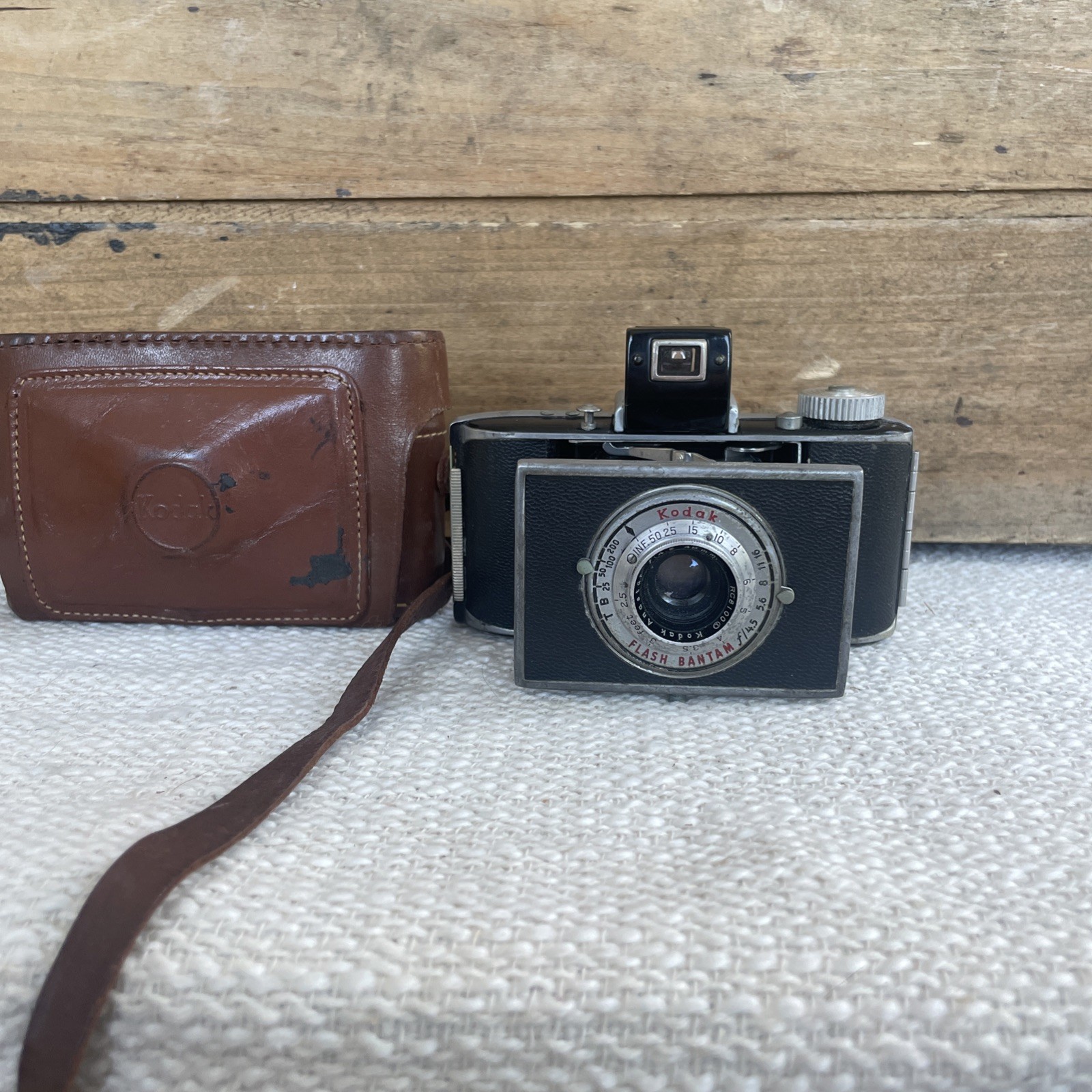
The Kodak Flash Bantam is a compact folding camera from Eastman Kodak. It is the flash-ready version of the original Kodak Bantam 4.5. The Bantam line of strut-folding cameras goes back to a 1935 design by Walter Dorwin Teague. Kodak introduced the Flash Bantam in 1947 as a post-World War II update, with flash synchronization added. It uses 828 roll film for 40mm by 28mm negatives and has a 48mm f/4.5 lens, commonly an Anastar. The body is Bakelite and metal, and there is a viewfinder for composing.
Specifications
| Film format | 828 roll film |
| Negative size | 40mm by 28mm |
| Lens | 48mm f/4.5 |
| Shutter speeds | 1/200, 1/100, 1/50, 1/25 second, plus B and T |
| Dimensions | 4.5 x 2 1/8 x 1 1/4 inches (115 x 65 x 45mm) |
| Weight | 338g |
Design
The Kodak Flash Bantam is a strut-folding camera with a Bakelite and metal body. It has a built-in flash shutter and takes 828 roll film. The lens retracts into the body when folded, which kept it compact for its era. It has a simple viewfinder and a manual film advance.
Context
The Flash Bantam came out in 1947 as an updated Bantam 4.5, with flash capability added to meet growing consumer demand for indoor photography. It was part of Kodak's post-war push to modernize its compact camera lineup. The Bantam line began in 1935. The Flash Bantam was a refined version aimed at more serious amateur photographers, moving beyond basic point-and-shoot use.
Market
Original service manuals for the Kodak Flash Bantam, dated November 1948, are available through repair literature vendors and have been listed at $10.00. The camera turns up now and then in antique shops and online marketplaces, with one Etsy listing priced at $37.95. A common observed issue is a crack in the viewfinder lens. No widespread failure patterns or maintenance details are documented.
eBay Listings


As an eBay Partner, we earn from qualifying purchases. This helps support our independent vintage technology research.