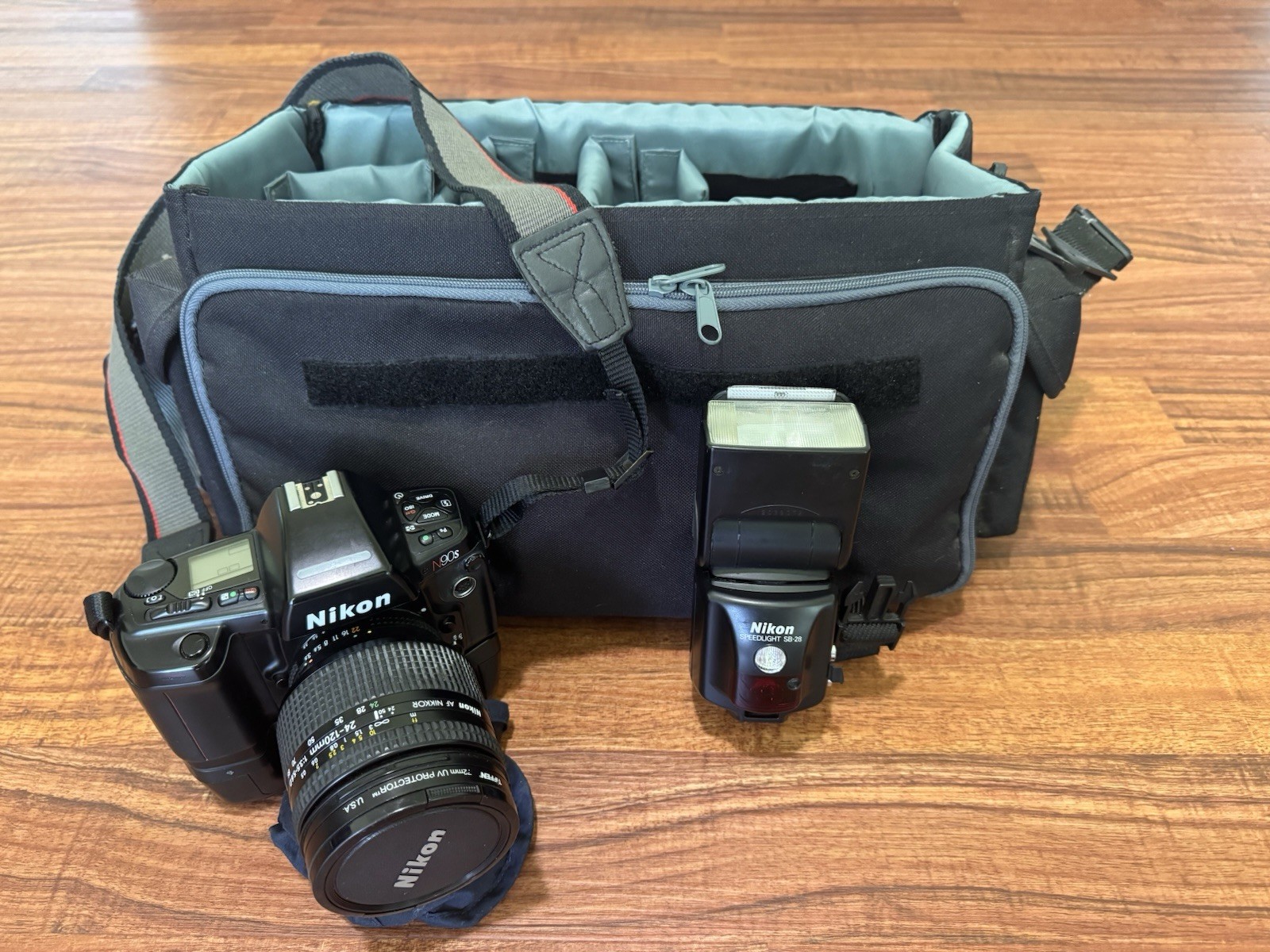
Nikon N90s (1994)
First, a note on identity. This page sits under the Kodak brand folder, but the N90s is a Nikon product through and through. No source connects Kodak to this camera in any way. The N90s, known as the F90x outside North America, is a 35mm autofocus SLR introduced in 1994 as a refinement of the N90 (F90) from 1992. The N90 had been criticized for sluggish autofocus. The N90s was Nikon's answer, positioned between the consumer N8008s and the flagship F4.
The camera is built around an aluminum alloy chassis with a fixed eye-level pentaprism viewfinder. It shows approximately 92% frame coverage (some sources claim 100%) at 0.75x magnification. The headline feature was Nikon's 3D Matrix Metering with an 8-segment sensor, offering Matrix, Center-Weighted (75%/25%), and Spot (2.3mm circle) modes. Shutter speeds run from 30 seconds to 1/8000 sec in 1/3 EV steps. Flash sync is 1/250 sec, and 1/320 sec is possible in aperture-priority auto with compatible Speedlights. Film advance is motorized at up to 4.1 fps. DX-coded film speeds span ISO 25-5000, and power comes from a single 2CR5 6V lithium battery. Dimensions are approximately 6.1 × 4.8 × 3.1 inches. Body-only weight is about 34.6 ounces, or 39.9 ounces with batteries.
The AF improvement over the N90 is the most contested fact in the record. Some sources claim the N90s got a new Multi-CAM 2000 sensor. Others insist it kept the same 246-area CAM sensor as the N90. Both accounts are noted here. The practical consensus among owners is that the N90s focuses somewhat better than the N90, particularly in low light, but stays a generation behind the F5's AF-S speed. HiFI-Stereo (October 1994, p.113) listed the N90s among SLR cameras in its period electronics reference guide, confirming its enthusiast-class positioning at the time.
Reception, then and now, has been warm. ephotozine described it as built to be used as a professional instrument with very high construction quality. Ken Rockwell has called it one of the greatest cameras Nikon ever made - a sleeper with the best ergonomics of any F-series, better than the F4 for most uses at a fraction of the price. Mike Eckman called it arguably the best bargain in autofocus film Nikons today, built like a tank and working like a Swiss watch.
Know the common failure points before buying. The in-body autofocus motor can fail, and it is generally not repairable because parts are scarce. The LCD displays (top and rear) are prone to bleeding or going blank after 10-15 years. Command dials can become intermittent. The rubber grip material decomposes after two decades. Light seals around the film door may need replacement, and a CLA is recommended since shutter lubrication dries out. The 2CR5 battery is still manufactured by Energizer. Current street prices run roughly $200-$350 for a body in excellent condition, or $250-$400 with a 50mm f/1.8D lens.
Known specs at a glance:
- 35mm AF SLR, Nikon F-mount, in-body focus motor
- Shutter: 30 sec to 1/8000 sec, vertical-travel metal focal plane
- Flash sync: 1/250 sec
- Continuous: 4.1 fps
- Metering: 3D Matrix (8-segment), Center-Weighted, Spot
- ISO 25–5000 DX-coded
- Battery: one 2CR5 6V lithium
- Introduced 1994; no original US retail price documented
eBay Listings



As an eBay Partner, we earn from qualifying purchases. This helps support our independent vintage technology research.