IHAGEE EXA IIB
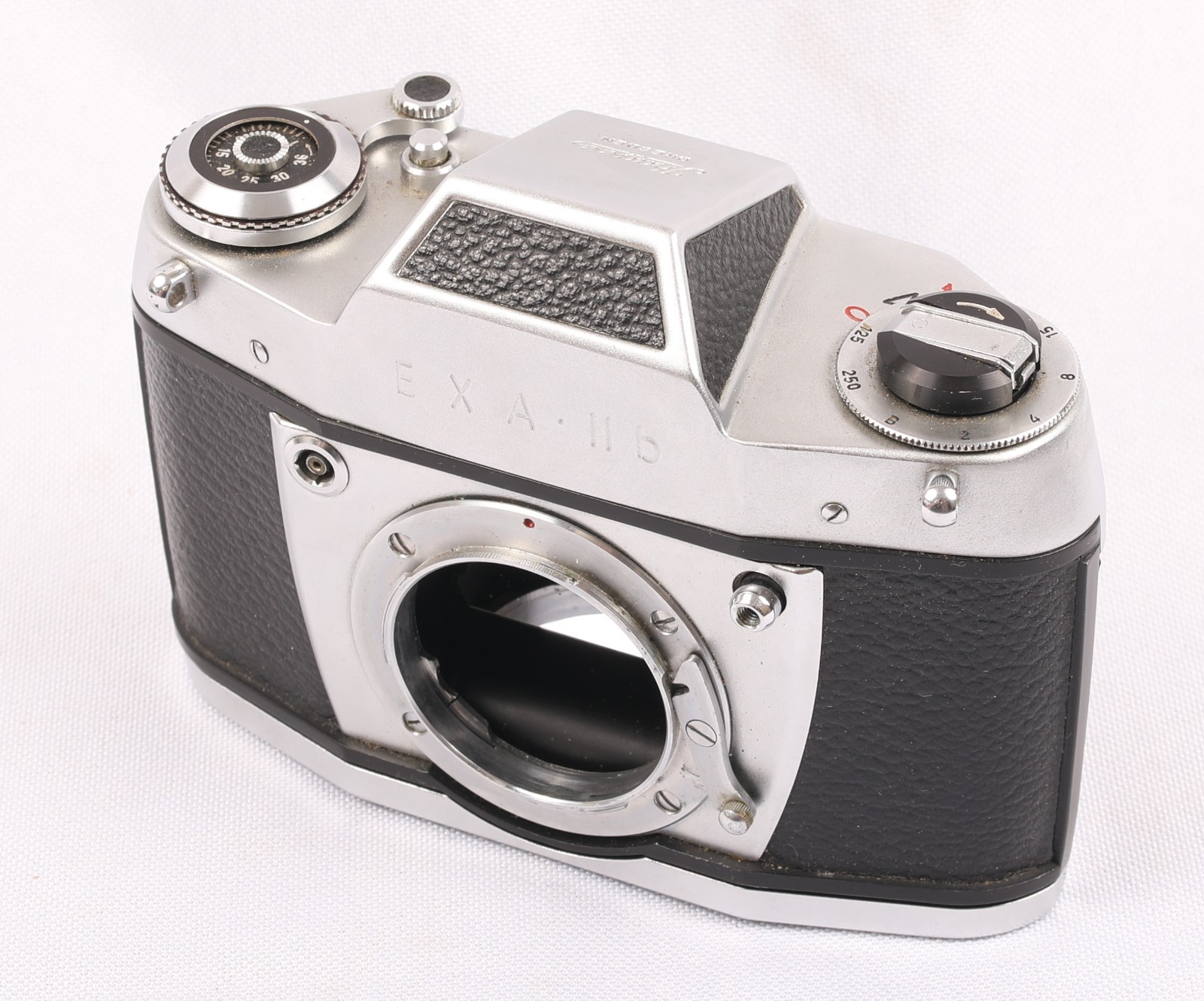
The Ihagee Exa IIb is a 35mm single-lens reflex (SLR) camera made by the German manufacturer Ihagee between 1964 and 1966. It was the final true Ihagee-designed SLR before the company was fully folded into the VEB Pentacon conglomerate. It adds mechanical refinements and ergonomic improvements over its predecessors.
Overview
The Exa IIb arrived in 1964 and succeeded the Exa IIa. It was the last Exa to carry a real Ihagee engineering identity before the brand was absorbed into the state-owned East German camera combine VEB Pentacon. Built in Dresden, it was positioned as an advanced amateur and semi-professional SLR with a simple, reliable mechanical design. It kept the Exa series habit of a fixed, non-interchangeable pentaprism and a horizontally-traveling cloth focal-plane shutter. It also brought several refinements aimed at usability and durability.
The Exa IIb was made for photographers who wanted a dependable, no-frills SLR with manual control over exposure and focus. It took lenses on the M42 screw mount (also called the Praktica thread mount), so a wide range of East and West German optics fit, including Carl Zeiss Jena, Meyer-Optik, and Schneider-Kreuznach. It had a built-in selenium light meter with center-the-needle exposure guidance, located in the prism housing. That feature came over from the Exa IIa, with improved readability.
The Exa IIb sits in a transitional spot in East German camera development. It kept the core mechanical layout of the original Exa (introduced in 1956), but it was built while manufacturers under the Pentacon umbrella were being standardized. It shares design cues with contemporary Praktica models, particularly in the shutter mechanism and metering system. It still has a distinct Ihagee lineage in its body casting, shutter release layout, and film advance ergonomics.
Specifications
| Specification | Value |
| Type | 35mm Single-Lens Reflex (SLR) |
| Film Format | 35mm (135 cartridge) |
| Years Produced | 1964–1966 |
| Lens Mount | M42 × 1mm screw (Praktica thread mount) |
| Shutter | Cloth focal-plane shutter, speeds 1–1/1000 sec + B; speeds 1–1/500 via instant-return mirror |
| Metering | Selenium-cell TTL meter with center-the-needle indication in viewfinder |
| Exposure Modes | Manual only |
| Viewfinder | Fixed pentaprism, eye-level, with split-image rangefinder spot and microprism collar |
| Dimensions | Approx. 145 × 90 × 55 mm; weight approx. 680 g (body only, no lens) |
Key Features
- Mechanically timed shutter with speeds from 1 second to 1/1000 second, offering high-speed performance rare in budget SLRs of the era.
- Integrated selenium meter with no battery requirement—self-powered via ambient light, providing reliable long-term operation.
- Split-image focusing screen with microprism collar for precise manual focusing, standard in advanced SLRs of the 1960s.
- M42 lens compatibility ensured access to a broad ecosystem of high-quality East and West German lenses.
- Instant-return mirror (at speeds 1/500 and slower) improved viewing continuity during rapid shooting.
Historical Context
The Exa IIb came out while the East German optical industry was consolidating. By the early 1960s, Ihagee had become part of VEB Pentacon Dresden. It had once been an independent innovator, known for the original Kine Exakta in the 1930s. Pentacon now coordinated production across several former brands, including Praktica, KW, and Zeiss Ikon. Even so, the Exa IIb kept distinct Ihagee design elements, particularly in its shutter mechanism and body mold, which set it apart from contemporary Praktica models like the PLC or Nova.
The camera competed in a growing market for affordable, mechanically sturdy SLRs aimed at amateurs moving up from rangefinders or viewfinder cameras. Its main rivals were the Praktica FX series, the Soviet Zenit-E, and entry-level Japanese SLRs such as the Topcon R and early Pentax models. It lacked the automation and electronic features starting to appear in Japan. It offered reliability, simplicity, and optical compatibility, which photographers in both Eastern and Western Europe valued.
Despite its technical merits, the Exa IIb had a short production run, ending in 1966. It was succeeded not by a direct Ihagee model, but by Pentacon-badged SLRs that further blurred brand distinctions. The discontinuation of the Exa line marked the end of Ihagee as a standalone camera developer, cementing its legacy as a pioneer of the 35mm SLR format.
Collectibility & Value
Today the Exa IIb is sought after by collectors of East German and mechanical SLR cameras. It was the final true Ihagee SLR, and original examples in working condition are increasingly rare. With no electronic components and a selenium meter, it is both durable and vulnerable. The meter needs no battery, but selenium cells can degrade over time, giving inaccurate readings or failing completely. The camera still works fully without the meter, since exposure is set manually.
In the collector's market, the Exa IIb typically sells for $150 - $300 USD depending on condition, lens inclusion, and meter functionality. Fully operational units with bright, clear viewfinders and responsive shutters command premium prices. Common issues include stiff film advance levers, shutter curtain wear (especially at high speeds), and light seal degradation. Buyers should verify shutter accuracy across all speeds, check for mirror bounce or binding, and inspect the focusing screen for cloudiness or fungus.
The Exa IIb is mechanically simple and shares parts with other M42-era cameras, so it is relatively straightforward to service with the right tools and expertise. Original spare parts are limited, though, and some internal components are no longer manufactured. That makes preserving original condition highly valued.
Similar Cameras
- Praktica FX 2 (1966–1970) – East German M42 SLR with similar build quality and selenium metering.
- Zenit-E (1965–1982) – Soviet-built M42 SLR, mechanically simpler but widely exported.
- Pentax Spotmatic (1964–1976) – Japanese M42 SLR with advanced CdS metering and broader international appeal.
- Topcon R (1963–1967) – High-end Japanese SLR with M42 mount and precision engineering.
- Fujica ST 705 (1964) – Early Fujifilm SLR with M42 compatibility and robust mechanical design.
Repair & Maintenance
The Exa IIb needs no batteries, since its selenium light meter generates its own current from ambient light. Degraded selenium cells cannot be easily repaired and often need replacement or recalibration by a specialist. The mechanical shutter should be checked for consistency, particularly at 1/1000 sec, where timing errors are common in aged units. Lubrication of the film transport and shutter mechanisms is recommended every 10-15 years to prevent gumming. Light seals should be replaced to stop light leaks, and the focusing screen should be inspected for haze or delamination. With its mechanical nature and lack of electronics, the Exa IIb is considered repairable by experienced technicians familiar with M42-era SLRs, though original replacement parts are scarce.
eBay Listings


As an eBay Partner, we earn from qualifying purchases. This helps support our independent vintage technology research.
Related Models
- Ihagee Exa 1a (1964-1977)
- Ihagee Exa 1b (1977-1985)
- Ihagee Exa 1c (1985–1987)
- Ihagee Exa 500 (1966–1969)
- Ihagee Exa IIa (1963-1964)
- Alpa Alnea 7 (1952)
- Alpa Prisma Reflex
- Agfa 254
- Agfa ActionCam (1995)
- Agfa Agfaflex