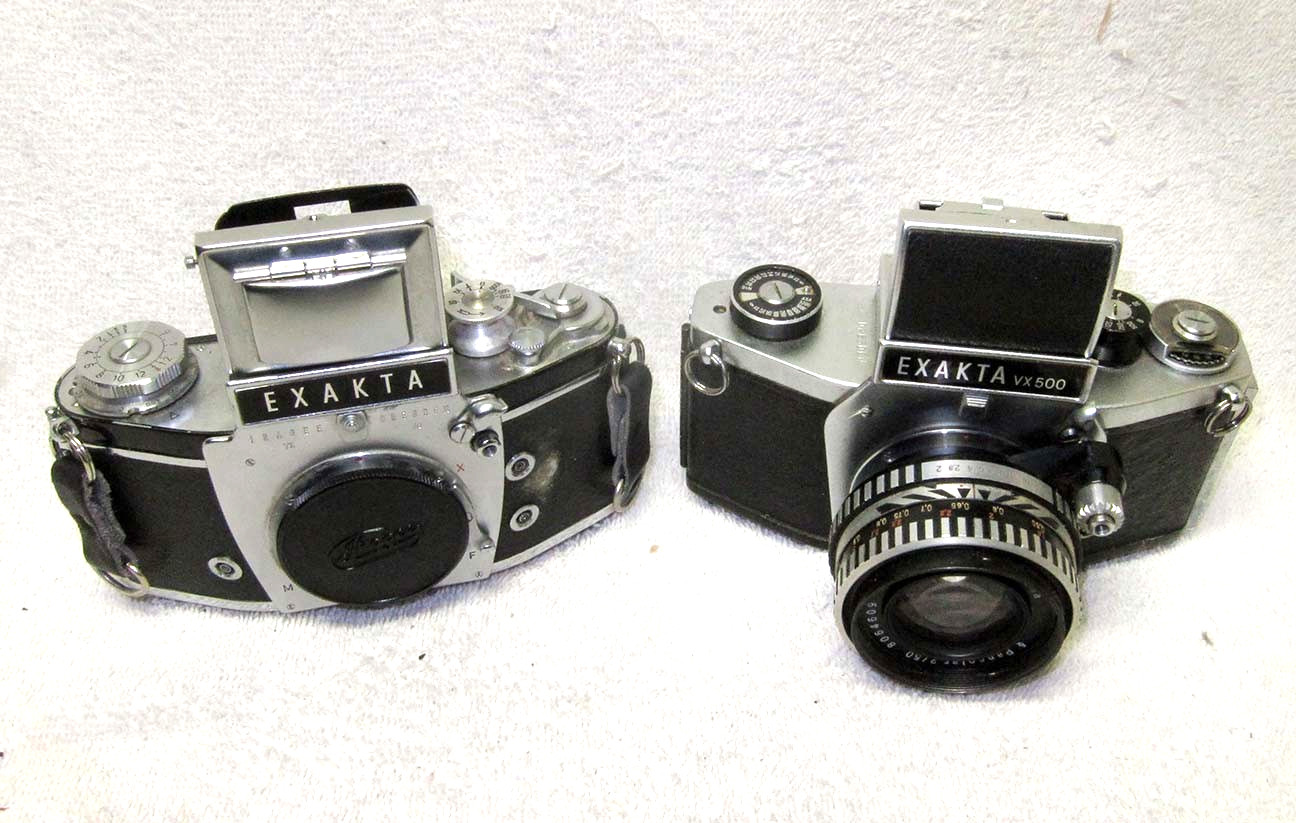
EXAKTA VX500
The Exakta VX500 is a 35mm single-lens reflex (SLR) camera introduced by Ihagee Kamerawerk in 1969 as an economical variant within the long-running Exakta VX series. Designed to offer reliable mechanical operation at a reduced cost, the VX500 features a maximum shutter speed of 1/500 second and lacks built-in light metering, targeting budget-conscious amateur photographers.
Overview
Released between 1969 and 1972, the Exakta VX500 emerged during a transitional period in the SLR market, when Japanese manufacturers were rapidly gaining dominance through advanced electronics and aggressive pricing. Ihagee, the East German manufacturer behind the Exakta brand, sought to maintain relevance by streamlining its product line and reducing production costs. The VX500 was positioned as an entry-level, no-frills SLR, derived from the earlier VX1000 and VX2000 models but stripped of their selenium-cell exposure metering systems. This removal allowed for a simpler top plate design and lower manufacturing expense, making the VX500 one of the most affordable Exakta SLRs at the time.
Despite its economy positioning, the VX500 retained the core mechanical robustness and precision engineering associated with the Exakta name. It features a vertically-traveling focal-plane cloth shutter with speeds from 1 second to 1/500 second, plus Bulb mode, and uses the standard Exakta bayonet mount (often referred to as the "Exakta Standard" or "Kine Exakta" mount), ensuring compatibility with a wide range of existing Exakta lenses. The camera maintains the classic Exakta layout with a large rewind knob on the left, a film advance lever on the right, and a prominent shutter speed dial concentric with the rewind knob. The absence of a built-in meter means exposure settings must be determined manually using an external meter or estimated based on experience.
The VX500 fits into the final phase of Exakta’s 35mm SLR development, following the more advanced VX1000 (1965) and preceding the short-lived VX Plus series. While lacking the technological innovations of its predecessors, the VX500 served as a practical, dependable tool for photographers who prioritized mechanical reliability over automation. Its production coincided with the decline of Ihagee as an independent entity, as the company faced increasing competition and supply chain challenges within the East German economy. As such, the VX500 represents both the culmination of Exakta’s mechanical SLR tradition and the end of an era for one of Europe’s pioneering camera brands.
Specifications
| Specification | Value |
| Type | 35mm Single-Lens Reflex (SLR) |
| Film Format | 35mm (135 film) |
| Years Produced | 1969–1972 |
| Lens Mount | Exakta Bayonet (Kine Exakta mount) |
| Shutter | Vertically-traveling focal-plane cloth shutter; speeds 1s – 1/500s in 1/3 stop increments, plus B (Bulb) |
| Metering | None (unmetered) |
| Exposure Modes | Manual only (shutter speed and aperture set manually) |
| Viewfinder | Fixed pentaprism eye-level viewfinder with microprism spot and split-image rangefinder center |
| Dimensions | Approx. 145 mm (W) × 95 mm (H) × 50 mm (D); weight approx. 650 g (body only, no battery or lens) |
Key Features
- Mechanically timed shutter with no reliance on batteries, ensuring full functionality regardless of power source availability.
- Exakta bayonet mount provides compatibility with a broad range of Exakta lenses from the 1950s through the 1970s, including popular models like the Zeiss Tessar, Pentacon Auto-Mutar, and Meyer-Optik Görlitz Lydith.
- Top-plate shutter speed dial integrated with the rewind knob, a signature Exakta design element that allows for quick speed selection without removing the hand from the rewind lever.
- Instant-return mirror (on later production models), improving viewing continuity after exposure—though early units may exhibit non-instant return behavior.
- Self-timer lever located on the front of the camera, manually cocked and released via a knurled knob.
Historical Context
The Exakta VX500 was introduced at a time of significant upheaval in the global camera industry. By the late 1960s, Japanese manufacturers such as Nikon, Canon, Pentax, and Minolta were rapidly advancing SLR technology with features like through-the-lens (TTL) metering, aperture-priority automation, and improved ergonomics. In contrast, Ihagee, based in Dresden, East Germany, operated under the constraints of a centrally planned economy with limited access to modern electronics and declining export capacity. The VX500 was thus a pragmatic response—an effort to sustain the Exakta brand by offering a simplified, cost-reduced version of proven mechanical designs.
While the VX500 lacked the sophistication of contemporary Japanese SLRs, it retained the high build quality and precise mechanics that had defined Exakta’s reputation since the 1930s. It competed indirectly with entry-level models like the Pentax Spotmatic (introduced 1964) and the Canon FT, though without built-in metering, it was inherently less convenient for average users. Nevertheless, the VX500 found niche appeal among photographers who valued mechanical reliability, manual control, and the extensive ecosystem of Exakta-mount lenses. Its production ended around 1972, marking the effective conclusion of Exakta’s 35mm SLR line, as Ihagee shifted focus to medium format and eventually ceased camera production altogether by the late 1980s.
Collectibility & Value
Today, the Exakta VX500 is a modestly collectible camera, primarily sought by Exakta enthusiasts, mechanical SLR collectors, and users interested in vintage lenses. It is not particularly rare, but complete, functional examples in good condition are increasingly difficult to find due to age-related wear and the degradation of rubber components such as the shutter curtain and light seal foam. The VX500 typically sells for $50–$120 USD on the secondary market, depending on condition, included accessories, and whether it comes with a lens.
When purchasing a VX500, collectors should inspect the shutter for consistency across all speeds, check for mirror bounce or sticking, and verify that the film advance and rewind mechanisms operate smoothly. The absence of a light meter eliminates concerns about selenium cell degradation—a common issue in the VX1000 and VX2000—but users should still ensure the viewfinder is clean and free of fungus or haze. Because the camera uses no batteries, it remains fully functional indefinitely if mechanically sound. However, the Exakta bayonet mount, while robust, can suffer from wear or misalignment if lenses are frequently changed, potentially affecting infinity focus.
Similar Cameras
- Pentax Spotmatic – A fully manual 35mm SLR with TTL metering, introduced in 1964 and widely exported.
- Canon FT QL – Mechanically operated SLR with a quick-load film system and CdS metering.
- Nikkormat FT – Nikon’s budget-friendly SLR offering, sharing many components with the Nikon F.
- Praktica LLC – East German SLR with M42 screw mount, known for rugged construction and affordability.
- Yashica TL Electro-X – A late 1960s SLR with manual operation and a distinctive design.
Repair & Maintenance
The Exakta VX500 requires no batteries for operation, as all functions are mechanically actuated. This makes it highly reliable over time, provided the internal mechanisms are well-maintained. Common issues include stiff or inconsistent shutter speeds (often due to dried lubricants), light leaks from deteriorated foam seals, and worn shutter curtains. The vertically traveling cloth shutter is particularly sensitive to improper handling or storage in humid environments.
Repair of the VX500 is feasible but requires specialized tools and expertise, especially for shutter calibration and mirror mechanism adjustment. Replacement parts are scarce, though some components are interchangeable with other Exakta VX models. Routine maintenance should include CLA (clean, lubricate, adjust) servicing by a technician experienced with vintage mechanical SLRs, replacement of light seals, and inspection of the film pressure plate and take-up mechanism. When stored properly—cool, dry, and with the shutter uncocked—the VX500 can remain functional for decades.
eBay Listings


As an eBay Partner, we earn from qualifying purchases. This helps support our independent vintage technology research.
Related Models
- Exakta Exakta II (1949-1950)
- Exakta Kine Exakta (1936–1949)
- Exakta RTL1000 (1969-1973)
- Exakta Varex IIa (1960-1963)
- Exakta Varex IIb (1963-1967)
- Alpa 6 (1948-1953)
- Agfa Agfaflex
- Agfa Ambiflex
- Agfa Easy
- Agfa Futura Af zoom