EXAKTA VAREX IIA
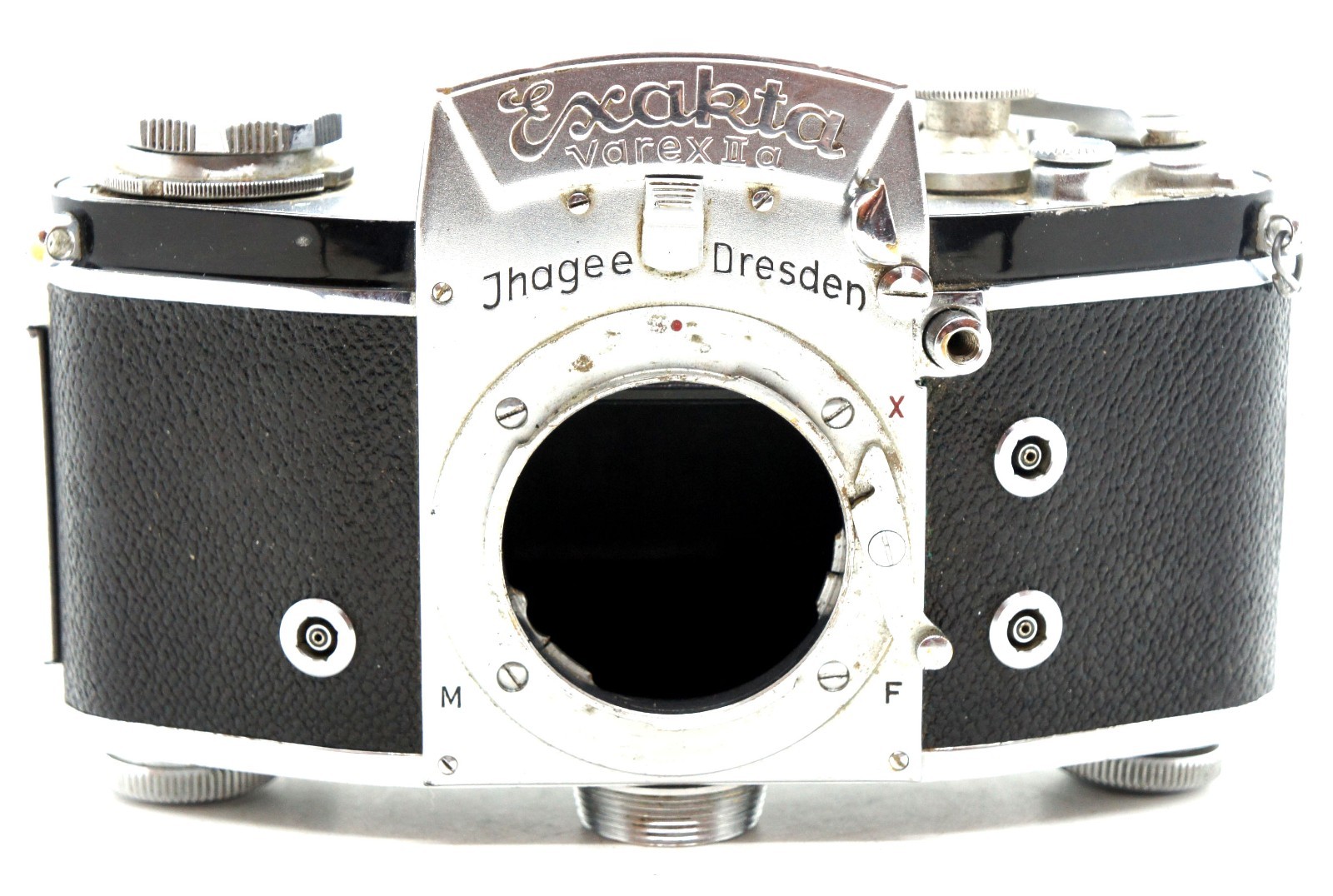
The Exakta Varex IIa is a 35mm single-lens reflex (SLR) camera made by Ihagee Kamerawerk in Dresden, East Germany, from 1960 to 1963. It updated the original Varex with changes to ergonomics, shutter performance, and lens compatibility. It was one of the last of Exakta's manually operated, all-mechanical SLRs before the more automated designs arrived.
Overview
The Exakta Varex IIa was introduced in 1960 as the direct successor to the Varex and Varex II. It brought improvements in shutter reliability, viewfinder optics, and mechanical precision. Ihagee marketed it mainly to advanced amateur and professional photographers, as a precision instrument for studio, photojournalism, and technical work. It kept the modular design that defined Exakta SLRs: interchangeable viewfinders, focusing screens, and a wide range of accessories on the proprietary bayonet mount.
The Varex IIa used the Exakta bayonet mount (often called the "Exakta Standard" or "Kine Exakta" mount). Lenses came from Zeiss Jena, Meyer-Optik, Schneider-Kreuznach, and others. The focal-plane shutter ran from 1 second to 1/1000th of a second, which made the camera versatile at a time when SLRs were still gaining ground on rangefinders. The shutter was a horizontally traveling cloth focal-plane type with a redesigned speed control mechanism, which reduced shutter lag and improved consistency at high speeds.
The Varex IIa also got a revised film advance with a longer lever throw and improved film tensioning, which reduced the risk of film misregistration. It kept the top-mounted accessory shoe for external light meters and viewfinder attachments, including the popular pentaprism and waist-level finder options. Unlike later SLRs, it had no built-in light metering, so users needed a handheld or accessory-mounted meter, which was common for the period. Its all-metal construction, precise engineering, and extensive accessory range made it one of the most capable mechanical SLRs of the early 1960s.
Specifications
| Specification | Value |
| Type | 35mm Single-Lens Reflex (SLR) |
| Film Format | 35mm (135 cartridge) |
| Years Produced | 1960–1963 |
| Lens Mount | Exakta Bayonet (Kine Exakta mount) |
| Shutter | Horizontal cloth focal-plane shutter; speeds 1 sec – 1/1000 sec + B |
| Metering | None (no built-in light meter) |
| Exposure Modes | Manual only |
| Viewfinder | Interchangeable (waist-level or pentaprism via accessory shoe) |
| Dimensions | Approx. 145 × 95 × 55 mm; Weight: ~750 g (body only, no lens) |
Key Features
- Interchangeable viewfinders and focusing screens: Allowed customization for different shooting styles, including eye-level pentaprism or waist-level ground glass.
- High-speed focal-plane shutter: Capable of 1/1000 sec, rare among early SLRs and ideal for action and bright-light photography.
- Exakta bayonet lens mount: Supported a wide range of third-party and Zeiss Jena lenses, enhancing system flexibility.
- Flash synchronization at all speeds: Via PC sync terminal and X/M contacts, with T-sync for time exposures.
- Modular accessory system: Included motor drives, intervalometers, and specialized backs, making it suitable for scientific and technical use.
Historical Context
The Varex IIa came out while 35mm photography was in transition, as SLRs began to replace rangefinders as the preferred tool of professional photographers. Competitors such as the Asahi Pentax Spotmatic (introduced in 1960) and the Nikon F (1959) were starting to add through-the-lens (TTL) metering and faster lens systems. The Varex IIa stayed purely mechanical and put reliability and precision ahead of automation. Ihagee operated under East German state control after World War II, and it struggled to compete with Japanese manufacturers who offered more modern electronics and mass-production efficiencies.
Despite these pressures, the Varex IIa was well regarded in Europe and North America for its build quality and optical performance. Technical and industrial photographers liked it because it worked with macro rails, bellows, and scientific attachments. The lack of built-in metering and the complex mechanical operation limited its appeal to the broader consumer market. Production ended in 1963 as Ihagee shifted toward simpler, more affordable models like the Exakta VX and later the RTL series. The Varex IIa was the culmination of Exakta's pre-electronic SLR engineering.
Collectibility & Value
Today the Exakta Varex IIa is a sought-after collectible among vintage camera enthusiasts, particularly those interested in mechanical precision and modular system design. In excellent working condition, with a matching pentaprism and original case, values typically range from $400 to $700 USD, depending on lens inclusion and provenance. Fully serviced units with clean viewfinders and reliable shutters command premium prices, especially when paired with classic lenses like the Carl Zeiss Jena Pancolar 50mm f/1.8 or the Meyer-Optik Domiplan 50mm f/1.4.
Collectors should watch for shutter cloth degradation, disintegrating light seals, and stiff or inaccurate shutter speeds - particularly at 1/1000 sec, where timing inconsistencies are frequent in unrestored units. The internal mechanics are intricate and need skilled servicing, and replacement parts are scarce. The bayonet mount can also suffer from wear or misalignment, which affects lens seating and infinity focus. A functional film advance and reliable flash sync are the key signs of a well-maintained example. Because of its mechanical complexity, the Varex IIa is not recommended for novice users, but it is a rewarding project for experienced collectors and restorers.
Similar Cameras
- Nikon F (1959) – A professional-grade SLR with modular design and extensive lens support.
- Asahi Pentax Spotmatic (1964) – Introduced TTL metering and a more user-friendly platform.
- Praktina FX (1952–1960) – Another German SLR with interchangeable components and bayonet mount.
- Konica F (1960) – Japan’s first SLR with a focal-plane shutter up to 1/2000 sec.
- Topcon RE Super (1963) – Known for its bright viewfinder and advanced metering system.
Repair & Maintenance
The Exakta Varex IIa needs no batteries and operates entirely mechanically. Regular maintenance is still essential because of age-related wear. Common issues include sticky shutter curtains, inaccurate speeds (especially at 1/1000 sec), and worn film advance gears. The cloth focal-plane shutter is sensitive to humidity and can tear if not properly lubricated. Light seals around the back and prism housing should be replaced to prevent light leaks. Lubrication of the shutter mechanism and film transport should only be done by technicians experienced with vintage Exakta models, since improper servicing can lead to jamming or timing errors. The modular design allows disassembly, but reassembly demands precision alignment, particularly of the mirror and shutter linkage. Checking the mirror return spring and film pressure plate periodically keeps frame spacing and image quality consistent.
eBay Listings



As an eBay Partner, we earn from qualifying purchases. This helps support our independent vintage technology research.
Related Models
- Exakta RTL1000 (1969-1973)
- Exakta Varex (1950–1956)
- Exakta VX500 (1969-1972)
- Exakta II (1949-1950)
- Exakta Kine Exakta (1936–1949)
- Alpa Alnea 7 (1952)
- Alpa Prisma Reflex
- Agfa 254
- Agfa ActionCam (1995)
- Agfa Agfaflex