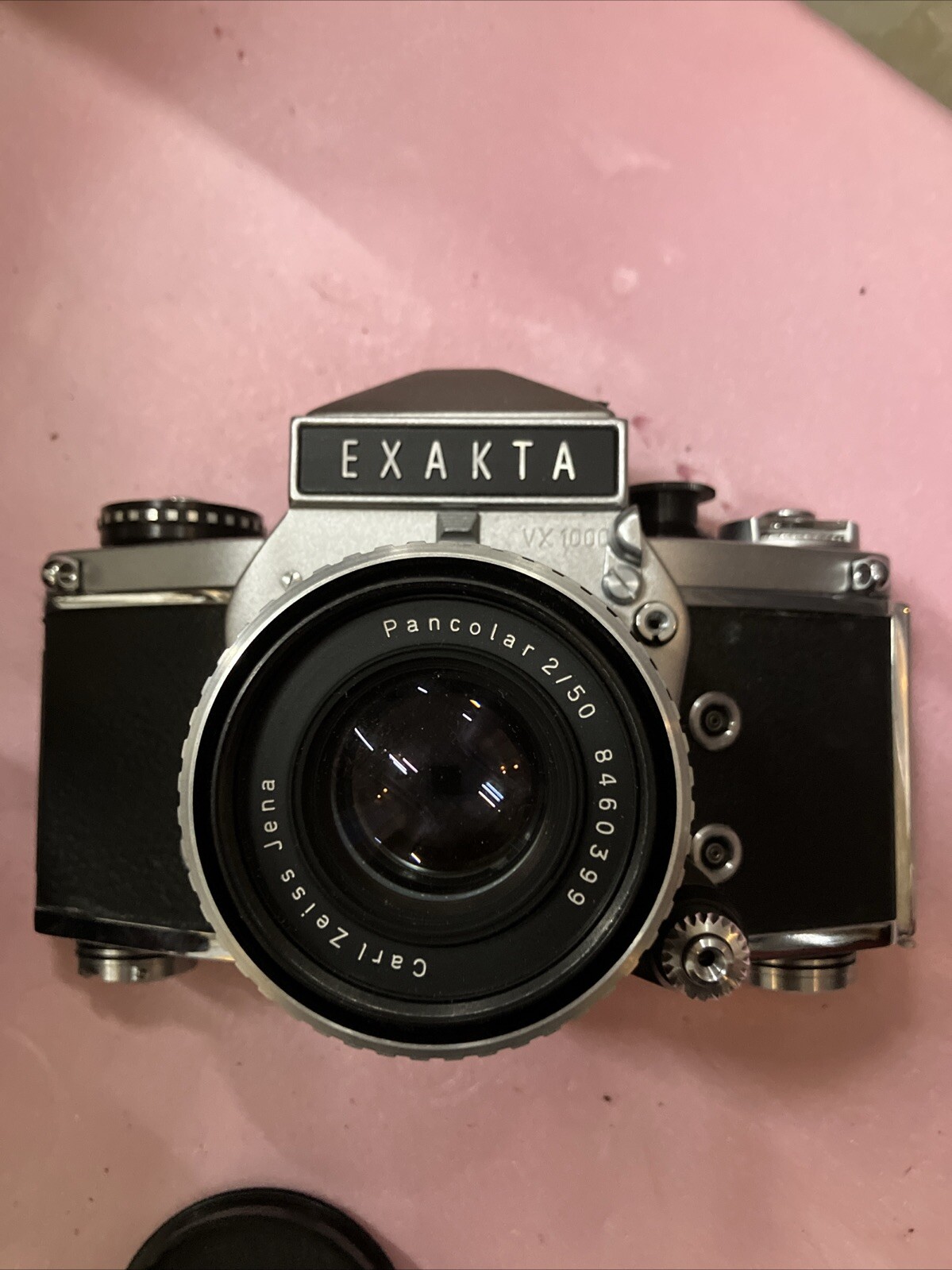
EXAKTA VX1000
The Exakta VX1000 is a 35mm single-lens reflex (SLR) camera produced by Ihagee Kamerawerk in Dresden, East Germany, from 1967 to 1970. It represents the final evolution of the Exakta V-series line, distinguished primarily by its high-speed vertical-travel focal-plane shutter capable of 1/1000 second, making it one of the fastest mechanical SLRs of its era.
Overview
Introduced in 1967, the Exakta VX1000 was designed as a professional-grade 35mm SLR for advanced amateur and press photographers who demanded reliability, precision, and fast shutter performance. It succeeded the Exakta Varex and VX500, continuing the lineage of the V-mount (also known as the Exakta bayonet) system that had been in use since the late 1930s. The VX1000 was positioned as a technically advanced successor with enhanced shutter performance and improved ergonomics, including a redesigned shutter speed dial and updated film advance mechanism.
Despite being developed during a period of increasing competition from Japanese manufacturers such as Nikon, Canon, and Pentax, the VX1000 maintained the robust mechanical construction and modularity that defined Exakta’s reputation. It featured a fully mechanical shutter, interchangeable viewfinders and focusing screens, and an extensive array of accessories, including motor drives, interchangeable backs (rare), and specialized lenses. The camera was marketed toward photographers who valued mechanical reliability and system expandability over electronic automation, which was beginning to emerge in competing models.
The VX1000 marked the end of an era for Exakta’s V-series SLRs. While it incorporated refinements over earlier models—such as improved flash synchronization (X and M contacts at 1/30s), a more accessible shutter speed dial, and a redesigned rewind crank—it could not overcome the manufacturing limitations and economic constraints of East German industry during the Cold War. Production ceased around 1970, and the model was not directly replaced, signaling the decline of Exakta as a major force in the global camera market.
Specifications
| Specification | Value |
| Type | 35mm Single-Lens Reflex (SLR) |
| Film Format | 35mm (135) |
| Years Produced | 1967–1970 |
| Lens Mount | Exakta Bayonet (V-mount) |
| Shutter | Vertical-travel metal focal-plane shutter; speeds 1 sec to 1/1000 sec, B, X-sync at 1/30 sec |
| Metering | None (body unmediated); compatible with external selenium meter prisms (e.g., EE or EES) |
| Exposure Modes | Manual only (no built-in metering or automatic exposure) |
| Viewfinder | Interchangeable pentaprism or waist-level finder; eye-level prism standard (non-metering) |
| Dimensions | Approx. 145 × 95 × 55 mm; weight approx. 710 g (body only, no lens) |
Key Features
- 1/1000 sec vertical-travel focal-plane shutter: One of the first mechanically timed shutters in an SLR to achieve this speed, enabling sharp stop-action photography without electronic control.
- Interchangeable viewfinder system: Compatible with a range of pentaprisms and waist-level finders, including metered variants (EE, EES) that coupled with selenium cells.
- Exakta V-mount compatibility: Supported a wide array of lenses from 18mm to 1000mm, including Carl Zeiss Jena, Schneider-Kreuznach, and Meyer-Optik designs.
- Fully mechanical operation: No batteries required for shutter function, ensuring reliability in extreme conditions.
- Flash synchronization: Dual X and M contacts with automatic switching via PC socket; sync speed at 1/30 sec.
Historical Context
The Exakta VX1000 was launched at a pivotal moment in photographic history. By the mid-1960s, Japanese manufacturers had begun to dominate the SLR market with increasingly sophisticated designs featuring through-the-lens (TTL) metering, aperture-priority automation, and rapid production scaling. In contrast, the VX1000 remained a purely mechanical camera, emphasizing durability and precision engineering over electronic innovation.
Ihagee, operating under the constraints of the East German planned economy, struggled to modernize its production facilities or integrate electronic components at scale. While the VX1000’s 1/1000 sec shutter was technically impressive—achieved through a refined vertical cloth shutter mechanism—it could not match the exposure automation or ergonomic refinements of contemporaries like the Nikon F (1959, updated through the 1960s), Canon FX (1964), or Pentax Spotmatic (1964). The lack of built-in TTL metering further limited its appeal as photographers increasingly demanded integrated exposure systems.
Nonetheless, the VX1000 retained a niche following among photojournalists and technical photographers in Eastern Europe and among collectors who appreciated its rugged build and system flexibility. Its production run was relatively short, ending around 1970, after which Ihagee shifted focus to simpler models like the Exakta 66 (a medium format SLR) and eventually ceased SLR development.
Collectibility & Value
Today, the Exakta VX1000 is a sought-after collector’s item, particularly among enthusiasts of mechanical cameras and Cold War-era optics. Its rarity, combined with its status as the fastest-shutter mechanical Exakta, contributes to its desirability. Well-maintained examples in working condition typically sell for $300–$600 USD, with higher prices for models accompanied by rare accessories such as the EES metered prism, motor drive, or original case.
When purchasing a VX1000, collectors should inspect the shutter for accuracy across all speeds, especially 1/1000 sec, as timing drift is common in aged mechanisms. The cloth focal-plane curtain is susceptible to wear, pinholes, or uneven travel. The film advance lever and rewind crank should operate smoothly, and the mirror movement should be snappy without sticking. Light seals often degrade and should be replaced for proper light-tightness. Additionally, the accessory shoe and PC sync contacts should be tested for electrical continuity.
Due to the age and mechanical complexity of the camera, finding qualified repair technicians familiar with Exakta’s unique mechanisms can be challenging. Parts availability is limited, and many repairs require custom fabrication or donor cameras. However, the VX1000’s fully mechanical design means that, once serviced, it can remain functional for decades without reliance on batteries or electronics.
Similar Cameras
- Nikon F (1959–1973) – A professional-grade mechanical SLR with interchangeable finders, focusing screens, and a robust F-mount system; considered the benchmark for system SLRs of the era.
- Pentax Spotmatic (1964–1973) – Introduced TTL metering in a compact body; widely exported and popular among amateurs and professionals alike.
- Canon FX (1964) – Canon’s first 35mm SLR with a focal-plane shutter; fully mechanical with a CdS meter (non-TTL).
- Praktica FX3 (1968) – East German SLR with a 1/1000 sec shutter and M42 screw mount; a more modern alternative with built-in metering.
- Yashica TL Electro (1968) – Early electronic shutter SLR with aperture-priority automation, representing the shift toward electronic exposure control.
Repair & Maintenance
The Exakta VX1000 requires no batteries for basic operation, as all shutter speeds are mechanically timed. However, if equipped with a metered prism (e.g., EE or EES), a 1.35V mercury battery (now obsolete) or modern substitute (e.g., Wein Cell or adapter with silver oxide) is required for meter functionality. Common issues include shutter timing inaccuracies, especially at high speeds, stiff or binding film advance levers, and degraded light seals. The focal-plane shutter curtains are made of rubberized fabric and may develop pinholes or tears over time. Lubricants in the shutter and mirror mechanisms often dry out, leading to sluggish operation. Repair is considered moderately difficult due to the complexity of the shutter assembly and limited availability of service manuals and replacement parts. Enthusiast forums and specialized repair shops in Europe are the best resources for restoration. Regular cleaning, lubrication, and calibration by a technician experienced with vintage Exakta models are recommended for sustained use.
eBay Listings


As an eBay Partner, we earn from qualifying purchases. This helps support our independent vintage technology research.
Related Models
- Exakta Exakta II (1949-1950)
- Exakta Kine Exakta (1936–1949)
- Exakta RTL1000 (1969-1973)
- Exakta Varex IIa (1960-1963)
- Exakta Varex IIb (1963-1967)
- Alpa 6 (1948-1953)
- Agfa Agfaflex
- Agfa Ambiflex
- Agfa Easy
- Agfa Futura Af zoom