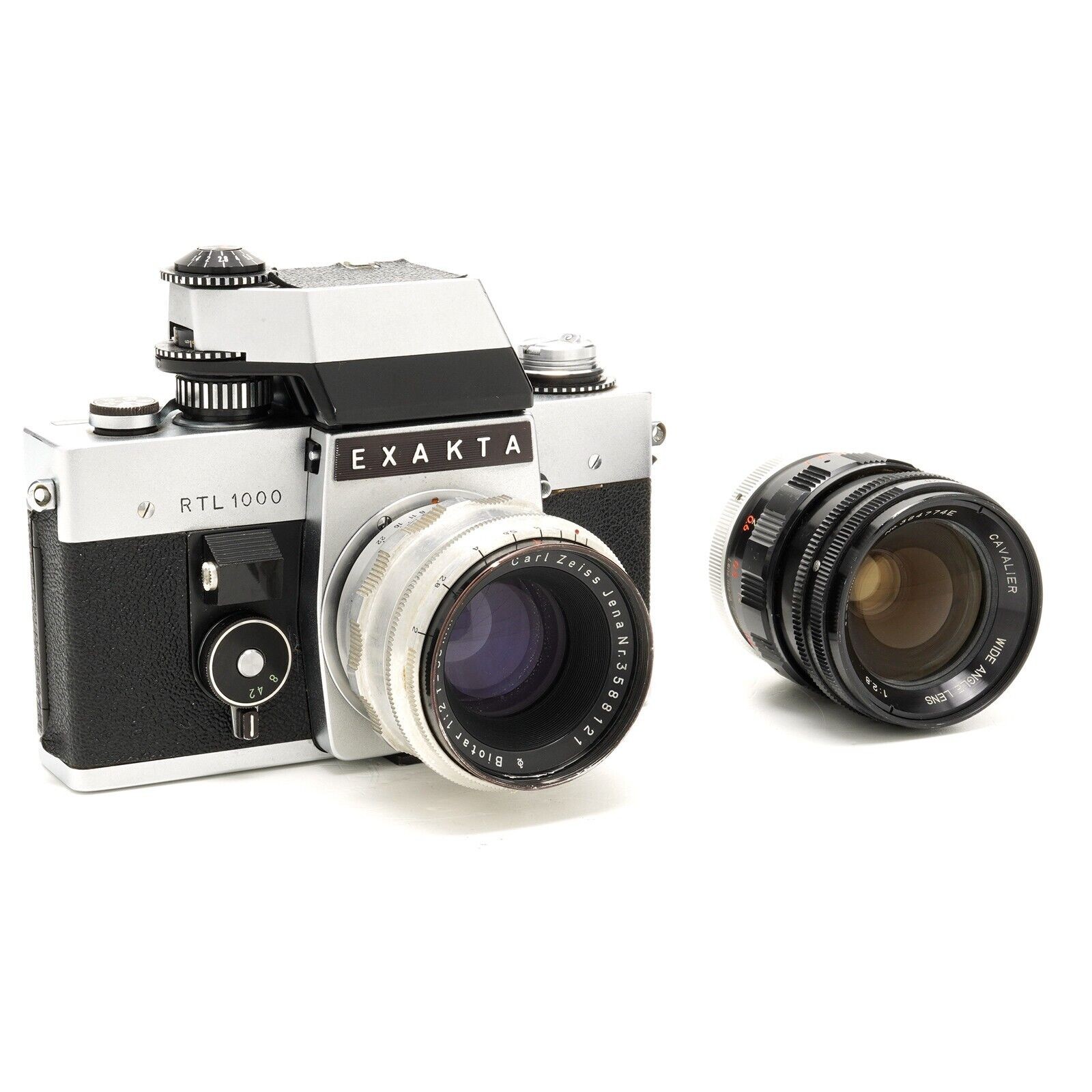
EXAKTA RTL1000
The Exakta RTL1000 is a 35mm single-lens reflex (SLR) camera produced by Ihagee Kamerawerk in East Germany between 1969 and 1973. Designed as a modernized successor to the earlier Exakta V series, the RTL1000 introduced through-the-lens (TTL) metering and a new bayonet lens mount, while retaining the brand’s reputation for robust mechanical construction and precision engineering.
Overview
The Exakta RTL1000 was introduced during a transitional period in 35mm SLR development, as manufacturers shifted from fully mechanical systems to integrated electronic metering and exposure control. Released in 1969, the RTL1000 marked Exakta’s attempt to modernize its lineup in response to increasing competition from Japanese manufacturers such as Nikon, Canon, and Pentax. It replaced the long-running Exakta V series, which had used a screw-mount lens system since the 1930s, and introduced a new bayonet mount—designated the Exakta Pentacon bayonet mount (sometimes referred to as 'Exakta bayonet' or 'Pentacon mount')—intended to support faster lens changes and improved mechanical coupling for aperture-priority automation.
Targeted at advanced amateur and semi-professional photographers, the RTL1000 featured a vertically traveling focal-plane shutter with speeds from 1 second to 1/1000 second, plus bulb mode. The RTL1000 features through-the-lens (TTL) stop-down metering using a cadmium sulfide (CdS) cell. The photographer must stop the lens down manually to meter, and exposure is indicated in the viewfinder; it does not offer aperture-priority automatic exposure or mechanical shutter speed selection.
The RTL1000 was part of Exakta’s final generation of SLRs before the brand’s decline in the face of Japanese competition. While it retained the brand’s signature top-mounted film advance lever and metal-bodied construction, it incorporated modern refinements such as an instant-return mirror, a redesigned pentaprism housing with a built-in hot shoe, and a more ergonomic grip. Despite these updates, production ceased by 1973 due to limited market penetration and the growing dominance of Japanese SLRs with more advanced electronics and broader lens ecosystems.
Specifications
| Specification | Value |
| Type | 35mm Single-Lens Reflex (SLR) |
| Film Format | 35mm (135 cartridge) |
| Years Produced | 1969–1973 |
| Lens Mount | Exakta BX bayonet mount |
| Shutter | Vertically traveling focal-plane shutter; 1 sec – 1/1000 sec + B |
| Metering | TTL stop-down CdS metering |
| Exposure Modes | Manual exposure with stop-down TTL metering |
| Viewfinder | Fixed pentaprism with microprism collar and split-image rangefinder spot; approx. 94% coverage |
| Dimensions | 148 × 95 × 55 mm; ~710 g (body only, no battery) |
Key Features
- Exakta BX Bayonet Mount: Replaced the older screw-mount system, enabling faster lens changes and mechanical coupling for aperture-priority exposure.
- TTL Full-Aperture Metering: Utilized a CdS cell for accurate exposure readings without stopping down the lens, improving viewfinder brightness and usability.
- Aperture-Priority Automation: One of the first Exakta models to offer semi-automatic exposure, where the user set the aperture and the camera selected the shutter speed.
- Interchangeable Focusing Screens: Allowed users to swap screens for different shooting needs (e.g., microprism, matte, grid).
- Praktica Mount Adapter Compatibility: Third-party adapters enabled use of Praktica M42 screw-mount lenses, significantly expanding lens options.
Historical Context
The Exakta RTL1000 was introduced during a period of rapid change in the 35mm SLR market. Japanese manufacturers were introducing increasingly sophisticated cameras with features like open-aperture metering, motorized film advance, and eventually electronic shutters. In contrast, East German camera production remained rooted in mechanical precision but lagged in electronic innovation. The RTL1000 represented Ihagee’s effort to remain competitive by integrating modern metering technology while preserving the brand’s mechanical reliability.
Despite its technical merits, the RTL1000 faced stiff competition from models like the Pentax Spotmatic (1964), which also featured TTL metering but enjoyed broader international distribution and a vast M42 lens ecosystem. The Nikon F (1959) and its successors dominated the professional market, while Canon’s FT series offered comparable automation with better export support. The RTL1000’s proprietary BX mount limited its appeal, as it lacked the extensive third-party lens support enjoyed by M42 and later Nikon F-mount systems. Additionally, political and economic constraints in East Germany hindered large-scale production and global marketing, further limiting its reach.
Collectibility & Value
Today, the Exakta RTL1000 is considered a niche collectible, valued more for its historical significance and mechanical craftsmanship than for practical use. It is relatively rare outside of Europe, particularly in North America, where Japanese SLRs dominated the market during its production run. In good condition, the RTL1000 typically sells for $75–$150 USD, with higher prices only for rare kits or mint examples with original lenses. Cameras accompanied by original lenses such as the Vambar 50mm f/1.8 or D.Zuiko 50mm f/1.4 command higher prices, especially if the lens is in excellent condition with minimal haze or fungus.
Collectors should inspect the shutter for accuracy across all speeds, as aging rubber components in the shutter mechanism can lead to inconsistent timing. The CdS metering system requires a 1.35V mercury battery (now obsolete), though modern PX625 equivalents or adapters for 1.5V alkaline batteries can be used with exposure compensation. However, CdS cells often degrade over time, leading to inaccurate readings or complete failure. The film advance mechanism and mirror movement should operate smoothly, and the light seals should be replaced to prevent light leaks. Due to the proprietary BX mount, finding native lenses can be challenging, though the availability of Praktica M42 adapters increases usability with more common screw-mount glass.
Similar Cameras
- Pentax Spotmatic (1964–1976): M42 mount, TTL metering, mechanical aperture-priority operation.
- Praktica PLC2 (1972–1975): M42 mount, TTL metering, similar target market in Eastern Europe.
- Canon FTb (1971–1976): FD mount, full-aperture metering, robust mechanical build.
- Nikon Photomic Series (e.g., Nikon F with DP-3): Professional-grade SLR with interchangeable viewfinders and TTL metering.
- Yashica TL Electro-X (1973): Electronic aperture-priority SLR with CdS metering, competing in the same semi-pro segment.
Repair & Maintenance
The Exakta RTL1000 uses a 1.35V mercury PX625 battery (not PX640) for its CdS meter. Modern equivalents include the Wein Cell MRB625 or adapters for SR625SW batteries. Without proper battery voltage, the meter will read inaccurately, typically underexposing images. The shutter is fully mechanical and does not require batteries for operation, but accurate metering is essential for correct exposure in aperture-priority mode.
Common issues include sluggish shutter speeds due to dried lubricants, sticky self-timer mechanisms, and degraded light seals leading to fogging or streaks on film. The mirror damping system may also fail over time, causing the mirror to bounce or not return smoothly. The aperture-priority linkage between the lens and camera body must be clean and properly aligned; misalignment can result in incorrect shutter speed selection.
Repair of the RTL1000 is considered moderately difficult due to the complexity of the internal metering linkage and the relative scarcity of service manuals and replacement parts. However, skilled technicians familiar with vintage German SLRs can restore functionality with careful cleaning, lubrication, and recalibration. Regular maintenance includes checking the film transport for smooth operation, verifying frame spacing, and ensuring the rewind mechanism engages properly. Given its age, a full CLA (clean, lubricate, adjust) is recommended for any RTL1000 acquired from long-term storage.
eBay Listings


As an eBay Partner, we earn from qualifying purchases. This helps support our independent vintage technology research.
Related Models
- Exakta Exakta II (1949-1950)
- Exakta Kine Exakta (1936–1949)
- Exakta Varex IIa (1960-1963)
- Exakta Varex IIb (1963-1967)
- Exakta Varex (1950–1956)
- Alpa 6 (1948-1953)
- Agfa Agfaflex
- Agfa Ambiflex
- Agfa Easy
- Agfa Futura Af zoom