Elmo Super 110 (1972–1975)
That first heft in your hands tells you this isn’t a toy — it’s a precision tool wrapped in brushed metal, with a zoom lens that still turns heads.
Overview
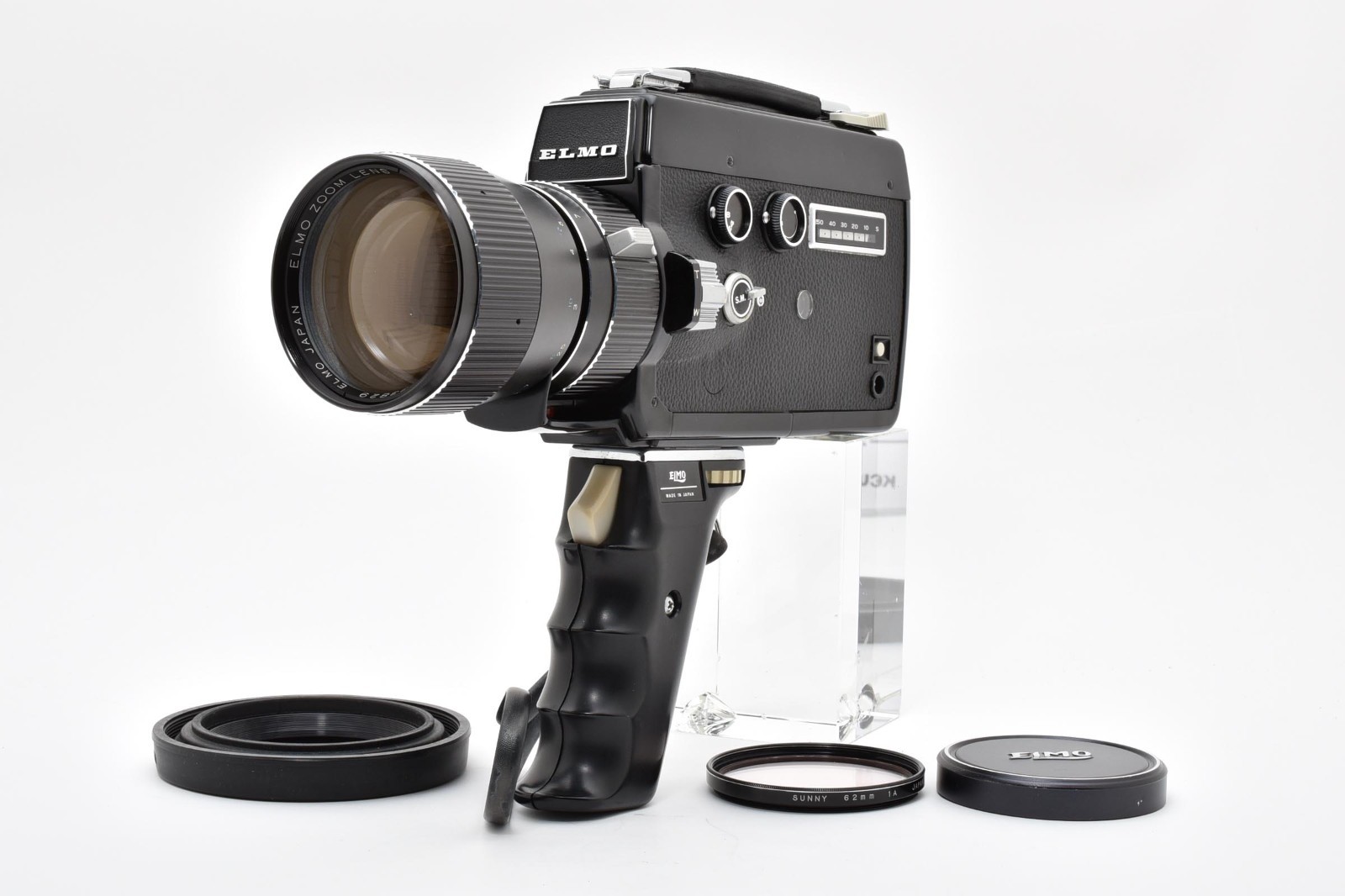
The Elmo Super 110 doesn’t announce itself with flash or gimmicks. It just sits there, dense and deliberate, like a piece of lab equipment that wandered onto a film set. Weighing in at 1.35kg, it’s built from solid aluminium — a far cry from the plastic-bodied Super 8s that flooded the market in the late '70s. This was Elmo’s top-of-the-range Super-8 camera, built for shooters who wanted serious control without stepping into professional 16mm territory. And it shows: from the smooth single-lens reflex viewfinder to the f/1.8 zoom lens that pulls in crisp, contrasty images with a richness modern digital often struggles to mimic.
Marketed between 1972 and 1975, the Super 110 arrived when most home movie cameras were still stuck on 18fps, automatic-only exposure, and fixed lenses. Not this one. It gives you 24fps — the cinematic standard — plus 54fps for slow motion, manual exposure, and a 10x power zoom that motors from 7mm to 70mm in about 7.5 seconds. That lens, the Elmo Zoom f/1.8 / 7–70mm, is the star. Owners rave about its sharpness, color saturation, and low-light performance, especially considering it’s a variable-aperture zoom from the '70s. It’s not just functional — it’s expressive.
And unlike many so-called “silent” Super 8 cameras that whine like dentist drills, a properly serviced Super 110 runs remarkably smooth and quiet, thanks to its DC micromotor. That makes it one of the few silent 8s you could realistically use for sync-sound experiments — even if the standard 110 lacks a dedicated audio socket (that’s the job of the rare 110R variant). It was sold in the USA by Honeywell Photographic Products, which gave it a quiet presence in American homes, though it never achieved the mass recognition of a Canon or Kodak. But among those who knew, it earned respect — the kind that lingers in forums decades later with comments like, “The pictures I get with this camera exceed all my other S8 cameras.”
Specifications
| Manufacturer | Elmo, made in Japan |
| Weight | 1350 g / approx. 1.35kg |
| Lens | Elmo Zoom 1,8 / 7 - 70 mm |
| Zooming ratio | 10x |
| Filter thread / size | 62mm |
| Focusing | manual, Split Image Focusing / micro split image, 1.5 m to infinity |
| Macro focusing | to 14cm from lens / from 0.014 m to 1.5 m |
| Zoom | Auto / Manual (Auto zoom: approx 7.5 sec from 70-7mm or 7-70mm) |
| Frame rates / Filming speed | 18, 24, 54 + single frame |
| Shutter opening angle | 160 degrees |
| Exposure | Manual / Auto; TTL EE, CdS cell |
| Film speed / ASA (daylight) | 25,40,64,100,160 / auto between 25/40 and 160/250 ASA (daylight/tungsten) |
| ASA (tungsten) | 40, 64, 100, 160, 250 |
| CCA filter | built-in 85A filter, coupled with movie light |
| Viewfinder | single-lens reflex with adjustable eyepiece: +1 to -3 diopters |
| Viewfinder information | f/stop indicator, film transport indicator, film-end indicator, battery check indicator |
| Remote control socket | Yes |
| Cable release socket(s) | Yes / 2, single frame and continuous running |
| Movie light socket | Elmo type, with CCA filter key |
| Film counter | 1-15 m / yes |
| Handle | detachable |
| Film drive motor | DC micromotor |
| Battery check button | yes |
| Power source | 4 x AA batteries |
| External power outlet | 6 V DC |
| Dimensions | approx. 25.8cm x 11cm x 8.2cm / 82 x 110 x 258 mm |
| Tripos socket | 1/4" |
| Sound | No sound |
Key Features
The Lens That Does It All
The Elmo Zoom f/1.8 / 7–70mm isn’t just a spec — it’s the soul of this camera. A 10x zoom with a fast f/1.8 aperture at the wide end was no small feat in the early '70s, especially in a consumer-grade Super 8 body. It’s a power zoom, meaning you can trigger smooth transitions with a lever, or dial it manually for precision. The 62mm filter thread opens up creative options, and the macro range lets you focus as close as 14cm — rare for a zoom of this era. Owners consistently report sharp, saturated images, with a contrasty punch that scans beautifully today. This lens alone is why many filmmakers still seek out the Super 110, even when simpler cameras might be easier to operate.
Through-the-Lens Metering Without the Bloat
Back when many cameras still relied on external light meters or basic CdS cells, the Super 110 offered TTL (Through-the-Lens) EE metering — and did it without needing a separate battery for the metering circuit. That’s because Elmo used integrated circuits (ICs) to streamline power use, a smart design choice that reduced complexity. You set your film speed (from 25 to 250 ASA, depending on lighting), and the camera adjusts exposure accordingly, with manual override if you want full control. It’s a system that feels modern in its flexibility, though some users note the meter can be “a bit jumpy,” especially when locked — a quirk to watch for when shooting in critical light.
Built Like a Tool, Balanced Like a Weapon
This is a camera that announces its quality before you even turn it on. The all-metal construction, compact dimensions (25.8 x 11 x 8.2 cm), and 1.35kg weight make it feel substantial without being unwieldy. The detachable pistol grip adds handheld comfort, though it’s often cited as the camera’s weakest point — “flimsy” is the word that comes up. Ironically, removing it reveals a well-balanced core body that pairs beautifully with stabilizers like the Steadicam Jr., a trick some filmmakers still use today. The oversized film gate is another hidden asset, especially for those doing their own telecine — it reduces edge artifacts and improves scan quality.
Viewfinder and Usability
The single-lens reflex (SLR) viewfinder is a joy — what you see is exactly what you get, with no parallax error. It includes an adjustable eyepiece (+1 to -3 diopters), so you can fine-tune focus without glasses. Critical info like f-stop, film transport status, end-of-reel warning, and battery check are all visible in the finder, so you don’t have to look away mid-shot. A window on the side lets you confirm film type, and rotating arrows show film movement — small touches that speak to thoughtful design. The 160-degree shutter angle provides a natural motion blur at 24fps, and the three-speed motor (18, 24, 54fps) plus single-frame mode gives real creative range.
Historical Context
The Elmo Super 110 landed in a market where most Super 8 cameras were marketed as easy-to-use home movie gadgets — automatic exposure, fixed lenses, no 24fps option. The Super 110 was different. It was positioned as a top-of-the-range tool for serious shooters, the kind who cared about frame rates, manual exposure, and lens quality. While its fit and finish was quite good, it wasn’t quite on par with the best European models — but it offered more features than most, at a price of £210 in England at introduction. Sold in the USA by Honeywell Photographic Products, it flew under the radar compared to Canon or Nizo, but it earned a quiet reputation among those who valued performance over branding.
Collectibility & Value
The Elmo Super 110 is underrated in the vintage camera market — a sleeper hit. One owner reported picking one up for just 5 EUR years ago, though those days are likely gone. A fully accessorized example with original case recently sold for 100€, and according to 2024 observations, CLA’d (cleaned, lubricated, adjusted), film-tested units now start around 300–400 Euro on eBay and Etsy. That’s still reasonable for a camera of this quality, especially when you consider the lens. The main concerns for buyers are the condition of the pistol grip (prone to cracking) and the light meter’s stability — some report it shifts when the motor starts. There’s no public data on common electronic or mechanical failures, but owners agree: a serviced Super 110 runs smooth and quiet, a hallmark of its engineering. If you’re scanning your films, the oversized film gate is an unsung bonus. It’s not the rarest Super 8, but it might be one of the most capable.
eBay Listings



As an eBay Partner, we earn from qualifying purchases. This helps support our independent vintage technology research.
Service Manuals, Schematics & Catalogs
Related Models
- Elmo 612S-XL (1978)
- Elmo Super 110R (1977)
- Arriflex 16 BL (1965)
- Arriflex 16 SR (1975)
- Arriflex 16 ST (1952)
- Arriflex 35 BL (1972)
- Arriflex 35 IIC (1964)
- Beaulieu 4008 ZM II (1977)
- Beaulieu 5008 S (1976)
- Bell & Howell 134 (1940)