Elmo 612S-XL (1978)
That rare Super 8 camera that could shoot in near-darkness and still record sound — if you don’t mind the whirring zoom and a belt that’s probably already cracked.
Overview
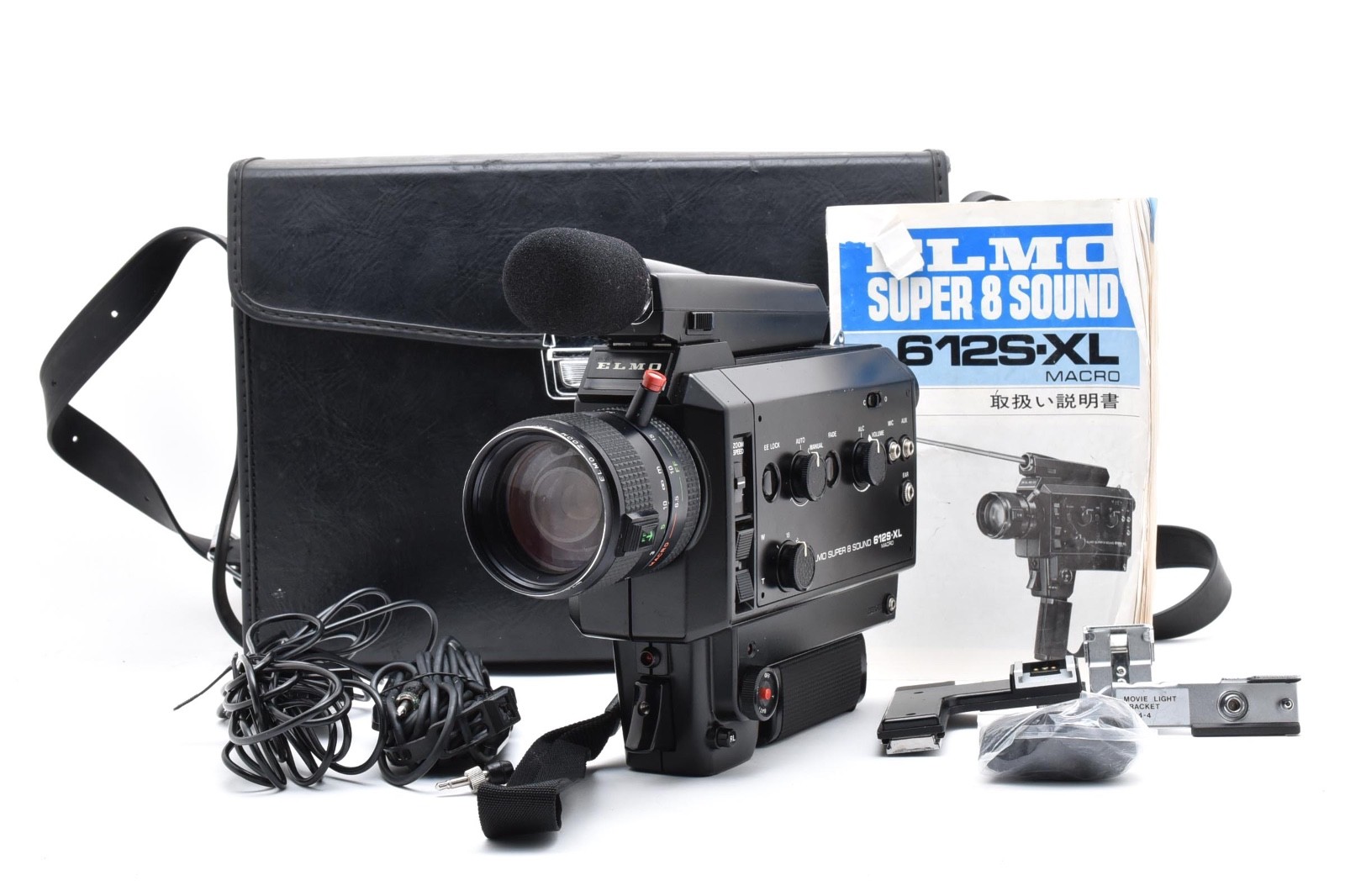
The Elmo 612S-XL Macro Super 8 Camera landed in 1978 with a quiet confidence that belied its feature set. It wasn’t flashy like some of the plastic-bodied Super 8 toys of the era — aimed at serious hobbyists and educators who wanted more control without stepping into the pro 16mm world. At 1800 grams, it’s hefty in the hand, but that weight speaks to its build: all-metal construction, precise mechanics, and a lens system that could pull in detail even when the lights were low. It was positioned as the baby brother to the more advanced Elmo 1012S-XL, but don’t let that label fool you — the 612S-XL was no stripped-down sibling. It packed in TTL metering, motorized servo zoom, split-image focusing, and even macro capabilities, all while recording sound directly to the film’s magnetic strip.
For its time, this was a lot of camera. Owners report it offered a ton of features for a consumer-level Super 8 movie camera — features that were often reserved for pricier models or professional rigs. It handled Super 8mm cartridges, which made loading a breeze compared to the threading nightmares of 16mm, and its 4:3 aspect ratio matched the TVs of the day. The camera ran on six AA batteries, a practical choice for field use, though battery life remains undocumented. What it lacked in portability, it made up for in capability — especially in low light. With a maximum aperture of f/1.2 on its Elmo zoom lens, it could gather light like few others in the format. That lens, an 8.5–51mm f/1.2, gave a useful range for both tight shots and wider scenes, and the split-image focusing screen made manual focus surprisingly accurate. Add in macro focusing, and you’ve got a tool that could handle everything from birthday parties to classroom demonstrations.
But it wasn’t perfect. The motorized zoom, while advanced, was loud — a constant mechanical hum that often crept into the audio track. And the sound quality? By today’s standards, it’s scratchy and noisy, with the film transport and shutter sounds clearly audible on playback. Still, for 1978, having synchronized sound at all in a consumer camera was a big deal. The 612S-XL included mic and auxiliary inputs, a headphone output for monitoring, and a built-in 85A CCA filter with a daylight/tungsten switch — simple white balance control that let you adapt to different lighting conditions. It also had TTL auto and manual exposure, a backlight compensation button, and auto fade-in/fade-out, which was a nice touch for amateur filmmakers who wanted polished transitions without external editing.
Specifications
| Manufacturer | Elmo |
| Product type | Super 8mm film camera |
| Production years | First released in 1978 |
| Weight | 1800 g |
| Shooting speeds | 18 fps, 24 fps, single frame |
| Lens maximum aperture | f/1.2 |
| Lens | Elmo zoom 1:1.2 / 8.5 – 51 mm |
| Film format | Super 8mm |
| Aspect ratio | 4:3 |
| Focusing | Split image focusing, Macro Focusing |
| Zooming | motorized servo zoom with auto (2 speeds) and manual control |
| Exposure | TTL auto and manual exposure control |
| Backlight control button | yes |
| Film speed | auto for 25/40 and 100/160 ASA (daylight/tungsten) |
| CCA filter | built-in 85A filter, with filter selector |
| Shutter opening angle | 220 degrees |
| Fading | auto fade-in/fade-out |
| Self-timer | yes |
| Remote control socket | yes |
| Cable release socket | yes |
| Flash shoe | yes |
| Power source | 6 x AA batteries |
| Dimensions | 70 x 247 x 278 mm (WxHxD) |
| Tripod socket | 1/4" |
| Origin | Made in Japan |
Key Features
Sound Recording & Audio Control
The 612S-XL records sound directly to the magnetic strip on Super 8 film, a feature that elevated it above many silent-only consumer models. While the audio quality is now considered scratchy and noisy — with clear presence of film transport and shutter noise — it was a significant convenience for users who wanted synchronized sound without post-production hassle. The inclusion of mic and auxiliary inputs allowed for external microphones or line-level sources, and the headphone output made real-time monitoring possible, a rarity at this level. The tungsten/daylight switch worked in tandem with the built-in 85A filter to adjust color balance, offering a basic but effective form of white balance control.
Zoom & Focus System
Motorized servo zoom was a standout feature, offering both automatic control at two speeds and manual override. But that convenience came at a cost: the zoom motor is loud, and its noise often bled into recordings, especially in quiet environments. The lens itself, an Elmo 8.5–51mm f/1.2 zoom, was fast and flexible, though not as long-ranged as the conflicting 7.5–75mm f/1.1 spec sometimes cited — the 8.5–51mm f/1.2 is the more consistently documented version. Focus was handled via a split-image rangefinder screen, which made manual focusing precise, and the macro focusing capability allowed for close-up work, expanding its utility beyond typical home movies.
Exposure & Operation
TTL (through-the-lens) auto exposure gave reliable results in most lighting conditions, and manual exposure was available for more control. The camera automatically adjusted for film speeds of ISO 25/40 (daylight) and 100/160 (tungsten), simplifying setup. A backlight compensation button helped in high-contrast scenes, and the 220-degree shutter angle provided a natural motion blur at 18 and 24 fps. Auto fade-in and fade-out were built-in effects, handy for beginners, and the self-timer, remote socket, and cable release socket added flexibility for solo shooters. The flash shoe allowed for still photography-style lighting, though flash sync details are not documented.
Drive Mechanism & Reliability
The camera uses a belt-driven mechanism, including a “trigger belt” that’s critical to motor operation. This is also its Achilles’ heel: a common failure point is a worn or broken trigger belt, which prevents the motor from running. Replacement belts exist, but sourcing and installing them requires technical patience. The drive system’s reliance on belts means that even well-preserved units may need servicing after decades of inactivity. Owners are advised to check for belt integrity before purchase — a non-working motor is often not a death sentence, just a repair bill.
Collectibility & Value
The Elmo 612S-XL trades in a wide price range: listings show examples from $86 to $299.95, depending on condition and completeness. A used unit at Kamerastore was listed for $86, but noted issues like “heavy internal haze” in the lens and missing screws — common cosmetic and optical flaws in aging cameras. The presence of a 43-page English user manual (available through Van Eck Video Services) is a plus for new owners, offering guidance on operation and basic maintenance. Collectors value this model for its low-light performance and robust feature set, but its appeal is niche. It’s not a flashy name like Super 8 Canon or Nizo, but it’s respected among those who’ve used it. The real cost of ownership often comes after purchase: belt replacements, cleaning, and lens haze mitigation can add up. Still, for under $100, a working unit is a functional piece of 1970s filmmaking tech that can produce images with more texture and depth than early video ever could.
eBay Listings


As an eBay Partner, we earn from qualifying purchases. This helps support our independent vintage technology research.
Service Manuals, Schematics & Catalogs
- Catalog — archive.org
Related Models
- Elmo Super 110 (1975)
- Elmo Super 110R (1977)
- Arriflex 16 BL (1965)
- Arriflex 16 SR (1975)
- Arriflex 16 ST (1952)
- Arriflex 35 BL (1972)
- Arriflex 35 IIC (1964)
- Beaulieu 4008 ZM II (1977)
- Beaulieu 5008 S (1976)
- Bell & Howell 134 (1940)