CONTAX AX
The Contax AX is a technologically advanced 35mm single-lens reflex (SLR) camera introduced in 1996 as a bold innovation in autofocus design. Unlike conventional SLRs that autofocus by moving lens elements, the AX achieves focus by shifting the film plane itself, enabling autofocus compatibility with manual-focus lenses.
Overview
Released during a period of rapid transition in camera technology, the Contax AX was positioned as a high-end, niche SLR aimed at professional photographers and advanced enthusiasts who valued precision engineering and optical excellence. Manufactured by Kyocera, which owned the Contax brand at the time, the AX was part of a broader line of premium Contax SLRs that included the successful RTS and S-series models. However, the AX stood apart due to its radical autofocus mechanism, which sought to solve a persistent limitation in SLR design: the inability to autofocus with legacy or manual-focus lenses.
The AX was designed to work seamlessly with the full range of Contax/Yashica (C/Y) mount lenses, including classic Zeiss optics, many of which lacked built-in focusing motors. Instead of modifying the lenses—a costly and impractical solution—Contax engineers rethought the camera body itself. By implementing a movable film plane that adjusts position to achieve focus, the AX could autofocus any C/Y lens, regardless of whether it was originally designed for manual focus. This system, known as the "Film Plane Autofocus System," relied on a contrast-detection mechanism using a secondary sensor to analyze image sharpness at the film plane, adjusting the film holder accordingly.
Despite its innovative engineering, the AX was not widely adopted. Its complexity, high price point (approximately $1,700 at launch), and the growing dominance of Nikon and Canon autofocus systems limited its market penetration. Nevertheless, the AX remains a landmark in camera design, representing one of the most ambitious attempts to bridge the gap between manual and autofocus photography without compromising lens compatibility.
Specifications
| Specification | Value |
| Type | 35mm Single-Lens Reflex (SLR) |
| Film Format | 35mm (135 film) |
| Years Produced | 1996–2005 |
| Lens Mount | Contax/Yashica (C/Y) bayonet mount |
| Shutter | Vertical-travel, focal-plane shutter; speeds from 16 min to 1/8000 sec, plus B |
| Metering | TTL full-aperture metering with 16-segment evaluative, center-weighted, and spot modes |
| Exposure Modes | Program AE, Shutter Priority, Aperture Priority, Manual, and Depth-of-Field AE |
| Viewfinder | Fixed pentaprism with 94% coverage and 0.85x magnification; interchangeable focusing screens |
| Dimensions | 148 × 95 × 65 mm (5.8 × 3.7 × 2.6 in); ~740 g (26 oz) body only |
Key Features
- Film Plane Autofocus System: The AX is the only production SLR to autofocus by moving the film plane rather than lens elements, enabling AF with any C/Y mount lens, including vintage manual-focus designs.
- Manual Lens AF Capability: Unique among SLRs, it can autofocus non-AF lenses by analyzing image contrast and adjusting the film plane position via a precision stepper motor.
- Interchangeable Focusing Screens: Offers 11 different screen types for specialized applications, including microprism, split-image, and grid options.
- Depth-of-Field AE Mode: Automatically calculates and sets exposure based on desired depth of field, useful for macro and portrait work.
- TTL Flash Metering: Fully supports Contax TLA-series flash units with advanced TTL balanced fill-flash and wireless multi-flash control.
Historical Context
The Contax AX was launched in 1996 at a time when autofocus SLRs had become the industry standard, dominated by systems from Canon (EOS), Nikon (F-mount AF), and Minolta. These systems relied on integrated autofocus motors in lenses, rendering older manual-focus lenses incompatible with AF without adapters—many of which compromised optical performance or functionality. Contax, known for its collaboration with Carl Zeiss and commitment to optical quality, sought a solution that would preserve access to its extensive library of high-performance manual-focus lenses while embracing autofocus technology.
The AX was the result of over a decade of research, building on concepts explored in the earlier Contax RTS III and prototypes like the AX-1. Its film-plane autofocus system was a radical departure from convention, requiring precise coordination between the camera’s metering system, film transport mechanism, and focus detection. While technically successful, the system had limitations: autofocus was relatively slow (especially in low light), and continuous AF was not supported. Additionally, the moving film plane introduced potential alignment issues, and the camera required meticulous calibration.
Market reception was mixed. Professional photographers appreciated the optical flexibility and build quality, but many were hesitant to adopt a system so divergent from mainstream offerings. The AX also faced internal competition from the Contax RX (a more conventional AF SLR) and the emerging Contax G-series rangefinders. By the early 2000s, as digital SLRs gained momentum, Kyocera shifted focus away from 35mm systems, and the AX was discontinued in 2005 without a direct successor.
Collectibility & Value
Today, the Contax AX is a sought-after collector’s item due to its rarity, innovative design, and association with Zeiss optics. Fewer than 20,000 units were produced during its nine-year production run, making it one of the rarest high-end Contax SLRs. In the used market, the AX typically sells for $800–$1,500, depending on condition, included accessories, and provenance. Fully functional units with original boxes and manuals command premium prices, especially in Japan and Europe where Contax retains a strong enthusiast following.
When purchasing an AX, collectors should verify that the film-plane autofocus system operates correctly, as the stepper motor and film transport mechanism are prone to wear or misalignment after prolonged disuse. Common issues include sluggish autofocus response, film plane calibration errors, and shutter timing inconsistencies. Because the camera relies on a complex array of sensors and microprocessors, it is sensitive to moisture and requires periodic servicing by specialists familiar with Contax electronics. Original batteries (two CR123A) are readily available, but the internal backup battery (for memory retention) may need replacement in older units.
Similar Cameras
- Minolta Maxxum 7000: Pioneered integrated autofocus in SLRs (1985), but limited to AF lenses.
- Pentax ME-F: Early attempt at AF SLR (1981), used motorized lenses with limited compatibility.
- Nikon F5: Professional-grade AF SLR (1996) with advanced metering and build quality.
- Canon EOS-1V: Last of Canon’s film flagship line (2000), offering high-speed AF and durability.
- Leica R8: High-end manual-focus SLR (1996) with electronic automation and precision engineering.
Repair & Maintenance
The Contax AX uses two CR123A lithium batteries for primary power and a CR1/3N lithium cell as a backup to retain user settings and autofocus calibration. Battery life is approximately 50 rolls of film under normal use. Due to its reliance on electronic calibration for the film-plane AF system, the camera should not be left without power for extended periods to avoid loss of focus alignment.
Common maintenance issues include degradation of the rubberized grip, wear in the film advance mechanism, and sensor dust affecting the AF system. The film-plane actuator is particularly sensitive and may require realignment if the camera is dropped or improperly stored. Repair is challenging due to the scarcity of service centers trained on Contax film bodies, especially outside Japan and Germany. Enthusiasts recommend sourcing serviced units from reputable camera technicians specializing in Contax or Zeiss equipment. Regular use and storage in a dry, temperature-stable environment are essential to preserving functionality.
eBay Listings

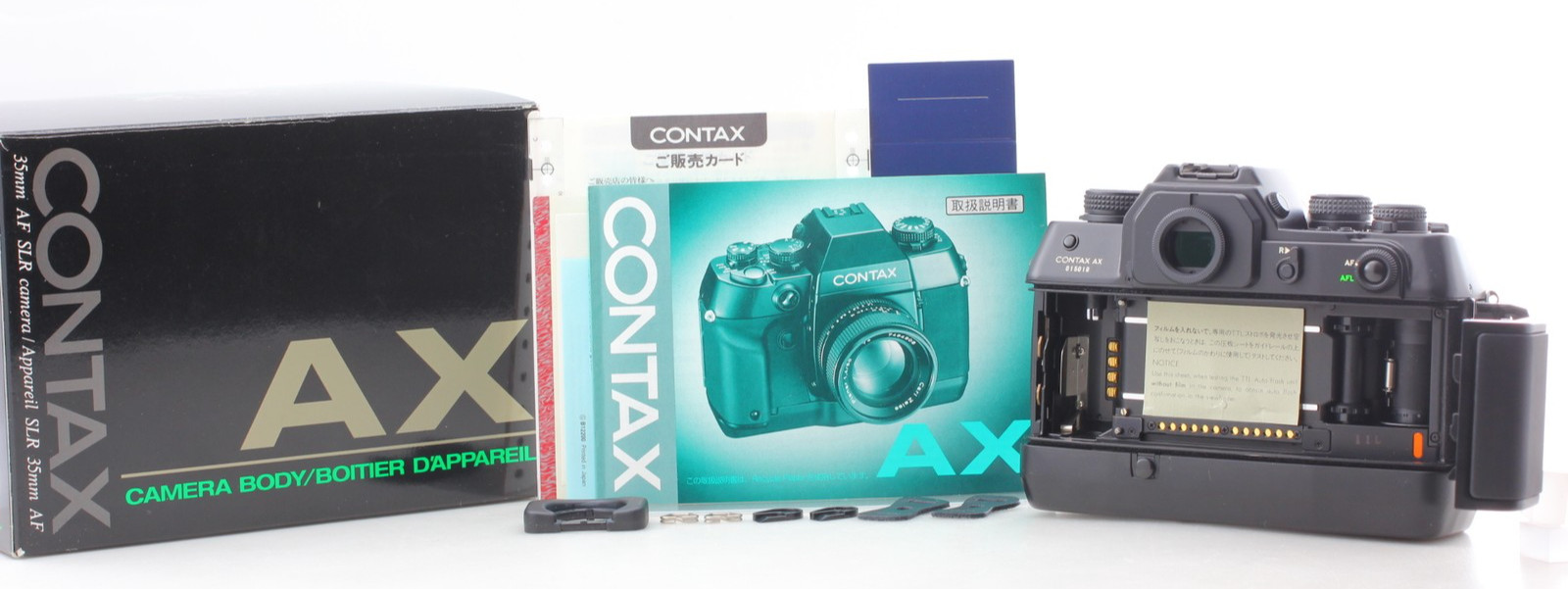


As an eBay Partner, we earn from qualifying purchases. This helps support our independent vintage technology research.
Related Models
- Contax 137 MA (1981-1984)
- Contax 137 MD (1980-1984)
- Contax 139 Quartz (1979-1985)
- Contax RTS II (1982–1990)
- Contax RTS (1975-1982)
- Alpa 6 (1948-1953)
- Agfa Agfaflex
- Agfa Ambiflex
- Agfa Easy
- Agfa Futura Af zoom