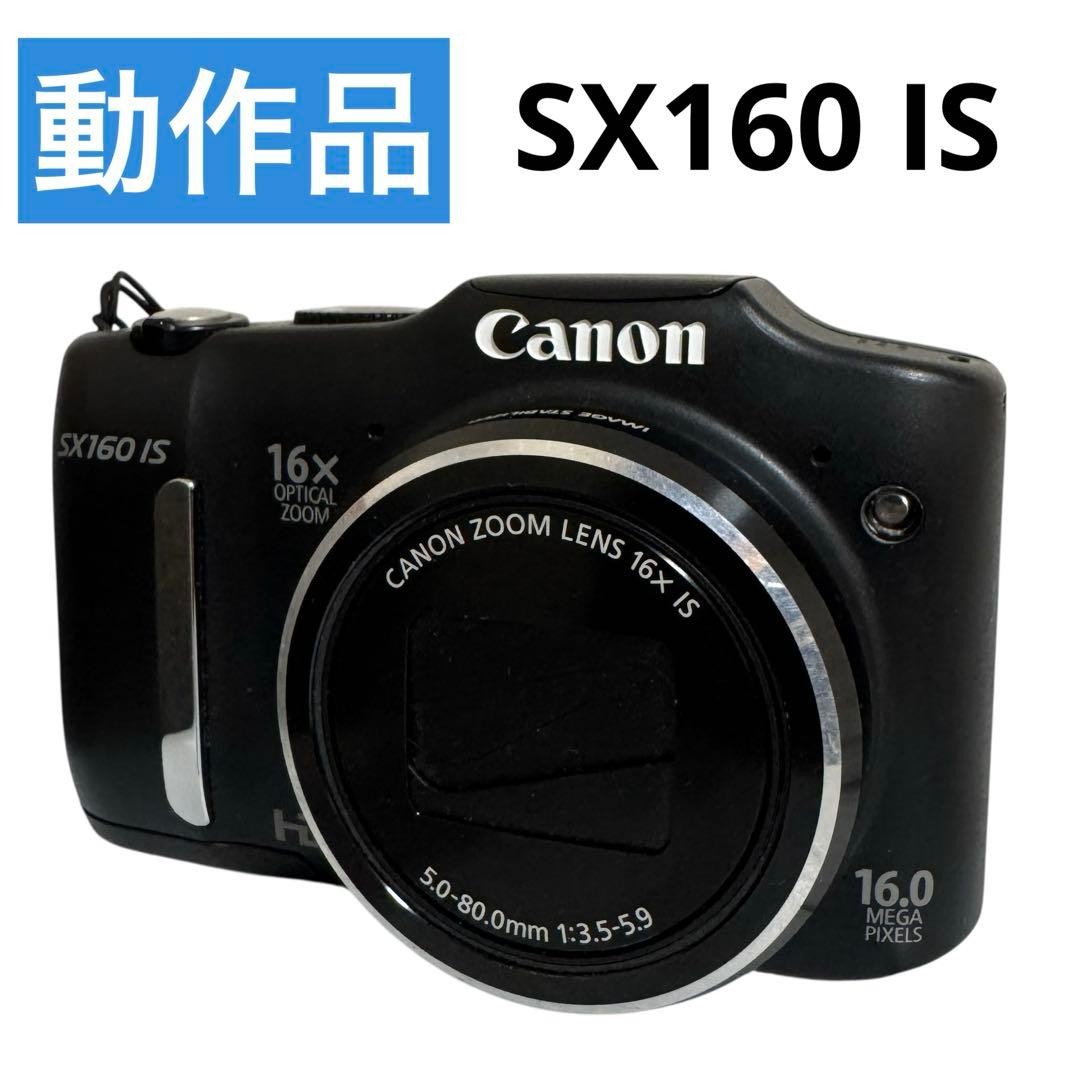
Canon PowerShot SX160 IS
At 328 grams with batteries, it slips into a jacket pocket like a thick wallet—ready for a 16x zoom leap into distant scenes.
Overview
The Canon PowerShot SX160 IS isn’t a rare bird, but it’s a familiar face in the world of early-2010s superzoom compacts—built for travelers and beginners who wanted reach without complexity. Marketed as an affordable bridge between point-and-shoot simplicity and serious zoom power, it hit shelves around September 2012 with a price tag of $229.99. It wasn’t chasing pro specs, but rather offering a practical, pocketable tool with a standout 28–448mm equivalent lens in a body that remained one of the smallest in its class. Owners report it delivers exactly what it promises: a long optical zoom, basic manual controls, and HD video, all powered by widely available AA batteries.
This is a camera defined by compromise, but not embarrassment. The 1/2.3-inch CCD sensor and 16.0-megapixel resolution were standard for its tier, and while low-light performance at ISO 1600 shows expected noise, the DIGIC 4 processor keeps things functional. The 3.0-inch LCD, with approximately 230,000 dots, isn’t sharp by modern standards, but it served well enough for framing and playback in daylight. What stands out is the lens: a 16x optical zoom with optical image stabilization, making handheld shooting at full telephoto actually viable. For casual photographers in the early 2010s, that was a compelling proposition.
It wasn’t a leap forward in autofocus technology—relying on a contrast-detection system without eye or subject tracking—but it worked reliably for static and slow-moving subjects. Video recording topped out at 1280 x 720 resolution at 25 fps, solidly HD but not full 1080p, and iFrame support allowed for easier editing on Mac systems. The use of AA batteries—alkaline or Ni-MH—was both a convenience and a limitation. While users could swap in fresh batteries anywhere, alkaline life was modest at around 150 shots; Ni-MH doubled that, making rechargeables the smarter choice for extended outings.
Specifications
| Manufacturer | Canon |
| Product type | Digital compact camera |
| Image sensor | 1/2.3-inch CCD |
| Effective pixels | Approx. 16.0 million |
| Lens | 16x Optical Zoom, 28–448mm (35mm equivalent) |
| Lens | f/3.5 (W) – f/5.9 (T) |
| Optical Image Stabilizer | Yes |
| DIGIC 4 Image Processor | Yes |
| ISO speed | AUTO, 100, 200, 400, 800, 1600 |
| LCD monitor | 3.0-inch TFT color LCD with approx. 230,000 dots |
| Movie | 1280 x 720 (HD) at 25 fps |
| Movie | 640 x 480 (SD) at 30 fps |
| Movie | iFrame Movie supported |
| Battery | 2x AA-size Alkaline or Ni-MH Batteries |
| Battery life (CIPA) | Approx. 150 shots with alkaline batteries |
| Battery life (CIPA) | Approx. 330 shots with Ni-MH batteries |
| Dimensions (W x H x D) | Approx. 4.45 x 3.07 x 2.97 in. / 113.0 x 78.0 x 75.5mm |
| Weight (including batteries and memory card) | Approx. 11.57 oz. / 328g |
| Minimum shutter speed | 15 sec |
| Maximum shutter speed | 1/3200 sec |
| Autofocus system | contrast detection autofocus system |
Key Features
16x Optical Zoom with 28–448mm Reach
The heart of the SX160 IS is its lens. That 16x optical zoom, spanning from a useful 28mm wide-angle to a dramatic 448mm telephoto, gave casual shooters a level of flexibility rarely seen in such a compact body. It wasn’t just about magnification—the optical image stabilization made that full range actually usable, reducing blur from hand shake. For travel, wildlife, or sports from the sidelines, this zoom range meant fewer lens changes and more spontaneity. The f/3.5–f/5.9 aperture wasn’t wide, but it was typical for superzooms of the era, trading speed for reach.
Compact Superzoom Form Factor
Despite its long lens, the SX160 IS was noted as one of the smallest cameras in its category. At just over 3 inches deep and under 12 ounces with batteries, it remained pocketable in a way many zoom-heavy compacts weren’t. The design favored function—chunky grip, straightforward button layout, lens barrel that extends smoothly—without flash or flair. Available in red, black, and white, it had a consumer-friendly look, but the build was mostly plastic, which kept weight down but didn’t inspire ruggedness.
AA Battery Power System
Using two AA batteries was a double-edged sword. On one hand, it eliminated the need for proprietary chargers—users could grab alkalines at any convenience store. On the other, alkaline life was poor, with CIPA ratings suggesting only about 150 shots. Ni-MH rechargeables nearly doubled that, making them essential for serious use. The battery door itself has been reported as a weak point, with some units developing closure issues over time. Still, the convenience of universal power sources remains a plus for collectors or travelers who value simplicity.
HD Video with iFrame Support
The camera captured 720p HD video at 25 fps, along with standard definition options. While not cutting-edge by 2012 standards—many competitors offered 1080p—it was sufficient for web sharing and casual viewing. The inclusion of iFrame Movie support was a subtle but thoughtful touch, allowing direct importing into iMovie on Macs without transcoding. This made it a modestly prosumer-friendly feature for Apple users, streamlining the editing workflow for home movies or travel clips.
Historical Context
The PowerShot SX160 IS followed the PowerShot SX150 IS, released in September 2011, and was positioned as an incremental upgrade with improved zoom performance. It arrived during a transitional period for digital cameras, as smartphones began to erode the low-end market. Canon targeted budget-conscious beginners and travelers, emphasizing its zoom range and ease of use. Reviews at the time called it a “good, inexpensive travel” camera and a “good choice for beginners on a budget,” acknowledging its limitations while appreciating its value.
Collectibility & Value
Today, the Canon PowerShot SX160 IS is not a sought-after collectible, but it remains functional and accessible. Used units have sold for as low as €30.98, while auction listings show bids reaching $73.00. It’s not a high-value item, but its utility keeps it in circulation. Common failures include the lens failing to extend or retract, non-responsive or grainy LCDs, and battery door issues. Repair guides are available, particularly through iFixit, making it a candidate for DIY restoration. Owners still report success with used units, noting they “still work” and remain “beautiful” in design and output for casual use.
eBay Listings
As an eBay Partner, we earn from qualifying purchases. This helps support our independent vintage technology research.