Canon Canonet Junior (1963)
A simplified, auto-exposure rangefinder camera introduced as the more accessible sibling to the original Canonet.
Overview
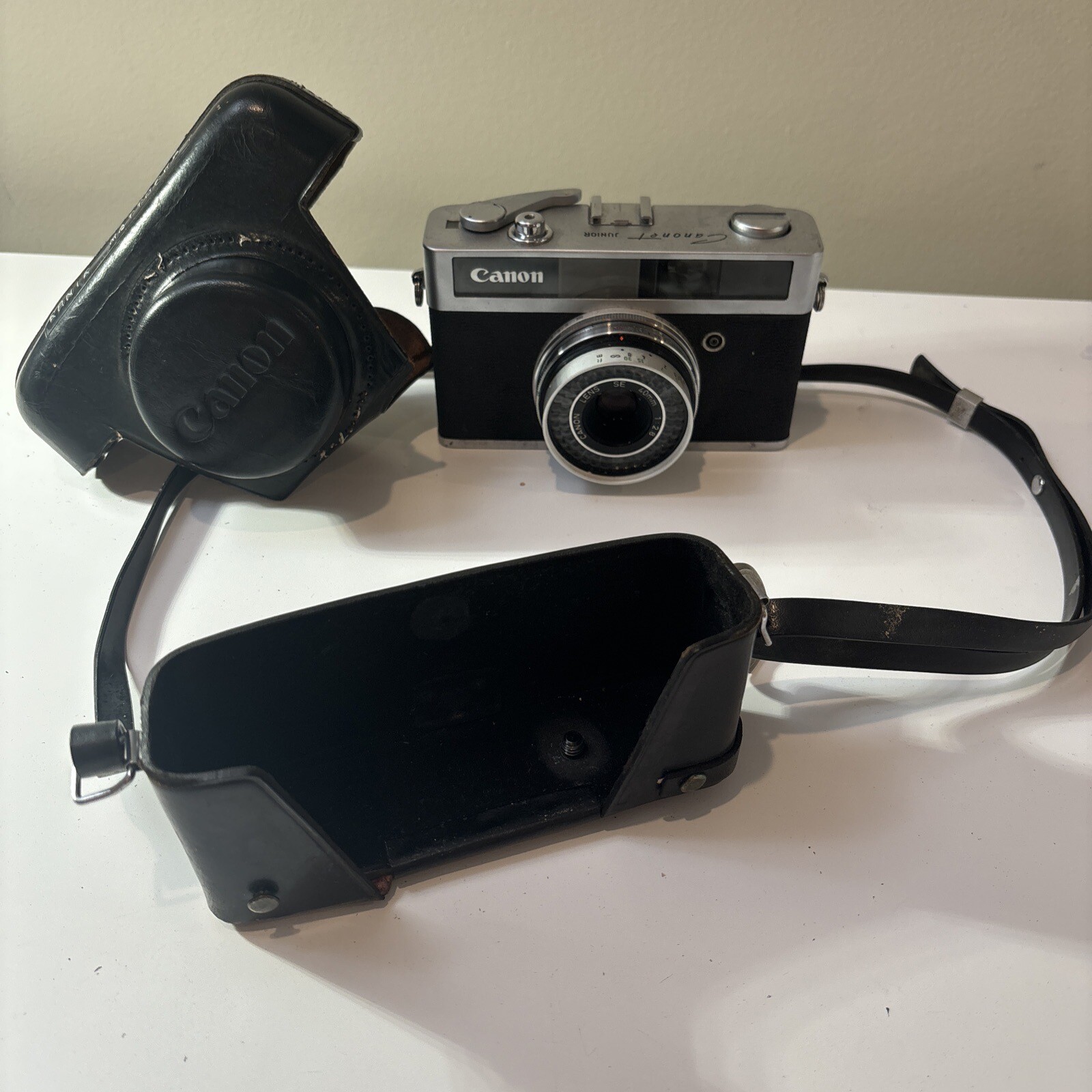
The Canon Canonet Junior is a rangefinder camera released by Canon in April 1963, two years after the original Canonet. Though part of the Canonet series, it lacks a coupled rangefinder, instead relying on zone focusing with preset distance settings. Designed for ease of use, it targets entry-level photographers with automatic exposure features uncommon at the time. The viewfinder displays focus symbols for common shooting scenarios—mountains, groups, or portraits—along with a meter needle showing the camera-selected shutter speed. Despite its simplified operation, it retains a solid build, feeling heavy for its compact size, and was marketed as "The Simpler More Automatic Canonet."
Specifications
| Lens | 40mm f/2.8 optic |
| Film speed range | ASA 10 to 200 |
| Shutter | Made by Seikosha |
| Weight | About 60 grams less than the Canonet (comparative only) |
| Dimensions | Slightly smaller and a little thinner than the Canonet (comparative only) |
| Viewfinder | Shows focus setting symbols for Mountains, a group of people, or a single person's head and shoulders. At the bottom is a meter needle indicating the shutter speed selected by the camera. |
| Focusing | Zone focusing using a distance scale on the lens, with detents at useful distances. No rangefinder or split image confirmation. |
| Exposure modes | In Auto setting, both aperture and shutter speed are automatically set. Off Automatic, only the aperture can be set. The camera works in manual or aperture priority mode. Shutter speed is selected by the camera at all times and cannot be set by the user. |
| Light meter | Selenium cell light meter wrapped around the lens. |
Design
The Canonet Junior eliminates the coupled rangefinder, simplifying the design for automatic operation. The film advance lever and rewind crank are positioned on the top of the camera. It uses a Seikosha shutter, produced by Hattori Tokei-ten, a company that began manufacturing camera shutters in 1930. The build feels heavy for its size, indicating a solidly constructed body.
Context
Released as a more accessible alternative to the original Canonet, the Canonet Junior was designed to be simpler and more automatic, catering to novice photographers during an era when most cameras required full manual control. It was sold in the USA under license as the Bell & Howell Canonet 28, reflecting its broader market positioning as a convenient, entry-level 35mm camera.
Market
Shutters in the Canonet Junior can become frozen due to hardened lubricant. The recommended fix is a solvent bath, though this repair is not advised for inexperienced users due to the complexity of camera mechanics.
eBay Listings



As an eBay Partner, we earn from qualifying purchases. This helps support our independent vintage technology research.