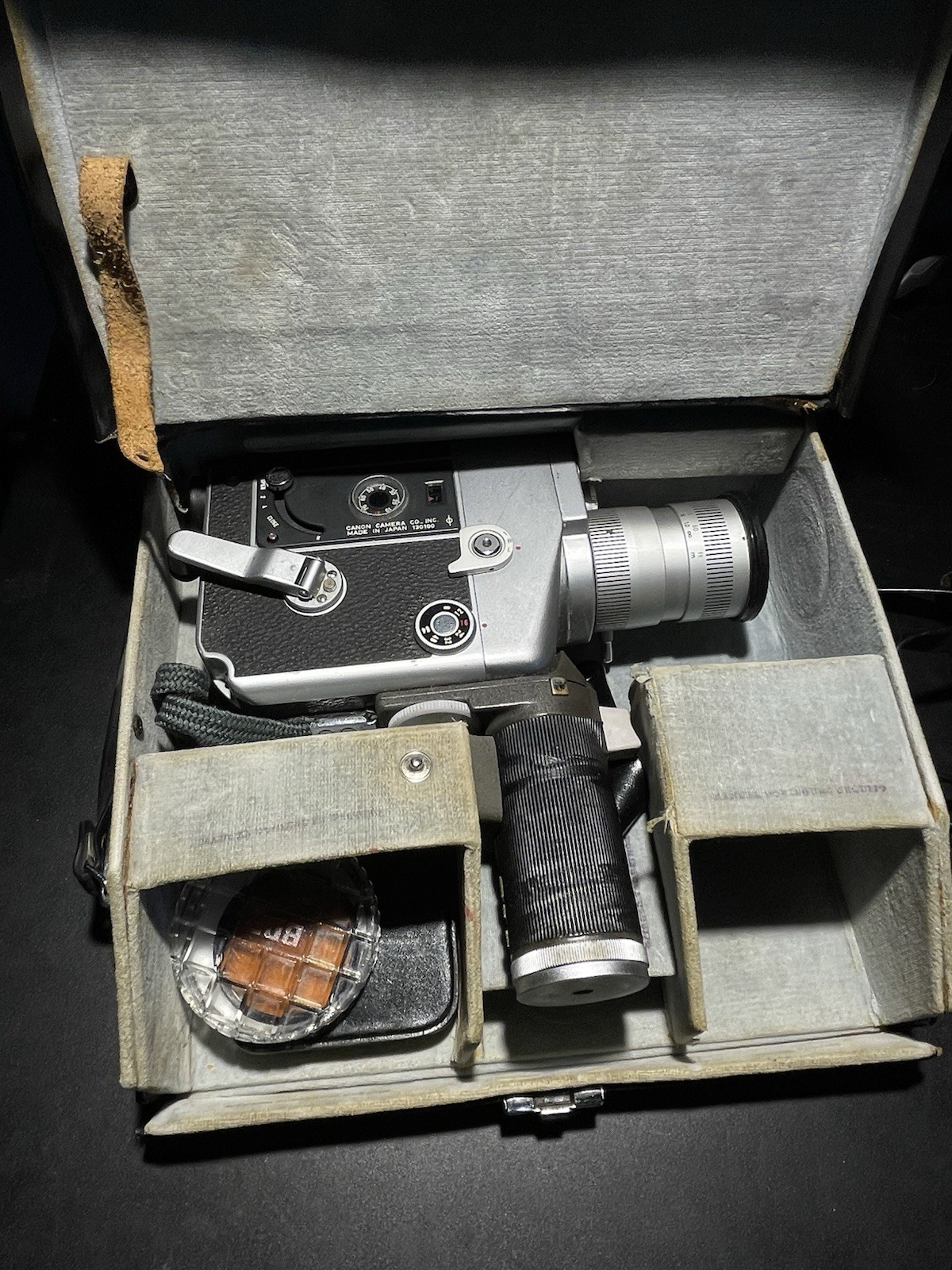
Canon Cine Zoom 512 (1964)
At 1.7kg, it rests in the hands like a precision instrument—dense, deliberate, and built to outlast its era.
Overview
The Canon Cine Zoom 512 isn't a camera for casual home movies. From the moment it's lifted, its weight broadcasts intent: this was engineered for filmmakers who demanded more from the 8mm format. Released in June 1964, it represented Canon’s ambition to transplant 16mm-level performance into a smaller gauge, treating the Double 8 platform not as a toy but as a legitimate medium for high-quality motion picture work. Owners report a machine that feels overbuilt—because it was. Nearly every component is machined or cast metal, with plastic used so sparingly it’s almost an afterthought. That heft, while tiring over long shoots, delivers rock-steady footage, especially when braced. One 1964 reviewer noted that even at the long end of the zoom, a firm surface under the pistol grip could yield stable handheld results. It was, according to Canon Camera Museum documentation, intended as a symbol of the company’s movie camera technology—its flagship in the Regular 8mm world.
What set the Cine Zoom 512 apart wasn’t just its construction, but its optics. The f/1.2 zoom lens was a technical feat for its time, leveraging Gauss relay lens design derived from Canon’s earlier Reflex Zoom 8-3 (1962) to achieve high magnification and resolution. Combined with a single-lens reflex viewfinder, it offered a level of optical clarity and compositional accuracy rare in consumer-grade 8mm cameras. The zoom range—8.5mm to 42.5mm—gave filmmakers real creative flexibility, and the ability to stop down to f/22 allowed control in brighter conditions. The model name itself speaks to its priorities: “5” for the 5x zoom, “12” for the f/1.2 aperture, a naming convention Canon would carry forward in future cine models.
Despite its sophistication, the camera remained mechanically driven. The spring-wound motor requires no battery to operate, capable—when new—of shooting 4 meters (13 feet) of film per wind, roughly half a standard 25-foot Double 8 roll. A reverse mode allowed for in-camera cross-fades, a feature prized by enthusiasts for creative transitions. Controls are logically laid out, with most clustered on the right side for thumb and finger access, though the aperture ring and zoom lever remain on the lens barrel, requiring a slight hand shift. It was the last Regular 8mm camera Canon produced before shifting focus to Super 8, marking the end of an era for the format.
Specifications
| Manufacturer | Canon |
| Model | Cine Zoom 512 |
| Type | 8mm movie camera |
| Production year | 1964 |
| Lens | Fast f1.2 (stopping down to f22) 8.5-42.5mm zoom lens |
| Zoom factor | x5 |
| Film format | Regular (Double) 8mm |
| Viewfinder | Single lens reflex viewfinder |
| Exposure meter | Built in CDS meter with 10 to 320 ASA range and exposure adjustment settings |
| Shooting speeds | 8, 16, 24, 32, 48, 64 fps and single frame |
| Shutter control | Continuously variable shutter control with stops at 'open', 1/2, 1/4 and 'close' |
| Motor | Spring motor capable of shooting 4m/13ft on a single wind |
| Frame counter | Frame counter with single frame marks, one complete revolution for 80 frames/1 ft |
| Reverse mode | Reverse mode to rewind film for filming cross-fades |
| Weight | 1.7kg |
| Dimensions | 210 x 114 x 53mm |
| Battery | Utilizes one 1.3V MD type (#625) mercury battery |
| Accessories | Teleconverter lens attachment, increasing the zoom to 14mm-70mm |
| Power grip | Operates electric motor zooming and shutter release with trigger |
| Construction | Almost all components are cast or machined metal, with very little plastic used at all |
Key Features
Fast f1.2 8.5-42.5mm Zoom Lens with Gauss Relay Design
This lens is the heart of the Cine Zoom 512’s reputation. At f/1.2, it was exceptionally fast for a zoom in 1964, especially in the 8mm format. The design borrowed from Canon’s earlier high-end optics, applying Gauss relay principles first seen in the 1962 Reflex Zoom 8-3 to maintain resolution and contrast across the zoom range. The 5x magnification (8.5–42.5mm) covered wide to tight telephoto, a rare breadth for the time. The aperture ring clicks smoothly from f/1.2 to f/22, giving control in varied lighting. The front accepts a teleconverter that extends the range to 14–70mm, effectively turning it into a 8.3x zoom, though at the cost of some light transmission. The lens’s speed and optical quality made it a favorite for low-light shooting and shallow depth-of-field effects, unusual in amateur film.
Single Lens Reflex (SLR) Viewfinder
Unlike many 8mm cameras that used separate optical viewfinders prone to parallax error, the Cine Zoom 512 employed a true single-lens reflex system. What the lens sees, the operator sees—accurately, and in real time. This eliminated guesswork in framing, especially at close distances or when zoomed in. The SLR mechanism used a rotating mirror synchronized with the shutter, flipping up during exposure and down during viewing. While this caused momentary blackout between frames, it ensured precise composition. For filmmakers aiming for professional results, this was a critical advantage, aligning the Cine Zoom 512 more closely with 16mm cinema practices than typical consumer gear.
Spring-Wound Clockwork Motor with 4m/13ft Runtime
The camera’s motor is entirely mechanical, powered by a wound spring—no batteries required for film transport. When fully wound, it was rated to shoot 4 meters (13 feet) of film, sufficient for about 20 seconds at 24fps. This design prioritized reliability and independence from power sources, a necessity in an era of inconsistent battery technology. However, collectors note that aged units often underperform; one owner reported needing three winds to complete one side of a Double 8 roll, versus the two specified in the manual. This degradation is common in vintage spring motors due to lubricant breakdown and metal fatigue. Still, when serviced, the mechanism is robust and capable of smooth, consistent film movement.
Continuously Variable Shutter Control
Instead of fixed shutter angles, the Cine Zoom 512 offers a continuously variable shutter with detents at “open,” 1/2, 1/4, and “close.” This allowed fine-tuned control over motion blur and exposure, particularly useful when shooting under artificial lighting or with variable frame rates. At “open,” the shutter delivers maximum exposure; at “close,” it effectively blocks light, useful for in-camera effects. The 1/2 and 1/4 positions provided intermediate settings, letting cinematographers balance flicker, blur, and brightness without changing frame rate or aperture. This level of control was uncommon in amateur cameras and reflected Canon’s professional aspirations for the model.
Integrated CDS Exposure Meter with 10–320 ASA Range
The built-in cadmium sulfide (CDS) meter provided through-the-lens light measurement, a significant convenience for accurate exposure. It supported film speeds from 10 to 320 ASA, covering the full range of available 8mm stocks. The meter required a single 1.3V mercury battery (MD #625), which reportedly lasted about two years with normal use. The readout was displayed in the viewfinder or via an external needle, depending on configuration, and allowed manual adjustment via an exposure compensation dial. While later models would adopt silicon blue cells, the CDS system was state-of-the-art for 1964, though sensitive to extreme temperatures and slow response times in low light.
Historical Context
The Canon Cine Zoom 512 was positioned as the pinnacle of Canon’s Regular 8mm offerings, embodying the company’s effort to bring 16mm-level engineering to the amateur market. It was marketed as a “masterpiece” by Canon, aimed at serious filmmakers rather than casual users. Its release in June 1964 placed it at the tail end of the Double 8 era; Canon would soon pivot to Super 8, making this model the last of its kind from the company. The integration of advanced optics, SLR viewing, and precise mechanical control reflected a moment when film technology was peaking before the digital transition. The naming convention—“512” for 5x zoom and f/1.2 aperture—became a template for future Canon cine cameras, signaling a lineage of performance-focused design.
Collectibility & Value
Current market listings show the Canon Cine Zoom 512 trading between $110 and $250, with condition and accessories influencing price. Units with the original teleconverter or power grip command higher interest. Collectors value its build quality and optical performance, though mechanical age is a consistent concern. The spring motor often requires servicing, with many units now achieving only 8–10 feet per wind instead of the original 13 feet. The rubber film path rollers can harden and seize, though some owners report successful operation after removal. Demand for repair manuals and service diagrams suggests a niche but active restoration community. Some owners report that early production models used higher-grade materials than later runs, making early serial numbers potentially more desirable. No official original retail price is documented, though a label marked “£22” has been found on one unit, with no context for when or where it was sold.
eBay Listings


As an eBay Partner, we earn from qualifying purchases. This helps support our independent vintage technology research.
Related Models
- Canon 1014 XL-S (1978)
- Canon 518 SV (1978)
- Canon AF 514 XL-S
- Canon Auto Zoom 2018 Electronic
- Canon Auto Zoom 518 Super 8
- Arriflex 16 BL (1965)
- Arriflex 16 SR (1975)
- Arriflex 16 ST (1952)
- Arriflex 35 BL (1972)
- Arriflex 35 IIC (1964)