Bell & Howell Filmo Auto-8
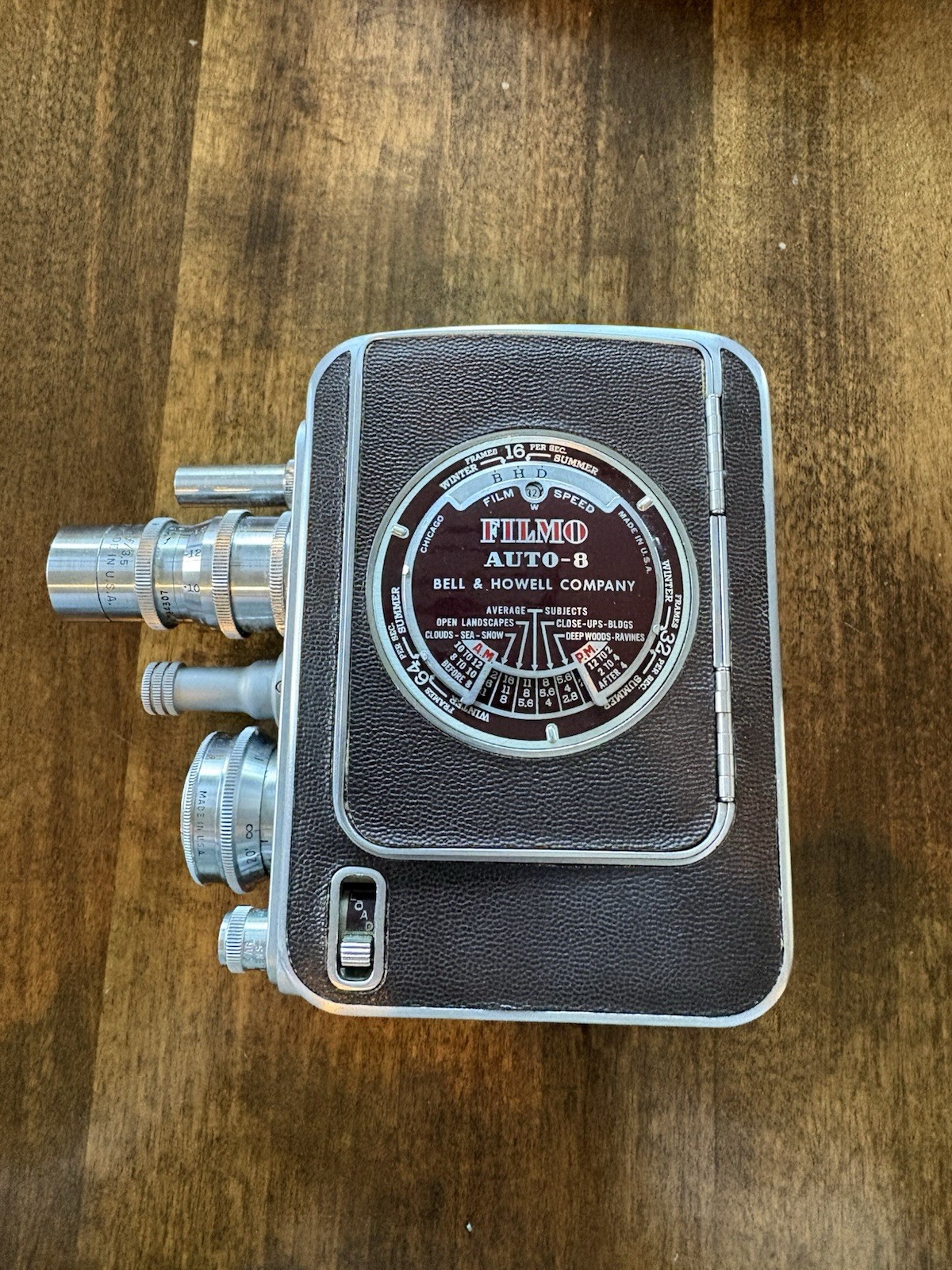
A magazine-loading 8mm movie camera wrapped in Hollywood pedigree, built for home filmmakers who wanted pro-style handling without the bulk.
Overview
The Bell & Howell Filmo Auto-8 isn’t one of the giants in the 8mm pantheon, but it carries the weight of its name. Bell & Howell had already carved its reputation in professional cinema, and the Auto-8 was part of a push to bring that engineering ethos to the amateur market. Marketed as a new magazine-loading 8mm movie camera with a Hollywood heritage, it arrived during a time when home moviemaking was shifting from novelty to aspiration. The design prioritized ease of use and rapid reloads—critical for families capturing fleeting moments or enthusiasts experimenting with short-form storytelling. While details about its internal mechanics remain sparse, the external logic of its build suggests a focus on reliability and simplicity, with controls laid out for intuitive operation. It wasn’t trying to be a studio rig, but it didn’t pretend to be a toy either.
What stands out is the loading method: magazine-loading meant users could swap pre-loaded film cassettes quickly, This wasn’t just convenience—it was a nod to continuity, letting shooters keep rolling without fumbling through manual threading in the dark. For its time, that was a meaningful upgrade over many entry-level 8mm cameras that demanded careful, error-prone loading.
Specifications
| Manufacturer | Bell & Howell |
| Product Type | Movie Camera |
| Film Format | Standard 8 mm |
| Film Format | Used a double 8 (split 16) film cassette. |
| Lens System | The camera has a two-lens turret system. |
| Load Type | magazine-loading |
Key Features
Dual Lens Turret System
The Filmo Auto-8 features a two-lens turret system, allowing shooters to switch between lenses without removing either from the camera. According to available documentation, this “DUAL LENS” setup gave users flexibility in framing— though exact optics aren’t specified.
Magazine-Loading Film System
Instead of threading film directly from a spool, users loaded pre-assembled cassettes—essentially self-contained film magazines that snapped into place. This design reduced the risk of dust exposure and misalignment, common issues in manually threaded systems. Sources suggest the Auto-8 used a double 8 (split 16) film cassette, meaning 16mm film was slit down the middle after processing to yield two 8mm strips. The magazine system made reloading nearly foolproof, a major selling point for non-technical users.
Collectibility & Value
Current market prices for the Bell & Howell Filmo Auto-8 vary significantly based on condition and completeness. Units listed in “good” condition with vintage case have sold for $45 (Poshmark), while others priced around $90 including tax appear on international resale sites. Etsy listings show a range from $59.99 (marked down from an original $59.99, suggesting pricing inconsistency) to $80 or best offer. Some units are sold “AS IS FOR PARTS” or as display pieces, indicating that working examples are not guaranteed. One eBay listing describes a unit as “working 1940s Bell Howell Filmo Auto-8 Film Video Camera,” though no further verification of functionality is provided in the documentation. The inclusion of a case appears consistent across listings, suggesting it was standard equipment or at least commonly retained by owners.
eBay Listings



As an eBay Partner, we earn from qualifying purchases. This helps support our independent vintage technology research.
Related Models
- Bell & Howell Filmo 70 (1923)
- Bell & Howell Filmo Straight Eight (1935)
- Bell and Howell 2709 (1912)
- Bell and Howell Filmo 70DR
- Canon Cine 8T (1956)