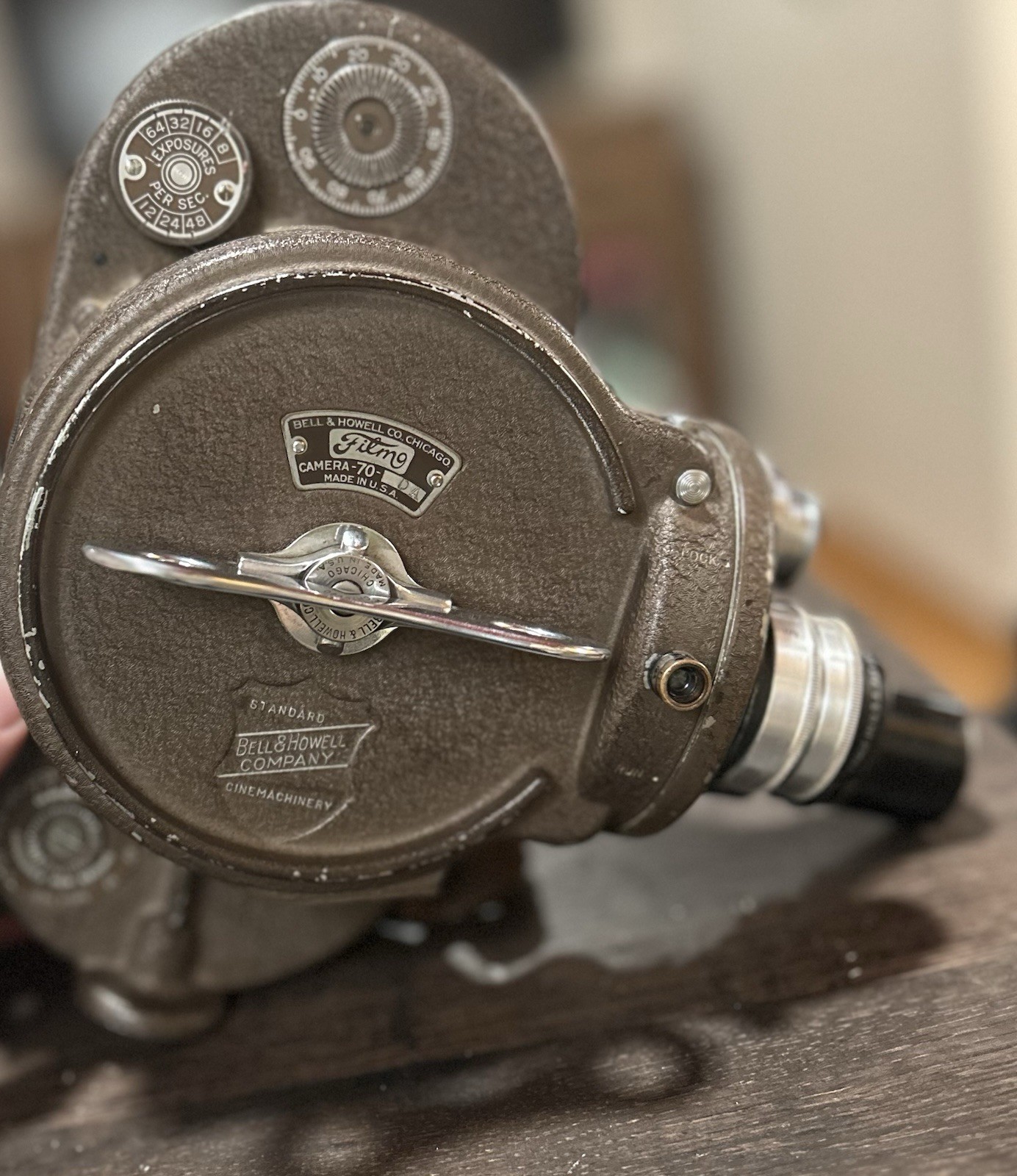
Bell & Howell Filmo 70 (1923)
At 1450 grams, it rests in the hands like a relic of a revolution—one that put motion picture capture into the palms of ordinary people for the first time.
Overview
The Bell & Howell Filmo 70 isn’t just another vintage movie camera—it’s the machine that redefined who could make films. Introduced in 1923, it earned its reputation as the first personal movie camera, a title not bestowed lightly. Before the Filmo 70, motion picture equipment was bulky, expensive, and largely confined to professional studios. This camera changed the game. Spring motor-driven and built around 16mm film, it brought portable, reliable cinematography to amateurs, educators, and independent filmmakers. Its design prioritized durability and ease of use, with a mechanical simplicity that allowed it to run without batteries or external power—just a good winding and steady hands.
Multiple variants exist—DA, DE, DL, DR, HR, G, H—suggesting a long and adaptable production life, though exact timelines remain murky. Some sources cite models from the 1940s and 1950s, including a 1948–1954 model reportedly used by the U.S. Navy, indicating military and institutional adoption. Despite the variations, the core identity remains consistent: a rugged, hand-wound 16mm camera built for real-world use. Owners report it was not just a novelty but a tool—used by newsreel and war correspondents who needed something dependable in the field. One Facebook group user summed it up: “Oh yeah…It works.” Another mused, “If only it could talk about what it has seen…,” a testament to the stories it may have carried through decades.
Specifications
| Manufacturer | Bell & Howell |
| Product type | 16mm Movie Film Camera |
| Film format | 16 mm |
| Film load | 100 ft |
| Shutter | 144 degree shutter |
| Speeds | Three Speed |
| Lens mount | C-mount |
| Lens mount | three lens turret |
| Viewfinder | built-in adjustable directors' finder |
| Motor | spring motor-driven |
| Weight | 1450 g |
| Dimensions | 60 x 130 x 250 mm |
Key Features
Spring Motor-Driven Mechanism
The Filmo 70’s spring motor is central to its identity. Unlike electrically powered cameras that tied users to outlets or heavy batteries, this system relied on a wound spring to drive both film transport and shutter operation. This mechanical autonomy was revolutionary in 1923 and remained a selling point for decades.
Three Speed 144 Degree Shutter
The camera features a 144-degree shutter with three selectable speeds, allowing variable frame rate control without modification at 12 fps. This gave filmmakers creative flexibility in capturing motion, whether for smooth action or deliberate stutter. The shutter angle—a critical factor in exposure and motion blur—was fixed at 144 degrees, a compromise between light efficiency and cinematic motion rendering. Sources suggest the system was designed for reliability over precision, with consistent performance under field conditions rather than laboratory accuracy.
Three Lens Turret with C-Mount
Mounted on a rotating turret, three C-mount lenses could be swapped mid-shoot without opening the film chamber. This was a significant advantage for documentary and news work, where changing focal lengths quickly was essential.
Built-In Adjustable Directors' Finder
The integrated directors’ viewfinder wasn’t just a convenience—it was a workflow innovation. Unlike reflex finders that showed exact framing through the lens, It was adjustable, likely for focus or diopter correction, though exact calibration details are not documented. This feature made the Filmo 70 particularly useful for solo shooters who needed both framing accuracy and operational simplicity.
Historical Context
The Bell & Howell Filmo 70 was first introduced in 1923 and is widely regarded as the first personal movie camera. It was one of the earliest spring motor-driven 16mm cameras, a combination that made it accessible and portable. Its introduction coincided with the rise of amateur filmmaking and educational cinema, filling a gap between professional 35mm rigs and toy cameras. Over time, its rugged build and mechanical reliability led to adoption beyond hobbyists—news and war correspondents reportedly used various Filmo 70 models in the field, where durability mattered more than convenience.
Collectibility & Value
Current market listings show wide price variation. A Filmo 70 was listed for $348.00 on Etsy, while another appeared on Adorama for $7 in used condition with heavy wear—suggesting condition and completeness drastically affect value. A repair manual for the DA and related models is available for $15.95, indicating some ongoing support for maintenance. One common issue reported is a locked shutter, with the recommended solution being cleaning and oiling. No information is available on spare parts availability, though the camera’s mechanical nature makes it potentially repairable with machining skills. Rental listings on ShareGrid price it at $150 per day, reflecting its niche appeal for period-accurate film production.
eBay Listings
As an eBay Partner, we earn from qualifying purchases. This helps support our independent vintage technology research.
Related Models
- Bell & Howell Filmo Auto-8 (1940)
- Bell & Howell Filmo Straight Eight (1935)
- Bell and Howell 2709 (1912)
- Bell and Howell Filmo 70DR
- Canon Cine 8T (1956)