BELCA BELTICA
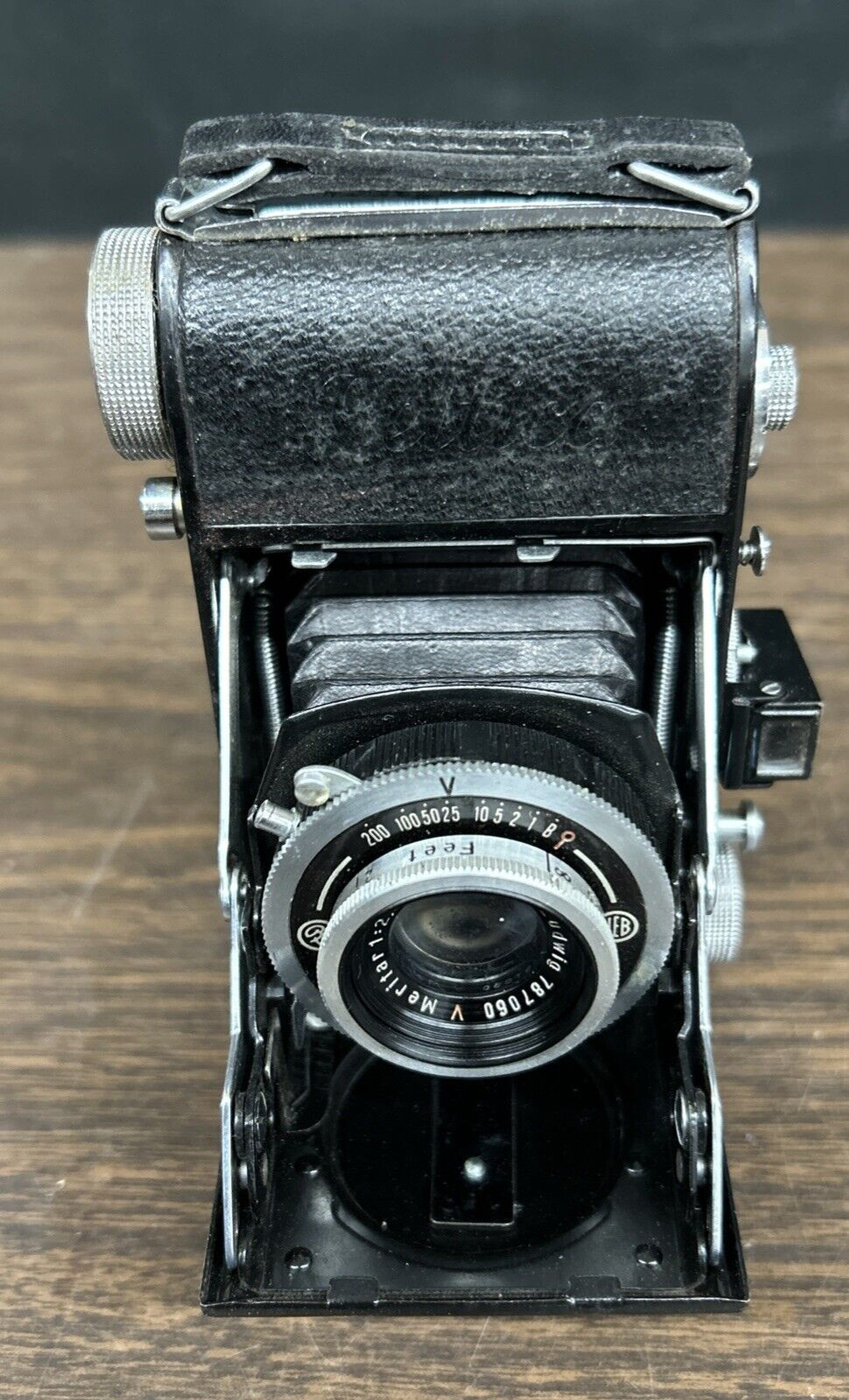
The Belca Beltica is a compact 35mm viewfinder camera produced in East Germany during the early 1950s. Featuring a unique bottom-hinged bed design and a fixed triplet lens, it represents a transitional period in postwar German camera manufacturing, combining pre-war mechanical principles with simplified, cost-effective construction for the emerging amateur photography market.
Overview
Manufactured by VEB Feinwerktechnik Görlitz under the Belca brand, the Beltica was introduced in 1951 as a budget-friendly 35mm camera aimed at amateur photographers in the German Democratic Republic (GDR) and export markets. It emerged during a period of industrial reorganization in East Germany, where former pre-war optical firms were consolidated into state-owned enterprises. The Beltica was not a high-end instrument but rather a pragmatic solution to meet demand for affordable photography tools in a resource-constrained economy. Its design reflects influences from pre-war German compact cameras, particularly in its folding mechanism and optical layout.
The camera utilizes a fixed 45mm f/3.5 Belar (or occasionally Belcotar) triplet lens, a modest but serviceable optic for its class. Focusing is achieved via a simple scale-based system with preset distances—typically 1.2 meters, 2 meters, and infinity—selected by rotating the lens barrel. The shutter is a two-speed Belshutter (a branded version of the common Compur-type leaf shutter), offering 1/30 and 1/100 second speeds, along with Bulb and Time settings. A selenium light meter is integrated into the top plate on later models, though it is un-coupled and serves only as a guide. The film advance is via a knob winder, and the camera uses standard 135 cartridges with manual frame spacing via red window on the back.
The Beltica occupies a niche position within the Belca lineup, which included more advanced models like the Belca S and Belca Rapid. It was not a flagship product but rather an entry-level offering, emphasizing mechanical reliability over advanced features. Production ended around 1956, likely due to increasing competition from more modern designs and the rising popularity of cameras with coupled metering and faster lenses.
Specifications
| Specification | Value |
| Type | Viewfinder (non-reflex) |
| Film Format | 35mm (135 cartridge) |
| Years Produced | 1951–1956 |
| Lens Mount | Fixed lens (non-interchangeable) |
| Lens | 45mm f/3.5 Belar or Belcotar triplet |
| Aperture Range | f/3.5 to f/16 (preset via dial) |
| Shutter | Belshutter (leaf), speeds: 1/30, 1/100 sec, B, T |
| Focusing | Scale focus (1.2m, 2m, ∞) |
| Metering | Uncoupled selenium cell (on later models) |
| Exposure Modes | Manual (shutter speed and aperture set manually) |
| Viewfinder | Optical direct-vision frame finder with parallax correction marks |
| Film Advance | Knob wind with manual reset frame counter |
| Frame Counter | Manual (reset via baseplate button) |
| Frame Spacing | Red window on back for frame alignment |
| Flash Sync | PC terminal and M-sync at 1/30 sec |
| Dimensions | Approx. 110 × 65 × 45 mm (closed) |
| Weight | Approx. 380 g (without film) |
| Construction | Metal body with leatherette covering, folding bed |
Key Features
- Bottom-hinged folding bed mechanism allows compact storage while maintaining lens alignment accuracy.
- Integrated selenium light meter (on later versions) provides exposure guidance without batteries.
- Dual-speed leaf shutter with Bulb and Time settings enables long exposures and basic time photography.
- Red window frame counter ensures accurate film positioning, typical of early 1950s 35mm cameras.
- Robust metal construction with leatherette finish, characteristic of East German engineering of the period.
Historical Context
The Belca Beltica was developed in the immediate postwar era, when East German manufacturers were re-establishing optical industries under Soviet oversight. VEB Feinwerktechnik Görlitz, formed from remnants of pre-war firms like Certo and Wirgin, sought to produce functional cameras using available tooling and materials. The Beltica’s design borrows from earlier Certo models, particularly in its folding mechanism and shutter layout, but simplifies production to reduce cost.
At the time of its release, the amateur 35mm market was expanding rapidly. Competitors included the Kodak Retina I (Type 117), Wirgin Edinex, and various Agfa models. While the Retina offered superior build and coupled shutters, it was significantly more expensive. The Beltica positioned itself as a domestically produced, affordable alternative for GDR citizens and Eastern Bloc markets. However, its lack of a rangefinder, slow lens, and manual frame spacing limited its appeal compared to more advanced contemporaries.
Despite its modest specifications, the Beltica played a role in democratizing photography in East Germany. It was marketed as a reliable, easy-to-use camera for everyday use, with emphasis on durability and repairability—key concerns in an economy with limited consumer goods. By the mid-1950s, however, newer designs with coupled shutters, faster lenses, and improved ergonomics rendered the Beltica obsolete, leading to its discontinuation around 1956.
Collectibility & Value
The Belca Beltica is a relatively obscure camera among collectors, though interest has grown in recent years due to the resurgence of interest in East German optical equipment. It is considered uncommon but not exceptionally rare; complete, functioning examples in good condition typically sell for $120–$200 USD at auction or through specialty dealers. Models with working selenium meters are more desirable, though the meter cells often degrade over time, rendering them non-functional.
When evaluating a Beltica for purchase, collectors should check for a smooth folding bed mechanism, as bent or stiff hinges are common due to age and wear. The leather bellows are prone to pinholes or deterioration, which can cause light leaks. The shutter should be tested for accurate timing, particularly at 1/30 and 1/100 sec; lubricant drying is a frequent issue. The lens should be free of fungus, haze, and separation—common in triplet lenses of this era. Original cases and manuals significantly increase value.
Due to its niche status, the Beltica is not widely serviced, and replacement parts are scarce. However, its mechanical simplicity makes basic maintenance feasible for experienced hobbyists. It is best appreciated as a historical artifact of early Cold War-era East German industry rather than a practical photographic tool.
Similar Cameras
- Kodak Retina I (Type 117) – German-made 35mm viewfinder with coupled shutter and rangefinder, superior build but higher cost.
- Wirgin Edinex – Contemporary East German 35mm camera with similar feature set and target market.
- Agfa Optima I (early models) – Non-rangefinder 35mm with automatic exposure, representing the next generation of compact design.
- Certo Super Sport – Pre-war folding 35mm with similar bed mechanism, showing design lineage.
- Zorki 1 – Soviet rangefinder based on Leica II, more advanced but less accessible in the Eastern Bloc.
Repair & Maintenance
The Belca Beltica requires no batteries for operation, though the selenium light meter on later models functions without power but may degrade over decades. Common issues include stiff or misaligned folding beds, dried shutter lubricants, and deteriorated leather bellows. The Belshutter mechanism can often be cleaned and re-lubricated with watchmaker’s oil, but disassembly requires precision tools. The red window should be checked for opacity or paint flaking, which can obstruct frame numbering. Regular use, gentle cleaning, and storage in a dry environment are recommended to preserve functionality. Due to limited service support, preventive maintenance is crucial for long-term preservation.
eBay Listings
As an eBay Partner, we earn from qualifying purchases. This helps support our independent vintage technology research.
Related Models
- Belca Belmira (1954–1957)
- Agfa Agfamatic 100
- Agfa Agfamatic 126
- Agfa Agfamatic 2000 pocket sensor
- Agfa Agfamatic 2008 pocket sensor
- Agfa Agfamatic 3000 Flash Pocket
- Agfa Agfamatic 3000 pocket sensor
- Agfa Agfamatic 3008 pocket sensor
- Agfa Agfamatic 4000 pocket sensor
- Agfa Agfamatic 4008 pocket sensor