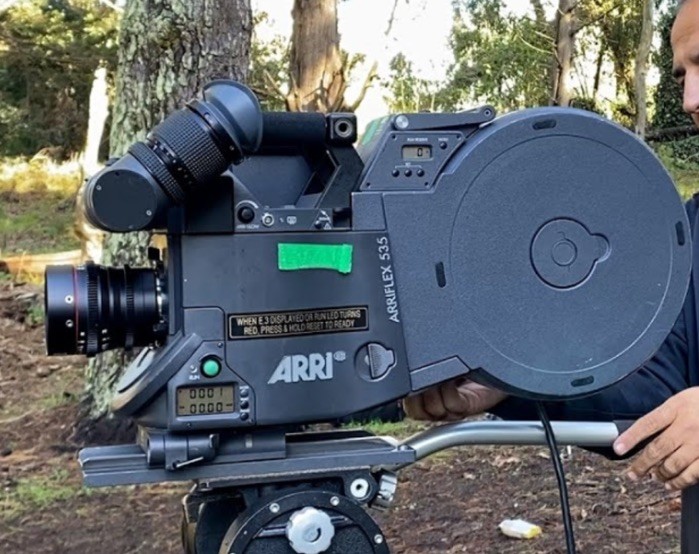
Arriflex 535B (1992)
At 7.7 kg, it is light enough for Steadicam, quiet enough for sync sound, and built to last decades on set.
Overview
The Arriflex 535B is a refinement of the 535 (also known as the 535A). It was introduced in 1992 as a variant of that camera. ARRI built it for professional motion picture production, where silence, reliability and modularity mattered most. It was marketed as a 35mm silent production camera, and it was designed to work in the studio or on location, particularly for sync sound shooting. It has a reputation for being hard-wearing and reliable, and owners report consistent performance even under demanding conditions. It weighs 7.7 kg (17.0 lbs) without magazine, which was lighter than many contemporaries, and that weight was explicitly leveraged for Steadicam use. Combined with near-silent operation, it was a favorite among cinematographers who needed mobility without giving up clean audio.
The exact production run is undocumented. The 535B arrived while electronic integration in film cameras was accelerating. It kept the mechanical precision expected of ARRI systems but added electronic inching via the PHASE button alongside traditional manual inching through a knob. That gives precise frame-by-frame control, whether setting up a shot or troubleshooting mid-roll. The design centered on adaptability. The modular, detachable viewfinder system let technicians and operators reconfigure the camera quickly for different rigs or shooting scenarios. It was not built for hobbyists. It was a tool for professionals who wanted consistency, serviceability and sturdy engineering.
Specifications
| Manufacturer | ARRI |
| Product Type | 35mm film camera |
| Introduced | 1992 |
| Film Format | 35mm |
| Perforation | 4-perf |
| Lens Mount | 54 mm PL-mount adjustable for filming in super 35 mm |
| Movement | Seven link with dual |
| Video Assist | C-mount for " CCD-camera |
| Viewfinder System | newly designed, light-weight and modular |
| Weight | 7.7 kg / 17.0 lbs without magazine |
Key Features
Silent Operation for Sync Sound Shooting
The 535B runs silently, and that is its defining trait. Earlier studio cameras needed bulky blimps or external sound enclosures for dialogue recording. The 535B was engineered to run quietly enough for direct sync sound capture. It wasn't done with muffling or compromise - the quiet is built into the movement and housing design. The camera could move between controlled sets and real-world locations without adding noise. Collectors and former users note that "silent" doesn't mean inaudible, but the sound is low and consistent, so it is easy to filter out in post if necessary. It became a staple on indie productions and high-end commercials alike.
Modular, Detachable Viewfinder System
The 535B introduced a newly designed, lightweight, modular viewfinder system. Operators could remove or reconfigure the viewfinder quickly depending on the rig, whether handheld, tripod or Steadicam-mounted. The system supported various eyepieces and optical paths, so cinematographers could tailor the view to personal preference or technical need. Because the viewfinder detached cleanly, maintenance and repair were simpler, and spare units could be swapped mid-shoot. That serviceability was typical of ARRI's design approach and contributed to the camera's longevity in rental houses and production fleets.
Seven-Link Movement with Dual Registration
The 535B has a seven-link movement with dual registration pins. This holds each frame flat and precisely aligned during exposure, which minimizes weave and jitter that can degrade optical printing or telecine transfers. The dual registration system engages before the shutter opens and releases after it closes, which reduces wear on the film stock. Owners report exceptionally clean gate performance even after years of use, provided regular maintenance is performed. The movement supports 4-perf pulldown as standard, in line with theatrical release norms of the era. Some later models introduced 3-perf capability, but the 535B favored robustness over format flexibility.
Electronic and Manual Inching Control
Precise film handling mattered for setup and repair, so the 535B offers two inching methods. Operators can advance the film manually with the inching knob, a direct-drive system that suits fine-tuning framing or checking splices. Electronic inching via the PHASE button gives smoother, motorized frame-by-frame advance, which is useful when the camera is mounted in hard-to-reach positions. The pairing reflects 1990s filmmaking, where mechanical reliability met emerging electronic convenience. Technicians appreciated having both options, especially during magazine changes or when diagnosing transport issues.
Lightweight Design for Steadicam Use
The 535B has a metal body and a full-sized 35mm gate, yet it was engineered to be lighter than many of its peers. At 7.7 kg (17.0 lbs) without magazine, it sat within the optimal range for Steadicam operation, which reduces operator fatigue and improves balance. ARRI explicitly marketed this trait, noting its suitability for dynamic, mobile shots. The weight distribution, aided by the modular viewfinder and compact body, allowed easier center-of-gravity adjustments on gimbals. It is not the lightest 35mm camera ever made, but its strength-to-weight ratio made it a practical choice for productions that needed both image quality and movement.
C-Mount for Video Assist Integration
The 535B includes a C-mount for attaching a CCD-camera for video assist, which was forward-thinking for its time. Directors, DPs and crew could monitor footage in real time through external video feeds, a growing need as productions became more collaborative and complex. The C-mount standard meant users could pick from a range of compatible video cameras instead of being locked into proprietary solutions. The video signal was low-resolution by modern standards, but it gave essential framing and performance feedback, especially on long lenses or remote setups.
Collectibility & Value
According to available documentation, the Arriflex 535B remains highly regarded for reliability and versatility in professional filmmaking. One listing on Used Cine Gear shows a price of USD $25,000.00, while a UK-based forum post cites £4995 (+VAT). These figures suggest strong residual value, particularly for fully serviced units. An Instagram post from a technician notes that camera packages are often "FULLY SERVICED by our in-house camera technician & will arrive to you READY TO WORK," indicating an active aftermarket support network. No original MSRP is documented, so depreciation is hard to assess. Given its widespread use in 1990s and early 2000s productions, surviving units are relatively common in the used market, but operational condition varies widely. Collectors prioritize cameras with clean movements, intact viewfinders and service records.
eBay Listings


As an eBay Partner, we earn from qualifying purchases. This helps support our independent vintage technology research.
Service Manuals, Schematics & Catalogs
- Catalog (1966) — archive.org
- Catalog — archive.org
Related Models
- Arriflex 16 BL (1965)
- Arriflex 16 SR (1975)
- Arriflex 16 ST (1952)
- Arriflex 16S (1952-)
- Arriflex 16SR2 E
- Arriflex 35 BL (1972)
- Arriflex 35 IIC (1964)
- Arriflex Alexa Plus
- Arriflex ARRICAM LT
- Beaulieu 1028XL (1978-)