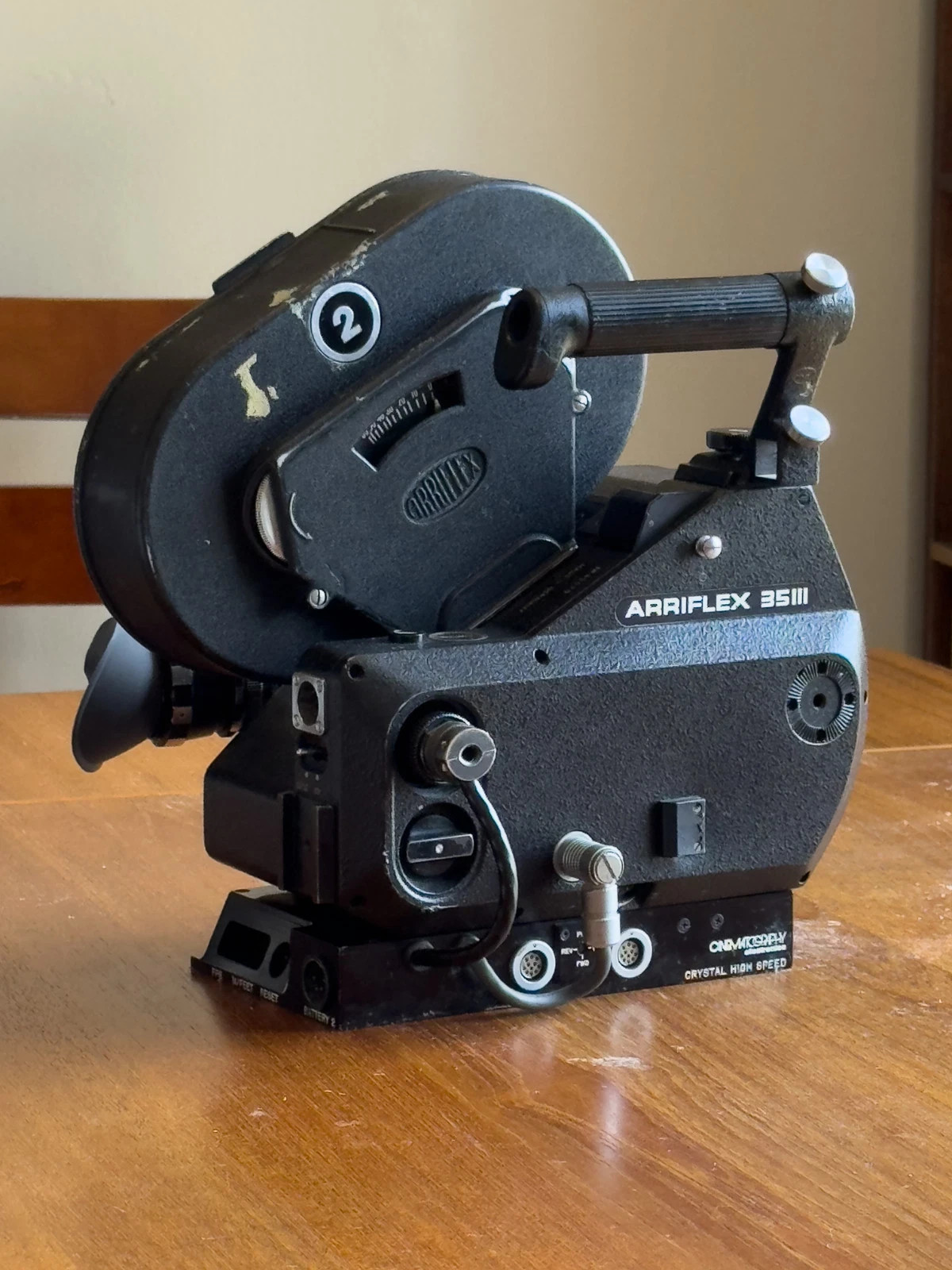
Arriflex 35 IIC (1964)
The camera that redefined handheld cinematography—still turning heads on film sets fifty years later.
Overview
You can feel it the second you pick one up: this isn’t just a movie camera, it’s a piece of cinema history that still breathes. The Arriflex 35 IIC, introduced in 1964, didn’t just enter the world of filmmaking—it rewrote the rules. Built by Arri (Arnold & Richter Cine Technik), it’s the definitive model of the Arriflex 35 II series, a title it earned not through marketing, but through sheer presence on set after set, decade after decade. It became a film production standard, trusted by cinematographers who needed reliability, precision, and the ability to move freely. And move they did—this was the camera that empowered the New Wave, that rode Steadicams into the future, and that still shows up on modern shoots for sequences where sync sound isn’t needed but soul is non-negotiable.
ARRI made the 35 IIC through the late 1970s, evolving from the original 1937 "Handkamera" concept—a compact, handheld news camera designed for rugged use and easy loading. After World War II, with the original Munich factory rebuilt, Arri returned to refining that vision, leading to the 35 II series. The IIC wasn’t just another iteration; it was the peak of that lineage. Owners report a mechanical simplicity that borders on elegance, with a build quality so exacting that critical tolerances are pinned or machined—no fiddling, no guesswork. It remains Arri's best-selling film camera across all models, a testament to its enduring utility and reputation.
And yet, it’s not a museum piece. Even today, you’ll find 35 IICs in action—not because they’re nostalgic, but because they work. They’re used for motor-only sync, for wild, dynamic camera moves, for moments when digital feels too clean. Stanley Kubrick trusted it on *A Clockwork Orange*, and the Pan Arri 35 IIC—with one Panavision-compatible lens mount—was used on *Star Wars: A New Hope*. Its reflex viewing system, born in 1937, is so fundamental that the basic design still echoes in ARRI’s digital ALEXA line. This isn’t just legacy—it’s lineage.
Specifications
| Manufacturer | Arri (Arnold & Richter Cine Technik) |
| Film format | 35mm |
| Shutter type | Spinning reflex twin-bladed "butterfly" mirror shutter |
| Maximum shutter exposure opening | 165 degrees |
| Lens mount (original configuration) | 3 Standard Mounts |
| Lens mount (later models after 1965) | Option of Bayonet mounts |
| Frame rate capability (with accessory) | Up to 80 frames per second |
| Film magazine capacities | 200 ft or 400 ft loads |
| Motor type | DC motor mounted downwards as a handgrip |
| Flange Focal Distance (FFD) | Nominally 52.00mm, but on IICs it is physically set to 51.97 - 51.98mm |
Key Features
Reflex Viewing That Changed Everything
The Arriflex 35 introduced the world’s first reflex mirror shutter in a motion picture camera—an invention by engineer Erich Kästner that fundamentally altered how filmmakers worked. The spinning mirror shutter allows the operator to see through the taking lens in real time, with no parallax error. That means what you see is exactly what you get, frame after frame. It’s not a perfect image—there’s noticeable flicker in the viewfinder when running—but it’s honest, immediate, and transformative. This system became standard across professional film cameras, a quiet revolution that started in Munich in 1937 and matured in the IIC.
Designed for Movement, Built for Stability
The 35 IIC’s movement uses a cardioid cam system, a significant evolution from the earlier simple eccentric claw mechanism. This design creates a dwell at the end of the pull-down stroke, stabilizing the film in the gate just before exposure—critical for sharp, steady images, especially at high speeds. Combined with a spring-loaded side-rail in the gate that applies gentle side pressure to the film, the camera fights gate weave with mechanical intelligence. It’s not over-engineered; it’s precisely engineered.
Flexibility in the Field
Equipped with a three-lens turret in its standard configuration, the IIC lets operators switch lenses quickly without breaking stride. Originally fitted with three Standard Mounts, later models (after 1965) offered the option of Bayonet mounts, increasing compatibility with high-speed primes and anamorphics. The camera also allows shooting anamorphic formats while displaying a desqueezed image in the viewfinder—a rare capability at the time, and one that made it a favorite for widescreen productions. The larger ground glass and movable viewfinder further enhance usability, letting operators frame and focus with confidence even in tight or awkward positions.
Power and Portability
The DC motor is mounted downward, doubling as a handgrip—a clever integration that makes handheld operation more balanced and intuitive. It runs at 24/25 fps as standard, with the ability to reach up to 80 fps when paired with an accessory speed unit. While detailed power requirements aren’t documented, one known unit reduced its motor current draw from 2 amps to 1 amp when running without film, suggesting thoughtful electrical design. All IIC motors use ball bearings, contributing to smooth, durable performance.
Historical Context
The story of the 35 IIC begins in 1937 with the original Arriflex 35 "Handkamera," presented at the Leipzig Spring Fair as a compact, handheld news camera built for robustness and ease of use. The German military became a major customer during WWII, and a U.S. copy—called the Cineflex—was developed for military applications. After the war, with the Munich factory rebuilt, Arri resumed production of the Handkamera as the 35 II, refining it over time. The IIC, introduced in 1964, represented the culmination of that evolution.
It was quickly embraced by filmmakers seeking agility and precision. The first Hollywood film to use an Arriflex was *Dark Passage* in 1947, but it was the IIC that cemented Arri’s dominance. Its reflex design earned two Scientific and Technical Academy Awards—in 1966 and 1982—and its influence is visible in nearly every professional film camera that followed. The IIC was used on landmark films like *The Good, the Bad and the Ugly* (1966), *The Graduate* (1967), *Apocalypse Now* (1979), and *Star Wars: Episode VI – Return of the Jedi* (1983). Some units remained in use into the 2010s, including on *Savages* in 2012.
The Arriflex 35 III, introduced in 1979, succeeded the IIC, but never matched its popularity. The IIIC, released in 1982, also failed to surpass the IIC’s status. This wasn’t just a camera—it was the standard.
eBay Listings



As an eBay Partner, we earn from qualifying purchases. This helps support our independent vintage technology research.
Service Manuals, Schematics & Catalogs
- Catalog (1966) — archive.org
- Catalog — archive.org
- Catalog — archive.org
Related Models
- Arriflex 16 BL (1965)
- Arriflex 16 SR (1975)
- Arriflex 16 ST (1952)
- Arriflex 35 BL (1972)
- Beaulieu 4008 ZM II (1977)
- Beaulieu 5008 S (1976)
- Bell & Howell 134 (1940)
- Bell & Howell 2709 (1912)
- Bolex H16 Reflex (1956)
- Bolex H16 RX-5 (1966)