Arriflex 35 BL (1972)
The camera that let cinematographers finally hear the silence—and then fill it with the sound of film history being made.
Overview
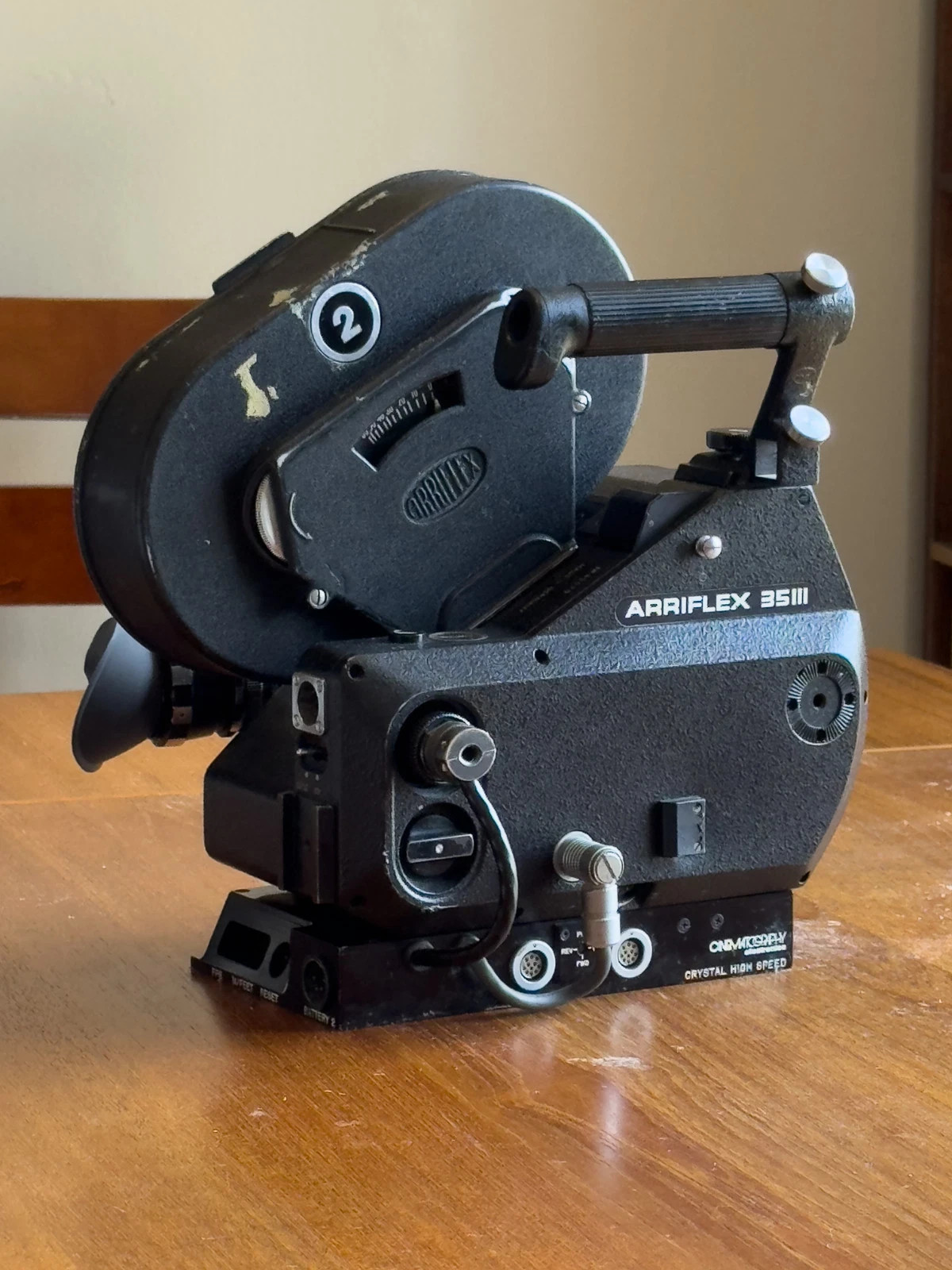
The Arriflex 35 BL wasn’t just a camera—it was a recalibration of what was possible on set. Before its arrival, the idea of a quiet, handheld 35mm film camera that didn’t sacrifice image quality or reliability was more dream than reality. Arri had already earned respect with the 35II and the 16BL, but the 35 BL was the first to answer a fundamental frustration: the need to carry around massive, cumbersome blimps just to shoot sync sound without noise. Introduced in 1972, it became the first self-blimped 35mm motion picture camera from Arri, meaning the silence was built in, not bolted on. That single innovation changed the rhythm of film production, allowing crews to move faster, shoot longer, and capture performances without the constant interruption of rolling a blimp on and off the camera.
More than 1,700 units were produced across the 35 BL series, spanning iterations from the BL1 to the final 35BL4S introduced in 1989. This wasn’t a short-lived experiment; it was a platform that evolved with the industry, becoming one of the most popular 'A' cameras in feature film production from the mid-1970s onward. Its reputation wasn’t built on gimmicks or marketing—it was forged on sets, in handheld rigs, on dollies, and eventually, floating through hallways on a Steadicam. The 35 BL didn’t just adapt to new techniques; it enabled them.
At 28 pounds without lens or film, it wasn’t exactly light by today’s standards, but in its era, it struck a near-perfect balance between heft and stability. It wasn’t trying to be a run-and-gun documentary tool, nor was it a studio beast like the Mitchell BNC. It was the bridge—compact enough for mobility, solid enough for precision, and quiet enough for dialogue. And when Stanley Kubrick reached for it on *The Shining*, pairing it with Garrett Brown’s nascent Steadicam system, the 35 BL proved it could do more than just record silence. It could create a new visual language.
Specifications
| Manufacturer | Arri (Arnold & Richter Cine Technik) |
| Film format | 35mm |
| Frame rate | 5-100 fps capable (24/25 fps standard) |
| Exposure at 24 fps | 1/48 second (with 180° shutter) |
| Shutter | 180-degree fixed butterfly shutter (for 35BL1 and 35BL2 cameras) |
| Lens mount | ARRI 41mm Bayonet mount (accepts Standard mount) |
| Magazine capacity | 400' and 1000' magazines were available |
| Weight without lens and film | 28 lb |
| Viewfinder magnification | 6.5x |
| Viewfinder tilt range | 120° vertically up and down |
| Eyepiece protrusion above camera body | 5 cm |
| Eyepiece angle | 20° |
| Power supply | 12 VDC via 4-pin XLR (1= ground, 4=+12V) |
| High-speed power supply | Requires up to 36V for frame rates beyond 50fps up to 100fps |
| Control port | 11-pin Fischer port |
| Film transport mechanism | Dual registration pins and double-pronged pull-down claw (special to BL1 for high speed) |
| Viewfinder | Continuously variable image magnification; image can be magnified up to two times |
| Total manufactured (35 BL series) | More than 1700 cameras |
Key Features
Noise Isolation as Engineering Philosophy
The 35 BL wasn’t just quieter—it was designed around silence. Arri’s engineers treated noise not as an afterthought but as a structural problem. The solution? An isolated “camera skeleton” that housed all the noise-generating components—the lens mount, gate, film transport, motor, and magazine—mounted on elastic bearings. This wasn’t just padding; it was a complete mechanical decoupling that prevented vibrations from traveling into the outer shell. The result was a camera that could run at 24 fps and register below the threshold of usable sync sound, a feat that previously required external blimps or studio-controlled environments. But there was a catch: the lens itself could still transmit noise, so lens blimps were often still required, especially in quiet scenes. This wasn’t a flaw so much as a reminder that engineering perfection has its limits—and its trade-offs.
Film Transport: Speed, Stability, and a Fabric Claw
Loading film used to be a ritual—slow, deliberate, and prone to error. The 35 BL changed that with its compact, single-block film transport unit mounted on a sliding carriage. This wasn’t just about convenience; the sliding mechanism contributed to noise isolation and allowed for faster magazine swaps, a small but critical advantage on tight schedules. The transport itself used a double-pronged pull-down claw, a design specific to the BL1 for high-speed operation, paired with dual registration pins on both sides of the film to ensure precise frame alignment. Even more curious was the claw’s material: hard fabric. Yes, fabric. By reducing the mass of the claw, Arri minimized inertial forces and vibrations during high-speed runs, a clever workaround to the physics of rapid film movement. It’s the kind of detail that makes repair techs pause and cinematographers shrug—until it fails.
Viewfinder: Bright, Adjustable, and Human-Centric
A camera is only as good as what you can see through it, and the 35 BL’s viewfinder was a revelation. With a base magnification of 6.5x and the ability to continuously magnify the image up to two times, focus pulling became a more precise, less stressful task. The eyepiece protruded 5 cm above the body and tilted 120° vertically, allowing operators to shoot from high angles, ground level, or anywhere in between without contorting their bodies. The 20° eyepiece angle wasn’t just ergonomic—it was a subtle nod to the reality of handheld operation, where every degree of flexibility counts. And because the viewfinder had high light-gathering capacity, the image stayed bright even in low-light conditions, a crucial advantage when working with fast lenses and tight stops.
Controls and Handling: Built for the Real World
The right-side handgrip wasn’t fixed—it adjusted via a Hirth serration, letting operators fine-tune the angle for comfort and control. That might seem minor, but on a 12-hour shoot, it’s the difference between fatigue and focus. On the left side, the speedometer unit and camera door hinge doubled as a second handle, a piece of functional minimalism that speaks to Arri’s design ethos: every part pulls double duty. The disc motor sat on the right side, keeping the center of gravity balanced, and the 11-pin Fischer control port ensured reliable communication with external controllers. For high-speed work beyond 50 fps, the camera demanded up to 36V and required auxiliary magazine throat rollers and a special external speed controller—another reminder that pushing the 35 BL to its limits meant bringing extra gear.
Historical Context
Before the 35 BL, the 35mm camera world was split between two extremes: small, lightweight cameras like the Arri 35II and Cameflex that were too noisy for sync sound, and large, quiet studio cameras like the Mitchell BNC that were practically immobile without a crane or dolly. The 35 BL was conceived to break that binary—to offer a lightweight, quiet alternative that didn’t force cinematographers to choose between mobility and silence. The idea germinated from the success of the Arriflex 16BL, whose self-blimped design proved that internal noise isolation could work. Arri applied those same principles to 35mm, and in October 1970, they showed a prototype at Photokina to gauge reaction. The response must have been encouraging, because by 1972, the 35 BL was real, and it was ready for prime time.
One of its most enduring innovations—the sliding transport block for fast film loading—was later adopted by other manufacturers, a rare compliment in a competitive industry. But more than its technical details, the 35 BL succeeded because it arrived at the right moment. As filmmaking became more mobile, more personal, and more technically adventurous, the 35 BL was there—quiet, reliable, and ready to follow.
Collectibility & Value
Today, a complete 35 BL1 system can list for as much as $49,500, a testament to its legendary status and enduring demand. These aren’t museum pieces gathering dust—they’re still used in period shoots, music videos, and by filmmakers who value the texture and discipline of shooting on 35mm. But ownership comes with responsibilities. Drive belt failure—particularly shutter and camera drive belts—is a common issue, especially on the later BL4S models. And when those belts go, the repair is no simple task. Replacing them is described as a “monumentally difficult” job, requiring deep disassembly and precision reassembly. There’s no quick fix, no user-serviceable parts. This is a machine that demands respect—and a skilled technician.
A typical package varies but often includes the camera body, 400' and 1000' magazines, video tap, matte box, follow focus, hand grips, and a motor controller. Finding one in working condition means verifying not just the electronics and mechanics, but also the integrity of the elastic bearings and noise isolation mounts, which can degrade over decades. It’s not a camera you buy on impulse. It’s a commitment.
eBay Listings



As an eBay Partner, we earn from qualifying purchases. This helps support our independent vintage technology research.
Service Manuals, Schematics & Catalogs
- Owner's Manual — archive.org
- Catalog (1966) — archive.org
- Catalog — archive.org
- Catalog — archive.org
Related Models
- Arriflex 16 BL (1965)
- Arriflex 16 SR (1975)
- Arriflex 16 ST (1952)
- Arriflex 35 IIC (1964)
- Beaulieu 4008 ZM II (1977)
- Beaulieu 5008 S (1976)
- Bell & Howell 134 (1940)
- Bell & Howell 2709 (1912)
- Bolex H16 Reflex (1956)
- Bolex H16 RX-5 (1966)