Arriflex 16 ST (1952)
The first professional 16mm camera with a reflex mirror shutter — a game-changer that let cinematographers finally see exactly what they were shooting.
Overview
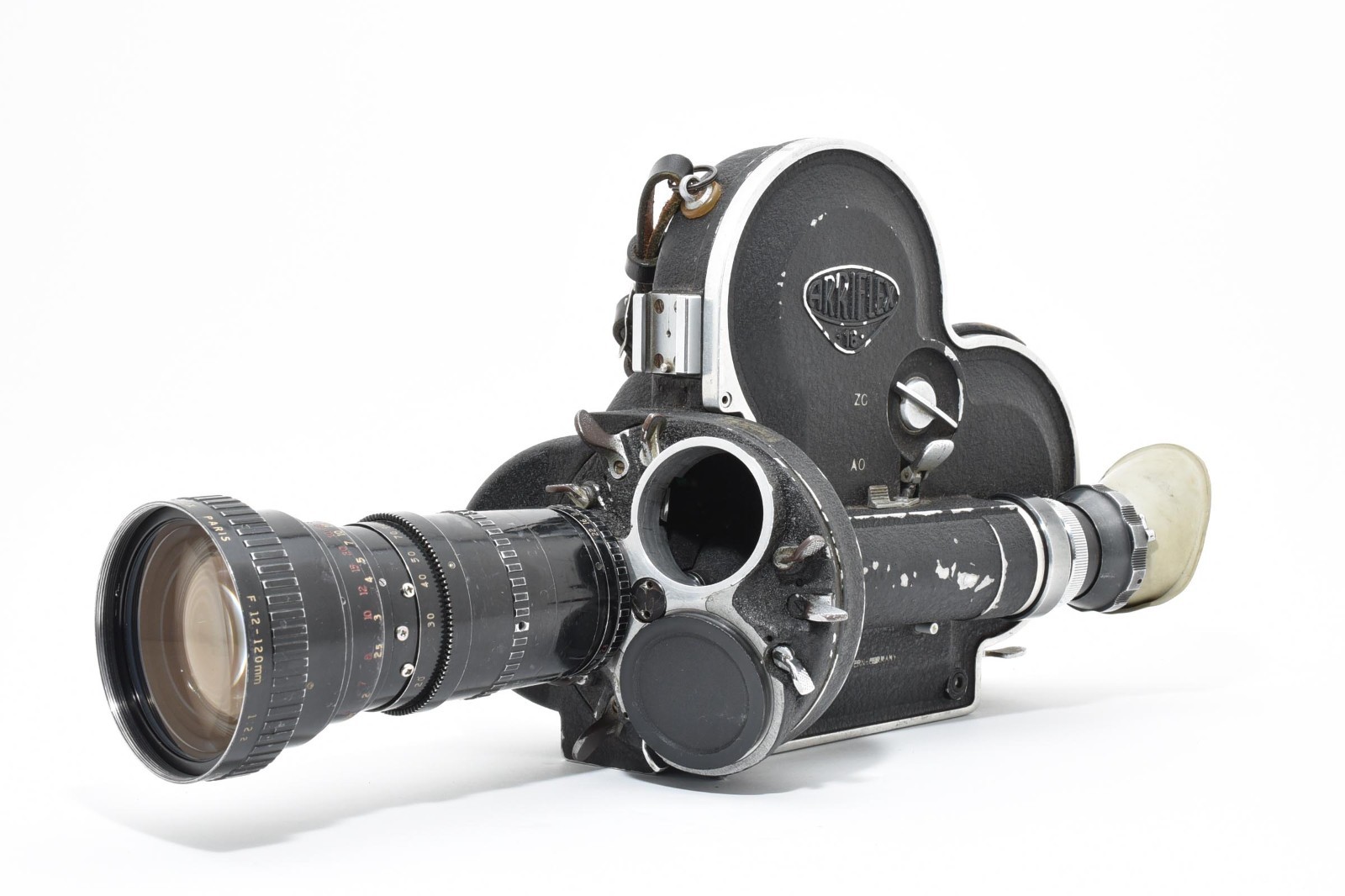
You can feel the history in the grip of the Arriflex 16 ST the moment you pick it up. Introduced in 1952 by Arnold & Richter (Arri), this wasn’t just another 16mm movie camera — it was the first professional model to feature a reflex mirror shutter, a breakthrough that fundamentally changed how filmmakers worked. Before this, you were guessing at focus and framing through a separate viewfinder. The 16 ST put the image directly in your eye, via a spinning mirror that synchronized with the film advance, so what you saw was what you got. That might sound obvious now, but back then, it was revolutionary.
It’s no exaggeration to call the 16 ST an iconic 16mm camera in the world. Designed by Erric Kneastner, it combined precision engineering with a thoughtful, ergonomic body layout. The cameraman grips the 45-degree angled mirror/shutter housing with four fingers, thumb resting on a curved extrusion — a design that feels natural once you’re in motion, though one Reddit user admitted being concerned about its weight when starting out. It’s not a lightweight kit, and it’s definitely not a beginner’s toy — it’s a serious tool for precise cinema work.
The 16 ST cemented Arri’s reputation for building high-quality 16mm professional film cameras, and collectors still treat it with reverence. It’s described as “more coveted” than the K-3, and while some users have compared it to the ARRI 16S (noting that the 16S has better build quality), the 16 ST holds its own as a landmark model. Even in 2016, it was still being used — one example was reportedly deployed on a documentary shoot in Turkey, a testament to its durability and enduring appeal.
Specifications
| Manufacturer | Arnold & Richter (Arri) |
| Film format | 16mm |
| Film capacity | Uses 30 meters cassettes |
| Magazines | 60m/200ft : 120m/400ft |
| Lens mount | tourelle pour objectif (lens turret) |
| Features | 3 lens rotating turret |
| Power requirement | needs a 8-12V power source |
| Motor type | electric motor |
Key Features
Reflex mirror shutter system
The defining innovation of the Arriflex 16 ST was its reflex viewing system — the first in a professional 16mm camera. By using a mirror that flipped in sync with the shutter, it allowed the operator to see through the lens in real time, eliminating parallax and focus guesswork. This wasn’t just a convenience; it was a fundamental shift in how films could be shot, especially in documentary and run-and-gun scenarios where precision mattered but time didn’t.
Ergonomic body design
The 16 ST’s body wasn’t just functional — it was sculpted for use. The 45-degree angled mirror/shutter housing isn’t just for looks; it’s the primary grip. Four fingers wrap around it, while the thumb rests on a curved extrusion, creating a secure, balanced hold. This design puts the camera’s center of gravity right in the hand, reducing fatigue during handheld shots. It’s a detail that feels intentional, not incidental — a sign of a tool built by people who understood how cameras are actually used.
Three-lens rotating turret
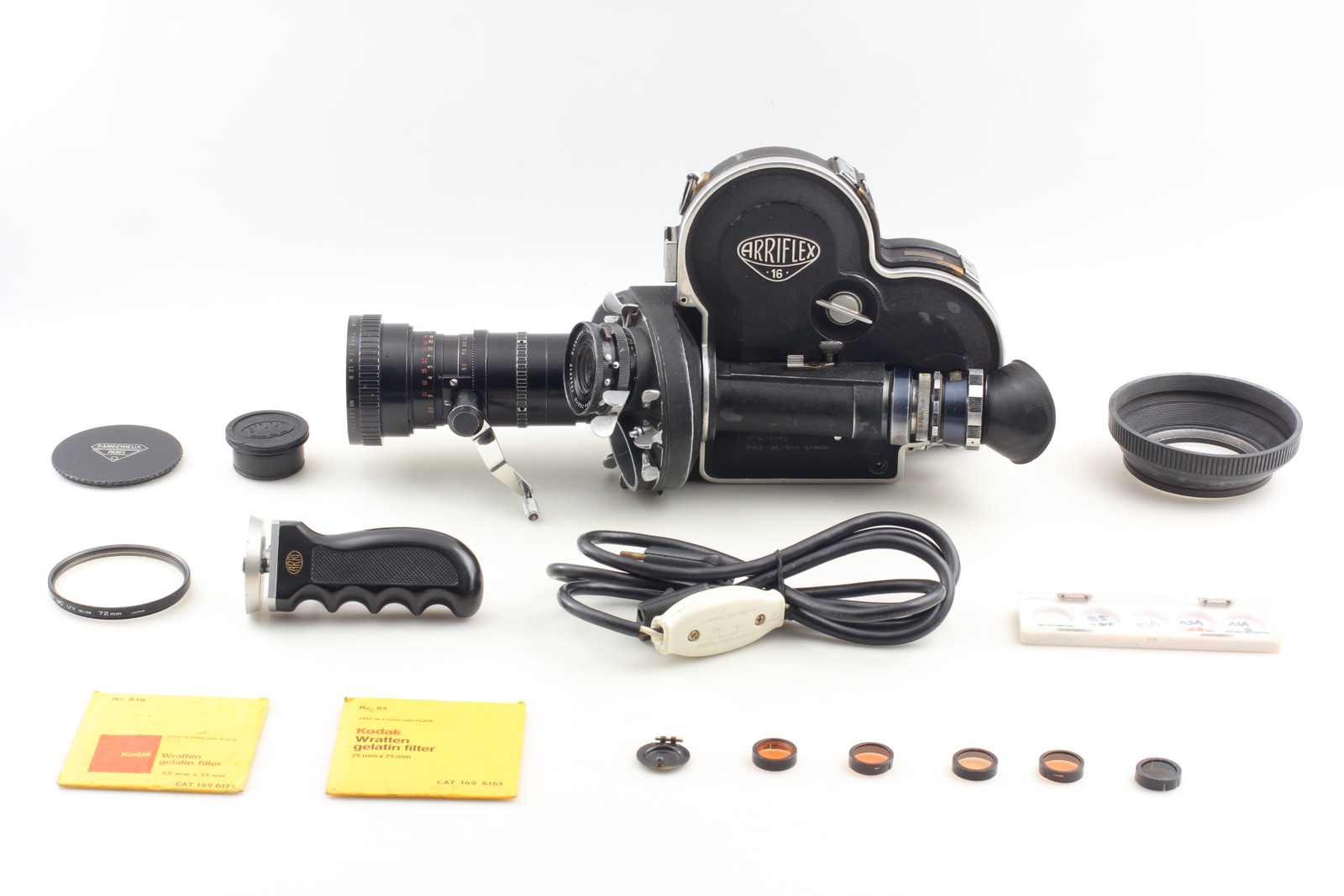
Mounted up front is a tourelle pour objectif — a rotating lens turret that holds three lenses. This wasn’t just about convenience; it allowed quick swaps between focal lengths without breaking stride. One listing mentions a kit that includes Schneider prime lenses (16mm, 30mm, 50mm), plus an Angénieux zoom — a high-end combination that speaks to the 16 ST’s role in serious production. The turret design became a signature of Arri cameras, and it started here in a professional 16mm form.
Modular accessories and power
The 16 ST was built to be expanded. It runs on an electric motor powered by an 8–12V source, and kits often included two motors, two 400 ft magazines, and a power cable with a European plug. The inclusion of an extended original Arri eyepiece suggests attention to operator comfort, especially during long takes. It’s a system, not just a camera — and that modularity helped it stay relevant for decades.
Collectibility & Value
The Arriflex 16 ST is a sought-after piece, and pricing reflects that. According to market estimates, average-condition units go for $900–1,000, while very good condition examples fetch $1,300–1,400. Mint-condition models can command $2,200–2,400. Historical sales support this range: a condition B-C unit sold for $1,144 in May 2011, a D-C example went for $699 in March 2009, and a condition B model brought $1,593 back in February 2003 — impressive for a 50-year-old camera even then.
One eBay listing offered a kit for $2,300, including lens, filters, and magazine, though it noted the lenses needed cleaning — a common caveat with vintage optics. The motors, at least, were reported to be running properly, which is critical since the electric motor is central to operation. While no data exists on common failures or maintenance issues, the fact that these cameras were still being used in 2016 suggests they’re robust if cared for.
For those looking to maintain or restore a 16 ST, original documentation is available — a printed manual goes for $15.95, and a “Technical Detail + Maintenance Book” is listed at $17.95. These aren’t just collectibles; they’re practical tools for keeping the camera alive.
eBay Listings


As an eBay Partner, we earn from qualifying purchases. This helps support our independent vintage technology research.
Service Manuals, Schematics & Catalogs
- Catalog (1966) — archive.org
- Catalog — archive.org
- Catalog — archive.org
Related Models
- Arriflex 16 BL (1965)
- Arriflex 16 SR (1975)
- Arriflex 35 BL (1972)
- Arriflex 35 IIC (1964)
- Beaulieu 4008 ZM II (1977)
- Beaulieu 5008 S (1976)
- Bell & Howell 134 (1940)
- Bell & Howell 2709 (1912)
- Bolex H16 Reflex (1956)
- Bolex H16 RX-5 (1966)