Arriflex 16 BL (1965)
The quiet revolution in 16mm filmmaking — a self-blimped workhorse built for sync sound, where silence wasn’t a luxury, it was the point.
Overview
If you’ve ever tried to capture dialogue on location with a clattering 16mm camera, you know the frustration: beautiful image, unusable sound. The Arriflex 16 BL was built to end that. Introduced in 1965 by Arnold & Richter (Arri), this wasn’t just another film camera — it was a solution. A professional 16mm motion picture camera designed from the ground up to be quiet enough for synchronous sound recording without external blimps or bulky housings. That’s the whole idea behind “self-blimped”: the noise suppression is built in, part of the chassis, not bolted on as an afterthought. It’s the kind of engineering that makes location shooters breathe easier.
The 16 BL carried forward the legacy of its predecessors — the 16 St and 16 M — while refining it for a new era of filmmaking where mobility and audio fidelity mattered more than ever. It wasn’t trying to reinvent the wheel, but to make the existing wheel quieter, smarter, and more adaptable. With its mirror-shutter design, precision film registration pin, and forward/reverse operation, it offered the reliability and image stability professionals demanded. And with features like a built-in tachometer and quick-change magazines, it kept pace with the rhythm of real-world production. This was a tool for people who needed to move fast, shoot clean, and record sound without compromise.
Specifications
| Manufacturer | Arnold & Richter (Arri) |
| Film gauge | 16mm |
| Type | Self-blimped 16mm camera |
| Film format | 16mm |
| Magazine capacity | 400 ft quick-change magazine |
| Lens mount | only one lens mount especially designed for the use of zoom lenses |
Key Features
The Quiet One
Call it what it is: the Arriflex 16 BL was built to be silent. Marketed as “The Quiet 16 mm mirror-shutter professional motion picture camera for location synchronous sound filming,” its entire design philosophy centered on noise reduction. Unlike earlier models that required external blimps — heavy, awkward enclosures that muffled the camera’s mechanical noise — the 16 BL had blimping engineered into the body itself. That meant you could roll film and record clean audio on set without turning your rig into a soundproofed tank. For documentary crews, newsreel teams, and indie filmmakers working with limited crews and tighter schedules, that was a game-changer. It wasn’t just quieter — it was professionally quiet, meeting the standards needed for sync sound without compromise.
Mirror-Shutter Precision
The mirror-shutter system wasn’t new to Arri, but it was perfected here. While the film is stationary during exposure (ensuring sharp, steady frames), the mirror rotates in sync with the shutter, allowing the viewfinder image to remain continuous. That means no blackout between frames — a huge advantage when tracking fast action or framing precise movements. Combined with the precision film registration pin, which locks each frame in place during exposure, the 16 BL delivered the kind of image stability that could stand up to big-screen scrutiny. It wasn’t just about being quiet; it was about being optically precise, mechanically reliable, and visually consistent.
Engineered for Zooms
One of the standout design choices was its lens mount — described as “only one lens mount especially designed for the use of zoom lenses.” At a time when zooms were becoming more common in field production but still posed challenges in balance, weight, and alignment, Arri didn’t just adapt an existing mount. They built one with zooms in mind. This wasn’t an afterthought; the camera was “designed taking today's advanced zoom lenses into consideration.” That meant better support, improved balance, and smoother operation when using heavier or longer lenses. For operators who needed to reframe on the fly — think news, sports, or vérité documentary — this was a subtle but critical upgrade.
Workflow That Works
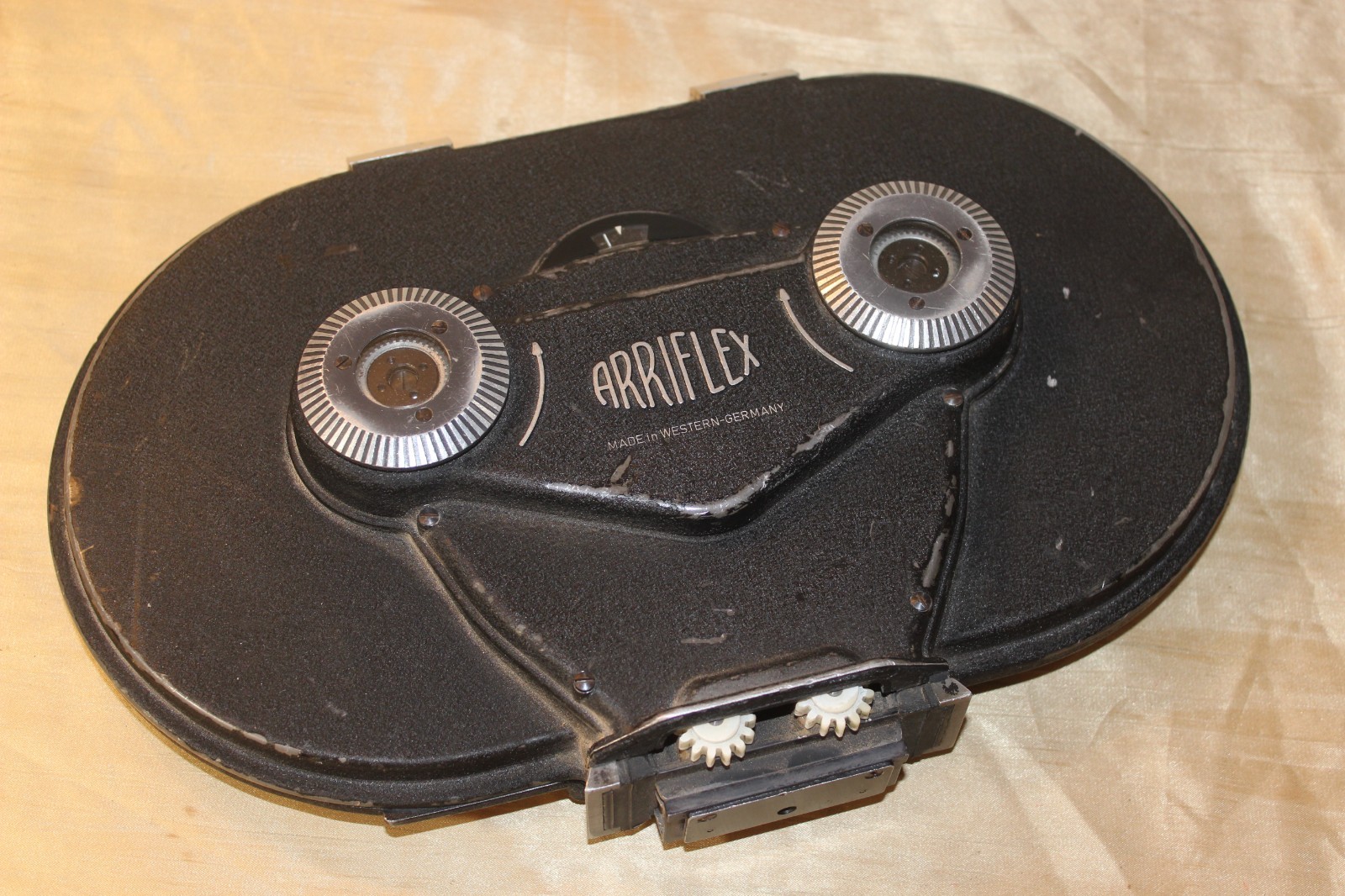
The 16 BL wasn’t just about silence and optics — it was built for the grind. Quick-changing magazines with built-in feed and take-up mechanisms meant you could swap film in seconds, not minutes. No fumbling with threading in the dark, no risk of fogging your roll. And the ARRI exposure control system? It’s tucked right into the inside of the camera door — convenient, protected, and always at hand. Add in forward and reverse operation (handy for checking focus or rewinding a take) and a built-in tachometer to monitor motor speed, and you’ve got a camera that anticipates real-world needs. This wasn’t a lab-bound museum piece; it was a field-ready tool that knew what shooters actually did.
Historical Context
The Arriflex 16 BL emerged at a moment when filmmakers were pushing beyond studio walls. Location shooting was becoming the norm, and sync sound was no longer a luxury — it was expected. Arri responded by focusing on one core problem: noise. Their stated goal was clear — “to develop a QUIET camera, of professional caliber for location sound filming” — and they built it around a set of practical virtues: versatility, compactness, light weight, and rugged reliability. It wasn’t a radical departure, but a refinement. By maintaining “the excellent technical features of the proven ARRIFLEX models 16 St and 16 M,” Arri ensured continuity for existing users while advancing the platform. This wasn’t a reinvention; it was evolution with purpose.
Collectibility & Value
Finding a complete, working Arriflex 16 BL today means navigating a market where full units are rare, but parts are surprisingly active. While no original pricing has been confirmed, current estimates suggest a full camera in average condition could fetch $1,000 to $1,100, with very good examples reaching $1,300 to $1,400 and mint units commanding $2,400 to $2,600. Historical sales data shows some volatility — a Condition C unit sold for $487 in 2013, while another Condition C model went for $775 the same year, and a 2007 sale hit $2,091 for a Condition C- unit, suggesting condition grading inconsistencies or market shifts over time.
Individual components still carry value: a crystal sync magazine sold for $507 in October 2023, and a bellows hood fetched $197 in December 2023. Even eyepieces — sold in lots — have moved for over $100. For restorers or collectors, the availability of a printed repair manual (Illustrated List of Parts) at $15.95 is a small but meaningful advantage. However, without documented common failures or maintenance pain points, servicing a 16 BL remains a challenge best left to specialists. It’s not a plug-and-play museum piece — it’s a mechanical artifact that demands knowledge to keep alive.
eBay Listings



As an eBay Partner, we earn from qualifying purchases. This helps support our independent vintage technology research.
Service Manuals, Schematics & Catalogs
- Owner's Manual — archive.org
- Owner's Manual (1965) — archive.org
- Catalog (1966) — archive.org
- Catalog — archive.org
- Catalog — archive.org
Related Models
- Arriflex 16 SR (1975)
- Arriflex 16 ST (1952)
- Arriflex 35 BL (1972)
- Arriflex 35 IIC (1964)
- Beaulieu 4008 ZM II (1977)
- Beaulieu 5008 S (1976)
- Bell & Howell 134 (1940)
- Bell & Howell 2709 (1912)
- Bolex H16 Reflex (1956)
- Bolex H16 RX-5 (1966)