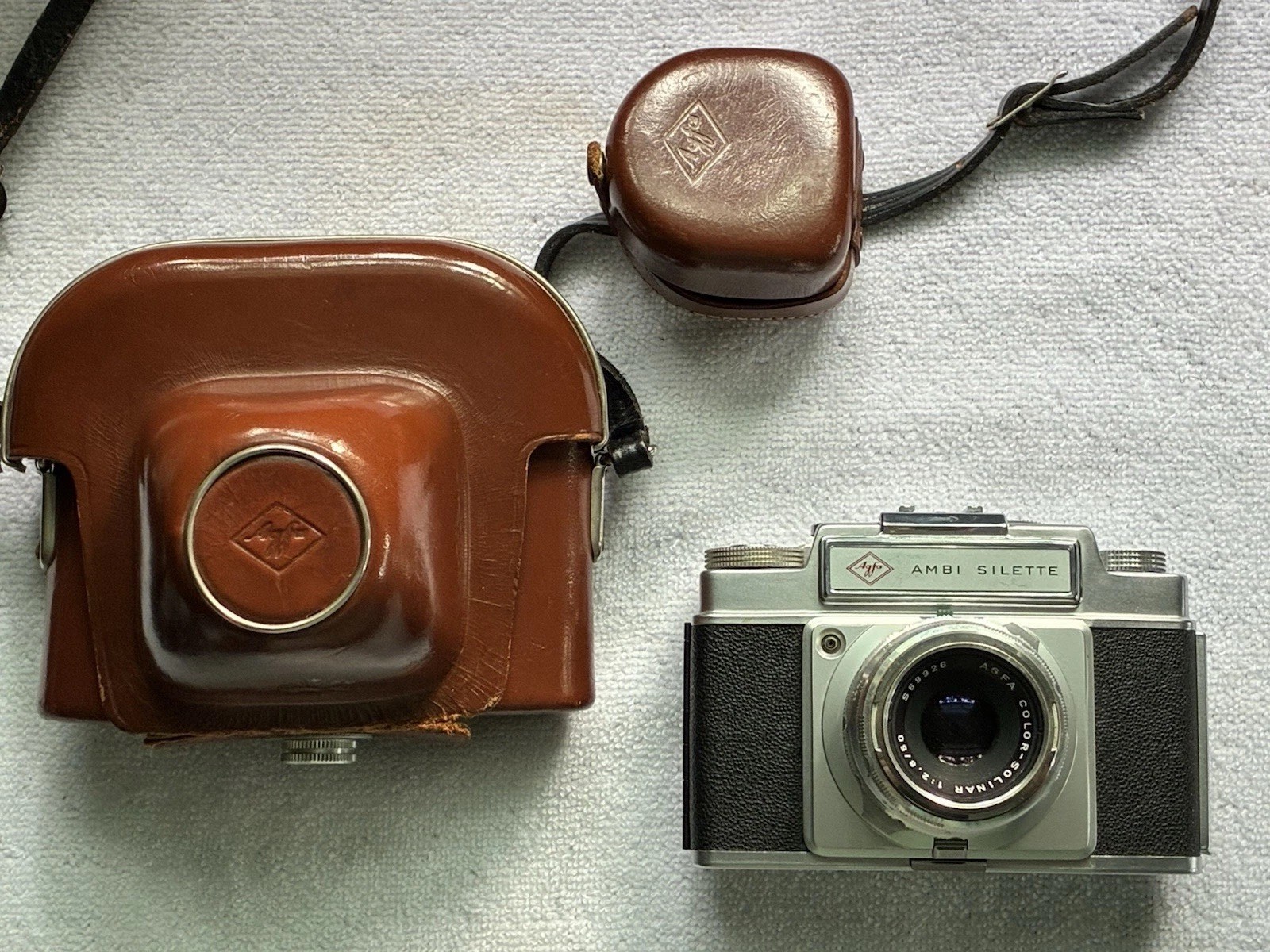
AGFA AMBI SILETTE
The Agfa Ambi Silette is a high-end 35mm rangefinder camera made by Agfa-Gevaert between 1957 and 1961. It is one of the few German-made rangefinders in Agfa's postwar lineup with interchangeable lenses.
Overview
Agfa introduced the Ambi Silette in 1957 as its flagship 35mm rangefinder. It was aimed at advanced amateurs and professionals who wanted a compact alternative to the dominant Leica and Contax systems. It was built in Leverkusen, West Germany, and was a modular system around the proprietary Silette bayonet mount. It belonged to Agfa's Ambi series, which also included simpler fixed-lens models like the Ambi Silette D and Ambi Silette Rapid. The interchangeable-lens version was the top of the range.
The Ambi Silette has a combined viewfinder and rangefinder window with superimposed brightlines and a central patch for manual focusing, typical of high-end rangefinders of the era. The body is all metal, with leather covering and knurled control dials. The shutter is a horizontal cloth focal-plane type with speeds from 1 to 1/1000 second, plus B. The shutter speed dial is coupled to the film advance lever, so the speed gets set correctly before the shutter is cocked. That safety feature was uncommon at the time. Film loading is also unusual: the back opens via a hinged door on the left side, and the film drops in without removing the spool.
Production ended in 1961, a fairly short run for such an advanced camera. Part of the reason was Agfa's shift toward simpler, mass-market cameras, and part was the rising dominance of SLRs. The Ambi Silette was Agfa's last serious attempt at the premium rangefinder market, and it remains a rare and respected piece of German engineering.
Specifications
| Specification | Value |
| Type | Rangefinder |
| Film Format | 35mm (135 cartridge) |
| Years Produced | 1957–1961 |
| Lens Mount | Silette bayonet mount |
| Shutter | Horizontal cloth focal-plane; 1, 1/2, 1/4, 1/8, 1/15, 1/30, 1/60, 1/125, 1/250, 1/500, 1/1000 sec, B |
| Metering | None (uncoupled light meter optional) |
| Exposure Modes | Manual only |
| Viewfinder | Combined optical viewfinder and coincident-image rangefinder with 50mm brightlines |
| Dimensions | Approx. 145 × 80 × 55 mm; Weight: ~680 g (body only) |
Key Features
- Interchangeable Silette Mount Lenses: Supported a range of high-quality Agfa Color-Aristar lenses including 35mm f/2.8, 50mm f/2, 85mm f/2, and 135mm f/4.
- Precision Focal-Plane Shutter: Offered speeds up to 1/1000 sec, rare among rangefinders of the period.
- Integrated Rangefinder Coupling: Accurate focusing with a bright, clear patch and automatic parallax correction.
- Drop-in Film Loading: Hinged back allowed loading without threading, simplifying the process.
- Shutter-Speed Safety Lock: Shutter could not be cocked unless the speed was correctly set, preventing missed exposures.
Historical Context
The late 1950s brought intense competition among German and Japanese manufacturers in the 35mm camera market. The Leica M3 (1954) and Contax G2 (though later) set the standard for rangefinder precision. Agfa went after a niche with a technically sophisticated but accessible alternative. The Ambi Silette was Agfa's answer to the Leica M series, with similar functionality, a more modern shutter design and easier film loading.
The competition was stiff. Leica was one rival, and emerging Japanese brands like Nikon (with the Nikon S series) and Canon were rapidly improving their rangefinders. The market was also shifting toward single-lens reflex (SLR) cameras, which gave through-the-lens viewing and easier lens interchangeability. Despite the Ambi Silette's technical merits, Agfa lacked the ecosystem and brand prestige of Leica, and production volumes stayed low. The company soon pivoted to consumer-oriented models, such as the Agfa Optima line, which used built-in CdS meters and automation. Those trends signaled the decline of the manual rangefinder.
Collectibility & Value
The Agfa Ambi Silette is rare and sought after among collectors of vintage German optics and rangefinder enthusiasts. Production was limited and the market life was short, so complete examples in working condition are uncommon. As of 2024, a fully functional Ambi Silette with a standard 50mm f/2 Color-Aristar lens typically sells for between €800 and €1,500, depending on condition, lens included, and provenance. Models with rarer lenses such as the 85mm f/2 or 135mm f/4 can fetch significantly more, especially if the lens is unscratched and the shutter runs accurately at all speeds.
When buying an Ambi Silette, check the shutter for consistency, particularly at high speeds (1/500 and 1/1000 sec). Cloth shutters from this era are prone to fraying or timing errors. Check the rangefinder alignment too, because a misaligned one makes precise focusing impractical. The leather covering often deteriorates over time, and replacing it is difficult because of the camera's unique shape. The Silette mount is proprietary and incompatible with modern systems, so lens choice is limited to original Agfa optics, which are themselves rare. Servicing takes specialized knowledge, since spare parts are not manufactured.
Similar Cameras
- Leica M3 (1954–1966): The benchmark for 35mm rangefinders; superior build and ecosystem, but significantly more expensive.
- Nikon S2 (1954–1958): Japanese alternative with excellent optics and robust build, compatible with a wide range of Nikon rangefinder lenses.
- Contax IIa/IIIa (1950–1961): Pre-war design updated postwar; complex but precise, with a large viewfinder and rangefinder.
- Canon VT (1956–1961): Compact rangefinder with interchangeable lenses and a bright viewfinder, aimed at similar users.
- FED 4 (Soviet Union, 1955–1970s): Leica-inspired, lower-cost option with interchangeable lenses and rangefinder, though less refined.
Repair & Maintenance
The Agfa Ambi Silette is fully mechanical and needs no batteries. Because of its age, it still needs regular maintenance. The horizontal cloth shutter can stick or give uneven speeds, particularly if the camera was stored improperly. A CLA (Clean, Lubricate, Adjust) by a technician experienced in vintage German cameras is recommended before regular use. The rangefinder may need recalibration if the image patch fails to align. Check the film advance lever and shutter cocking mechanism for smooth operation. Replacement parts are scarce, so repairs often mean careful restoration rather than swapping parts. Owners are advised to avoid extreme humidity or temperature, which can degrade the leather and internal lubricants.
eBay Listings


As an eBay Partner, we earn from qualifying purchases. This helps support our independent vintage technology research.
Service Manuals & Schematics
- Owner's Manual — archive.org