Yamaha TC-920: The Quiet Workhorse of Yamaha’s Cassette Era
In the late 1970s, as high-fidelity audio systems reached new levels of sophistication, cassette decks evolved from simple portable recorders into precision audio components. Among the many manufacturers pushing the boundaries of analog tape technology, Yamaha stood out for its engineering rigor, musical sensibility, and commitment to value. The Yamaha TC-920, introduced in 1978, was one such model—a no-frills yet highly capable cassette deck that exemplified Yamaha’s philosophy of combining reliability, accuracy, and musicality in a compact, well-engineered package.
Though not as widely celebrated as some of its more premium siblings like the TC-850 or TC-1000, the TC-920 carved out a loyal following among audiophiles and home recording enthusiasts who appreciated its consistent performance and thoughtful design. Positioned in the upper-mid tier of Yamaha’s cassette lineup, the TC-920 offered many of the features found in higher-end models without the premium price tag, making it a smart choice for those building a serious two-channel system during the analog tape heyday.
Technical Specifications
The Yamaha TC-920 was engineered with a focus on stable tape transport, accurate azimuth alignment, and low noise—hallmarks of a well-designed cassette deck. While not a fully professional machine, it incorporated several pro-grade features that elevated its performance above typical consumer models.
| Specification | Detail |
| Year Introduced | 1978 |
| Type | 3-Head, Dual Capstan Cassette Deck |
| Tape Speed | 1⅞ ips (4.76 cm/s) |
| Head Configuration | Separate Record, Playback, Erase Heads |
| Azimuth Adjustment | Fixed (factory-set) |
| Motor Type | Dual Direct-Drive Motors |
| Wow and Flutter | < 0.08% (Dolby On) |
| Frequency Response | 40Hz – 15kHz (Dolby B) |
| Signal-to-Noise Ratio | 68 dB (Dolby B) |
| Input Level (Recording) | 150 mV (1kHz, 0dB) |
| Output Level (Playback) | 1.2 V (1kHz, 0dB) |
| Input Impedance | 47 kΩ |
| Output Impedance | 12 kΩ |
| Power Requirement | 120V AC, 60 Hz |
| Power Consumption | 18 watts |
| Dimensions (W×H×D) | 435 × 137 × 295 mm |
| Weight | 8.1 kg (17.8 lbs) |
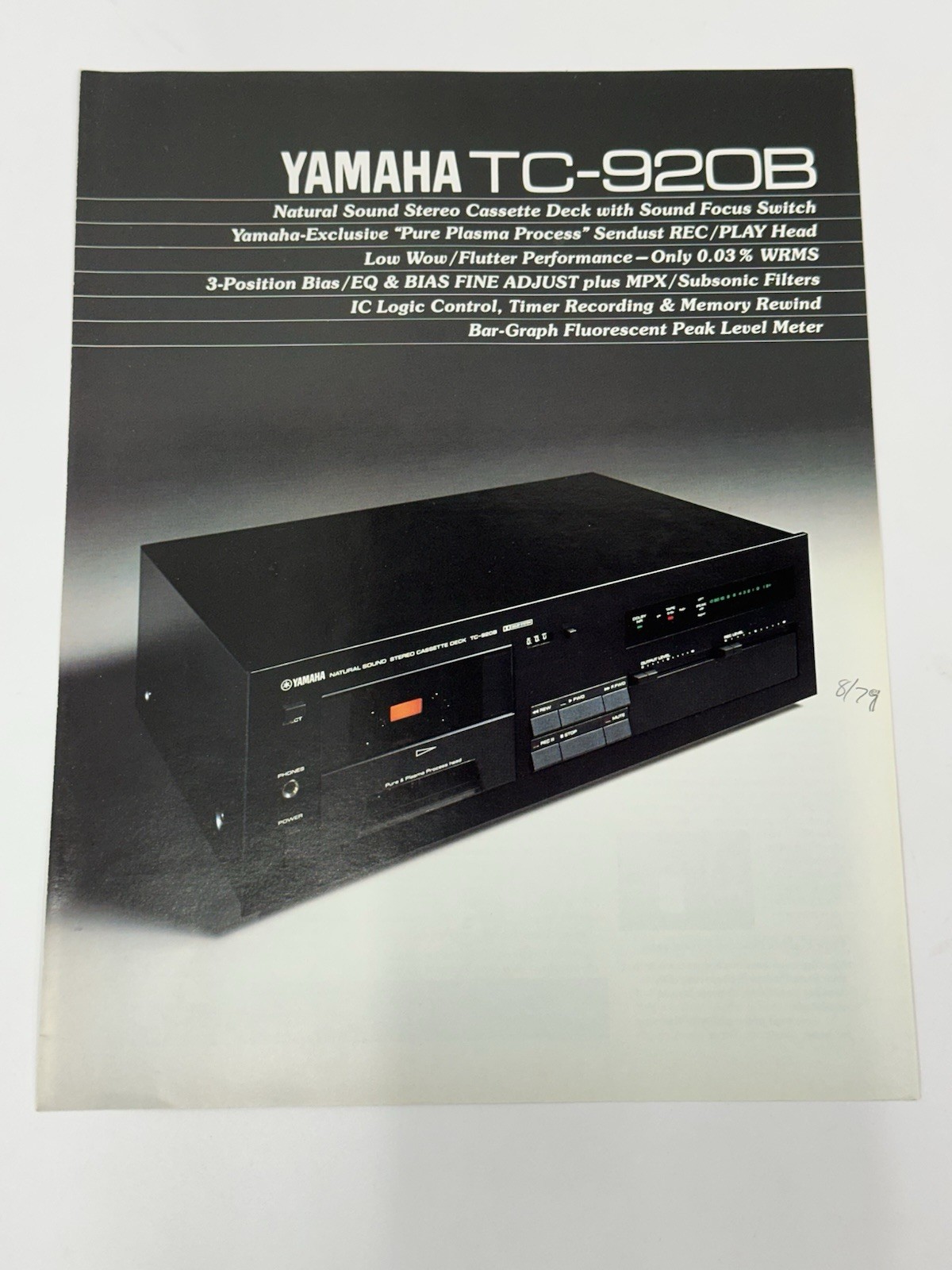
The use of a 3-head system—with independent record, playback, and erase heads—allowed for superior monitoring during recording, a feature typically found on more advanced decks. This meant users could listen to the playback head output in real time while recording, ensuring optimal levels and sound quality. The dual direct-drive capstan system minimized tape slippage and ensured consistent tape tension, contributing to the low wow and flutter figures that were impressive for its class.
Sound Characteristics and Performance
The Yamaha TC-920 delivered a sound signature that was clean, neutral, and remarkably transparent for a mid-tier cassette deck. It lacked the exaggerated warmth or brightness that some manufacturers used to mask tape limitations, instead presenting a balanced, accurate reproduction that let the source material speak for itself.
With Dolby B noise reduction engaged, the TC-920 achieved a surprisingly wide frequency response and low background hiss, making it well-suited for recording vinyl, FM broadcasts, or even line-level sources from a turntable preamp. The 3-head design ensured excellent channel separation and precise stereo imaging, while the fixed but well-aligned heads provided consistent azimuth performance—critical for preserving high-frequency detail.
Users reported that the TC-920 handled Type I (ferric) and Type II (chrome) tapes with equal competence, though optimal performance was achieved with good-quality chrome tapes and proper bias settings (manually selectable via front-panel switch). The deck’s electronics were clean and low-distortion, contributing to its reputation as a reliable tool for both playback and home duplication.
Notable Features and Innovations
While the TC-920 wasn’t loaded with flashy features, it offered several thoughtful design elements that enhanced usability and performance:
- Dual Capstan Transport: Reduced tape flutter and improved speed stability.
- 3-Head System: Enabled real-time monitoring during recording.
- Manual Tape Type Selection: Allowed optimization for ferric, chrome, or metal tapes (though metal tape support was limited).
- Dolby B Noise Reduction: Standard for high-end cassette decks of the era, reducing high-frequency hiss by up to 10 dB.
- Level Meters: Large VU meters provided clear visual feedback for recording levels.
- Direct Drive Motors: Enhanced speed accuracy and reduced mechanical wear over time.
- Solid Chassis Construction: A heavy, rigid metal frame minimized vibration and contributed to long-term reliability.
One of the TC-920’s most underappreciated features was its ease of maintenance. Yamaha used high-quality, long-lasting rubber drive belts and idler wheels, and the internal layout was relatively accessible for cleaning and demagnetizing—routine tasks essential for preserving tape deck performance.
Common Issues and Maintenance
Like all vintage cassette decks, the Yamaha TC-920 requires periodic maintenance to perform at its best. The most common issues encountered today include:
- Deteriorated Rubber Components: Belts, tires, and pressure pads can harden or crack over time, leading to poor tape contact or transport malfunctions. Replacement with modern equivalents is recommended.
- Dirty or Worn Heads: Accumulated oxide residue can dull sound quality. Regular cleaning with isopropyl alcohol and a lint-free swab is essential.
- Magnetic Buildup: Demagnetizing the heads and tape path every 50–100 hours of use helps maintain frequency response and clarity.
- Capstan Shaft Stiction: If the deck has been idle for years, the capstan shafts may require cleaning and lubrication to restore smooth operation.
Fortunately, the TC-920’s modular design makes servicing straightforward, and many of its internal components are still available through vintage audio suppliers. Its robust build means that, with proper care, a restored TC-920 can continue to deliver excellent performance decades after its manufacture.
Current Market Value and Collectibility
The Yamaha TC-920 is not a rare or highly sought-after collector’s item like some of the flagship models from Nakamichi or Revox, but it holds steady appeal among practical audiophiles and cassette enthusiasts. In today’s market, a fully serviced and functional TC-920 typically sells for $150–$250, depending on condition and included accessories.
Its value lies not in rarity, but in reliability and performance per dollar. For those building a vintage system with cassette capability—especially for archiving vinyl or enjoying pre-recorded music tapes—the TC-920 offers a compelling balance of quality and affordability.
While it may not command attention at audio shows, it’s the kind of deck that quietly wins fans through consistent, no-nonsense performance.
Conclusion and Legacy
The Yamaha TC-920 may not have the name recognition of a Nakamichi Dragon or a Sony TC-V55, but it represents the quiet excellence of Yamaha’s engineering philosophy during the golden age of analog audio. It wasn’t designed to impress with flashy specs or exotic materials, but to deliver accurate, reliable tape reproduction with minimal fuss.
In an era when cassette decks were transitioning from convenience devices to serious audio components, the TC-920 stood as a testament to Yamaha’s commitment to musical integrity and user-focused design. Today, it remains a worthy addition to any vintage audio setup—a dependable, well-built machine that continues to honor the analog experience with every turn of the capstan.
For the discerning listener who values substance over spectacle, the Yamaha TC-920 is a hidden gem well worth rediscovering.
eBay Listings


As an eBay Partner, we earn from qualifying purchases. This helps support our independent vintage technology research.
Related Models
- Yamaha CT-610 (1978)
- Yamaha CT-7000 (1978)
- Yamaha CT-710 (1976)
- Yamaha CT-810 (1978)
- Yamaha TC-1000 (1978)
- Sony TC-2050SD (1978)
- Aiwa AD-F990 (1993)
- Kenwood KX-3060 (1982)
- Sony TC-2130A (1974)
- Sony TC-2220 (1972)