Yamaha R-100 (1973)
The Yamaha R-100 is a vintage integrated receiver introduced in 1973, during a pivotal era in audio equipment development when Japanese manufacturers began to establish themselves as serious contenders in the high-fidelity market. As one of Yamaha's early forays into the receiver category, the R-100 embodies the company’s commitment to precision engineering, musical accuracy, and durability—hallmarks that would come to define Yamaha's reputation in the audiophile world.
Though not as widely documented as some of its contemporaries, the R-100 holds a quiet distinction among collectors and vintage audio enthusiasts for its clean, no-frills design and reliable performance. It represents a transitional period when receivers were evolving from basic AM/FM tuners with amplification into more sophisticated all-in-one components capable of delivering high-quality sound reproduction.
Design and Build Quality
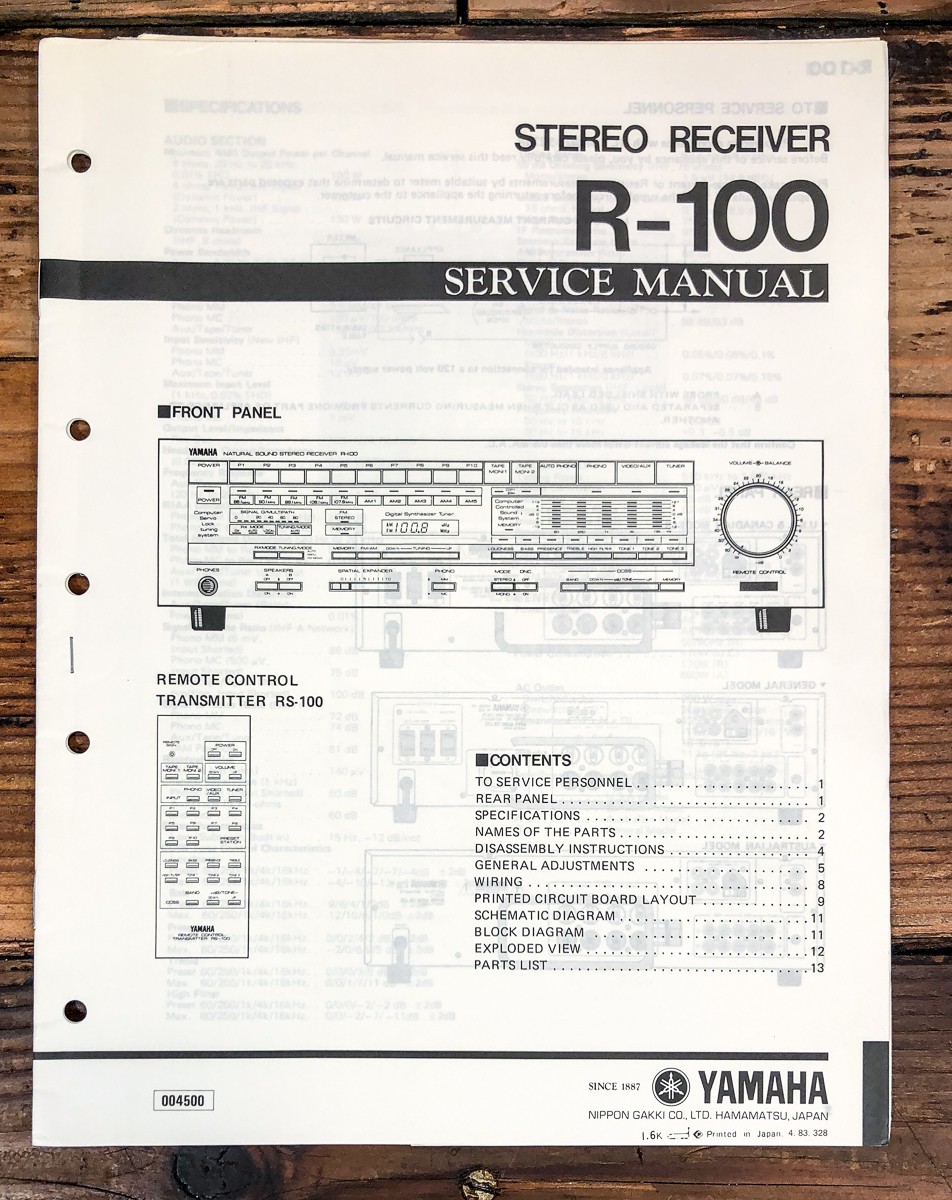
The Yamaha R-100 features a minimalist front panel typical of early 1970s Japanese audio gear. It sports a brushed aluminum faceplate with a symmetrical layout, housing large rotary knobs for volume, tuning, and input selection. The aesthetic is utilitarian yet elegant, reflecting the era’s preference for functional design over flashiness. The receiver measures approximately 435 mm (W) × 156 mm (H) × 360 mm (D) and weighs around 12 kg (26.5 lbs), indicating a robust internal construction with a substantial power transformer and heat dissipation systems.
Build quality is excellent by the standards of its time. Yamaha used high-grade components throughout, including durable potentiometers and switches sourced from reputable suppliers. The chassis is well-shielded to minimize interference between the tuner and amplifier sections, a common issue in integrated receivers of the period.
Audio Performance
The R-100 delivers 60 watts per channel into 8 ohms, a respectable output for its era. While not as powerful as some of the higher-end models released later in the decade, this power rating is sufficient to drive a wide range of bookshelf and floor-standing speakers commonly used in the 1970s. The amplifier section employs a dual-differential input stage and a complementary push-pull output configuration, contributing to low distortion and a neutral sonic character.
Frequency response is rated at 20 Hz to 20 kHz (±0.5 dB), with a total harmonic distortion of less than 0.1% at rated output. These specifications indicate a well-engineered amplifier designed for accurate sound reproduction rather than coloration. The damping factor is approximately 40, which, while modest by modern standards, provides adequate control over most passive speakers of the era.
Signal-to-noise ratio exceeds 80 dB, ensuring a quiet background during playback. The use of discrete transistors—rather than integrated circuits—throughout the audio path was typical for the time and contributes to the unit’s serviceability and longevity.
Tuner Section
The R-100 includes both AM and FM tuner sections, with analog needle meters for signal strength and tuning accuracy. The FM tuner utilizes a phase-locked loop (PLL) system or a similar high-stability design, ensuring consistent reception and minimal drift. It supports the standard 88–108 MHz FM band with a sensitivity of around 1.8 µV for 20 dB quieting, which was competitive for its time.
The AM section covers the standard medium wave broadcast band (530–1710 kHz) with adequate selectivity and sensitivity for local and regional stations. While not designed for DX (long-distance) reception, it performs reliably under normal listening conditions.
Tuning is accomplished via a large rotary knob connected to a mechanical dial with a luminous scale, allowing for precise station selection. The inclusion of a stereo indicator light and a mono/stereo switch reflects the transitional phase of FM broadcasting, when stereo compatibility was still becoming standardized.
Inputs and Outputs
The R-100 offers a modest but functional array of connectivity options typical of early 1970s receivers:
- Phono input (MM): Equipped with RIAA equalization for moving magnet cartridges. Input sensitivity is approximately 3 mV.
- Tape input/output: One tape loop with standard RCA jacks, allowing for recording from the receiver to an external tape deck.
- Auxiliary input: For connecting additional line-level sources such as a tuner, CD player (added later), or television.
- Preamp output: Allows for future expansion with an external power amplifier.
- Speaker terminals: Dual sets for A/B speaker selection, compatible with 4–16 ohm loads.
The rear panel is cleanly laid out with gold-plated or brass binding posts for speaker connections and color-coded RCA jacks for inputs and outputs.
Technical Innovations and Yamaha's Philosophy
In the early 1970s, Yamaha was still establishing its identity in the consumer audio market. Unlike some competitors who emphasized flashy features or exaggerated power ratings, Yamaha focused on measured performance, reliability, and musical fidelity. The R-100 reflects this philosophy with its conservative specifications and emphasis on engineering integrity.
One of Yamaha’s core principles during this period was the use of extensive listening tests combined with technical measurement—a practice that would later become central to their product development. The R-100, while not a flagship model, benefited from this rigorous approach, resulting in a receiver that sounds balanced and natural across a wide range of musical genres.
Serviceability and Maintenance
As a product of the 1970s, the R-100 is relatively easy to service compared to modern integrated electronics. Most components are through-hole mounted on accessible circuit boards, and service manuals were historically available through Yamaha’s technical support network. Common maintenance tasks include recapping the power supply, cleaning potentiometers and switches, and aligning the FM tuner if reception issues arise.
Due to its age, original units may require restoration to achieve optimal performance. Capacitors, in particular, degrade over time and should be replaced to prevent hum, distortion, or failure. However, the availability of replacement parts and active online communities make the R-100 a viable candidate for restoration.
Legacy and Collectibility
The Yamaha R-100 is not as widely recognized as later models like the R-5, R-6, or the legendary CR-800 series, but it holds a quiet respect among vintage audio aficionados. It represents an important chapter in Yamaha’s evolution from a musical instrument manufacturer to a full-line audio electronics brand.
Today, the R-100 is sought after by collectors who appreciate its understated design, solid build, and authentic 1970s sound. While not a high-power beast, it delivers a warm, engaging listening experience that pairs well with vintage speakers like the Yamaha NS-1000, KEF LS3/5a, or Advent speakers.
Units in good working condition typically sell for $200–$400 in the vintage audio market, depending on cosmetic condition and functionality. Fully restored examples with upgraded capacitors and cleaned controls command higher prices.
Conclusion
The Yamaha R-100 may not have the fame of some of its peers, but it stands as a well-crafted, honest receiver from a formative period in Yamaha’s audio history. Its combination of solid performance, thoughtful design, and reliability makes it a rewarding addition to any vintage audio setup. Whether used as a daily driver in a retro system or preserved as a collector’s item, the R-100 exemplifies the quiet excellence of early 1970s Japanese hi-fi engineering. For those exploring the roots of modern audio, the Yamaha R-100 is a worthy ambassador of its era.
eBay Listings



As an eBay Partner, we earn from qualifying purchases. This helps support our independent vintage technology research.
Related Models
- Yamaha CA-2010 (1972)
- Yamaha CR-400 (1975)
- Yamaha CR-800 (1978)
- Yamaha UC-1 (1979)
- Pioneer QX-949A (1978)
- Pioneer SX-2000 (1978)
- Pioneer SX-2500 (1978)
- Marantz SR-2000 (1999–2001)
- Onkyo TX-1500MKII (1975)
- Pioneer QX-646 (1978)