Teac W-520-R: The Quiet Master of Analog Tape
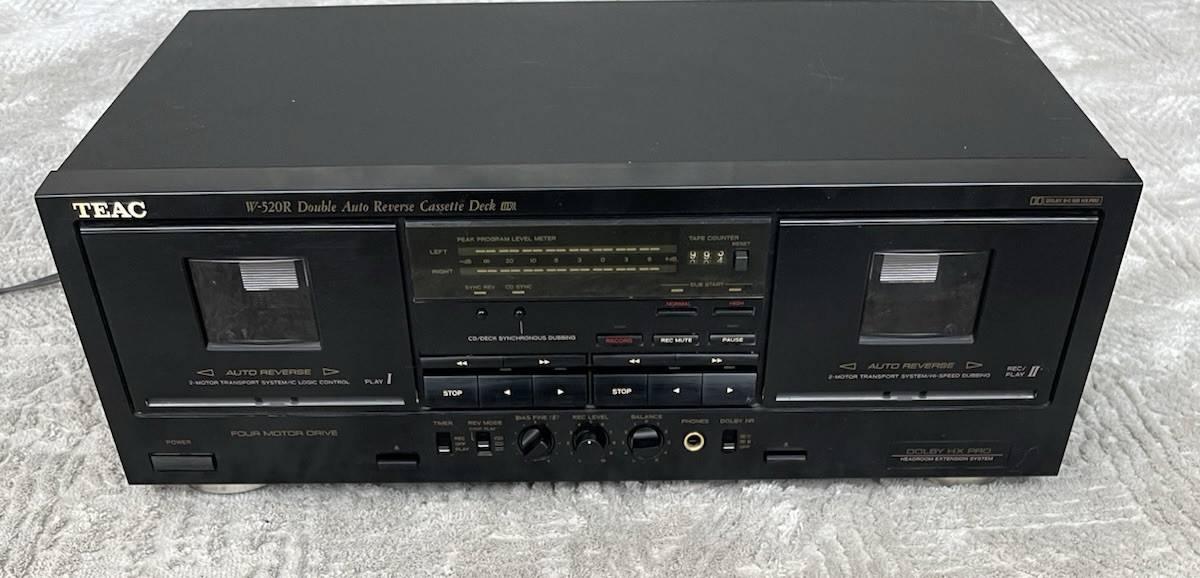
In the late 1970s, when cassette tapes were gaining popularity for convenience and portability, Teac stood apart by continuing to refine the art of open-reel analog recording. The Teac W-520-R, released around 1978, was not just another reel-to-reel deck—it was a statement of fidelity, precision, and dedication to the audiophile ideal. Though less widely known than some of its siblings in the Teac lineup, the W-520-R has quietly earned a cult following among tape enthusiasts and vintage audio collectors for its exceptional build quality, smooth operation, and rich, musical playback.
Part of Teac’s professional-leaning consumer series, the W-520-R was designed for serious home recording and high-fidelity music reproduction. It arrived during a transitional period in audio history—when digital was on the horizon, but analog tape still reigned supreme in studios and discerning listening rooms. The W-520-R didn’t try to compete with futuristic promises; instead, it focused on doing one thing exceptionally well: capturing and reproducing sound with warmth, detail, and analog soul.
Technical Specifications
The W-520-R was engineered with a blend of studio-grade components and user-friendly features, making it suitable for both home taping and semi-professional use. It supported standard ¼-inch tape on 7-inch or 10.5-inch reels and offered multiple tape speeds for flexibility in recording and playback.
| Specification | Detail |
| Model | W-520-R |
| Manufacturer | Teac Corporation, Japan |
| Year Introduced | 1978 |
| Format | ¼-inch open-reel analog tape |
| Tape Speeds | 7.5 ips, 15 ips (standard) |
| Track Configurations | 4-track stereo (½-track playback) |
| Heads | 3-head design (erase, record, playback) |
| Motor Type | Dual direct-drive motors |
| Wow and Flutter | < 0.20% (15 ips, RMS) |
| Frequency Response | 30Hz – 20kHz (15 ips, +3/-6dB) |
| Signal-to-Noise Ratio | > 60 dB (Dolby B capable) |
| Inputs | Line In (RCA), Mic In (¼" jack) |
| Outputs | Line Out (RCA), Headphones (¼" jack) |
| Recording Equalization | 120 µs / 70 µs (switchable) |
| Power Supply | 120V AC, 60 Hz (North American version) |
| Dimensions | 440 mm (W) × 145 mm (H) × 350 mm (D) |
| Weight | 12.5 kg (27.5 lbs) |
The 3-head configuration was a hallmark of high-end decks, allowing for precise monitoring of the recorded signal—a feature especially valuable for musicians and engineers making live recordings. The dual direct-drive motors ensured consistent tape tension and speed stability, minimizing wow and flutter and contributing to the deck’s excellent dynamic range.
Sound Characteristics and Performance
The Teac W-520-R delivers what many audiophiles seek in analog: a smooth, warm, and immersive soundstage. At 15 inches per second (ips), the W-520-R reveals its full potential, offering extended high frequencies, tight bass response, and a three-dimensional quality that digital formats often struggle to replicate. Even at 7.5 ips, the deck maintains impressive clarity and presence, making it ideal for archiving vinyl records or capturing live performances.
Tape saturation on the W-520-R is gentle and musical—never harsh—adding a pleasing harmonic richness to vocals and acoustic instruments. When paired with high-quality tape (such as Ampex 456 or RMGI SM900), the results are stunningly lifelike. The inclusion of Dolby B noise reduction (optional) helps tame tape hiss without overly dulling the high end, preserving the natural sparkle of the recording.
One of the W-520-R’s strengths is its transparency. It doesn’t impose a strong sonic signature; instead, it faithfully renders the source material while enhancing it with the organic texture that only analog tape can provide. Whether you're duplicating LPs, recording FM broadcasts, or tracking a solo piano, the W-520-R captures the emotional essence of the performance.
Notable Features and Innovations
While not as flashy as some of Teac’s more famous models (like the X-10 or A-3340), the W-520-R includes several thoughtful features that reflect Teac’s engineering excellence:
- 3-Head Design with Real-Time Monitoring: Enables accurate monitoring during recording, essential for level setting and error detection.
- Dual Direct-Drive Motors: Eliminates capstan belts that can stretch or degrade over time, ensuring long-term speed accuracy.
- Switchable EQ Settings: Allows compatibility with different tape formulations (e.g., normal bias vs. high bias tapes).
- Front-Panel Level Meters: Large VU meters provide clear visual feedback for input and output levels.
- Solid Mechanical Construction: Die-cast chassis and metal transport components ensure durability and reduce vibration.
- User-Friendly Layout: Intuitive controls and clearly labeled switches make operation straightforward, even for beginners.
The W-520-R also features a dedicated record level control with a calibration tone generator, enabling precise tape alignment—a must for achieving optimal frequency response and minimizing distortion.
Common Issues and Maintenance
Like all vintage tape decks, the Teac W-520-R requires periodic maintenance to perform at its best. The most common issues stem from age-related wear:
- Deteriorated Rubber Components: Although the W-520-R uses direct drive, it still has rubber idlers and pressure pads that may harden or crack over time. These should be replaced during servicing.
- Dirty or Worn Heads: Tape heads accumulate oxide buildup and may need demagnetizing and cleaning with isopropyl alcohol.
- Capacitor Aging: Electrolytic capacitors in the power supply and audio circuits can dry out, leading to noise or malfunction. A recap by a qualified technician is recommended for heavily used units.
- Tape Path Misalignment: Over time, guides can shift slightly, affecting tracking and frequency response. Professional alignment ensures optimal playback.
With proper care—regular cleaning, demagnetization, and occasional calibration—the W-520-R can continue to deliver outstanding performance for decades. It’s a testament to Teac’s build quality that many units still operate flawlessly today.
Current Market Value and Collectibility
The Teac W-520-R is not as widely collected as some of Teac’s more iconic models, but its reputation among reel-to-reel enthusiasts is growing. Units in good working condition typically sell for $400–$700, depending on cosmetics, functionality, and included accessories. Fully serviced and calibrated decks with replaced rubber parts command higher prices, especially if they include original manuals or tape calibration tools.
While not a rare “unicorn” model, the W-520-R is increasingly recognized as a hidden gem—a no-nonsense, high-performance recorder from Teac’s golden era. Its appeal lies in its reliability, sonic quality, and understated elegance. For collectors focusing on analog tape or Japanese audio craftsmanship, the W-520-R is a worthy addition.
Conclusion and Legacy
The Teac W-520-R may not have the name recognition of a Nakamichi Dragon or a Revox A77, but it stands proudly among the ranks of high-fidelity reel-to-reel recorders. It represents a time when Japanese manufacturers like Teac, Akai, and Sony pushed the boundaries of home audio, blending precision engineering with musicality.
Today, the W-520-R appeals to a niche but passionate audience: analog purists, tape archivists, and musicians who value the tactile experience and sonic depth of open-reel recording. In an age of digital perfection, the W-520-R reminds us that sometimes, the imperfections—tape hiss, slight saturation, the whir of spinning reels—are what make music feel alive.
If you’re lucky enough to find a well-maintained Teac W-520-R, treat it with care. Clean the heads, demagnetize the path, and play a reel of jazz at 15 ips. You’ll be rewarded with a listening experience that’s not just accurate—but deeply human.
eBay Listings



As an eBay Partner, we earn from qualifying purchases. This helps support our independent vintage technology research.
Service Manuals & Schematics
- Service Manual — archive.org
Related Models
- Teac A-6700DX (1980)
- Teac A-105 (1975)
- Teac A-106 (1975)
- Teac A-170 (1976)
- Teac A-2300 (1978)
- Sony TC-2050SD (1978)
- Aiwa AD-F990 (1993)
- Kenwood KX-3060 (1982)
- Sony TC-2130A (1974)
- Sony TC-2220 (1972)