Teac V-95-RX: The Forgotten All-in-One Audio Innovator
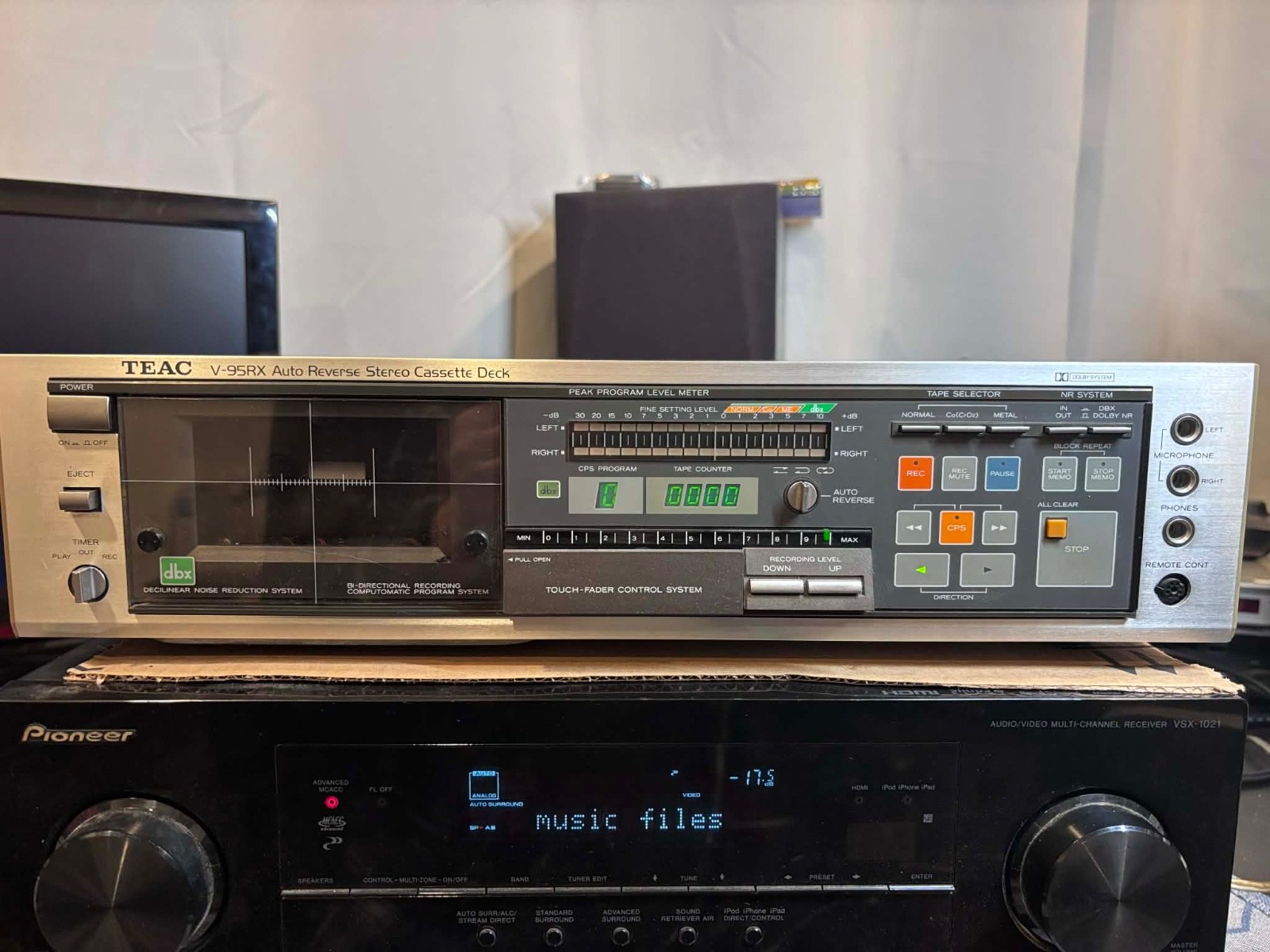
In the mid-1970s, Japanese electronics manufacturers were pushing the boundaries of integration, convenience, and design in home audio. While brands like Pioneer, Sony, and Kenwood often dominate the nostalgia conversation, Teac quietly introduced a unique hybrid machine that defied easy categorization: the Teac V-95-RX. More than just a receiver or a tuner, the V-95-RX stands as a fascinating artifact of an era when engineers experimented boldly with form and function. Though not widely documented, this rare unit combined AM/FM reception, cassette recording and playback, and an eye-catching visual tuning display into a single, compact chassis—making it a true “all-in-one” solution for the modern audiophile of its day.
A Unique Hybrid in the Teac Lineup
The Teac V-95-RX emerged during a transitional period in audio technology. The early 1970s saw the rise of the integrated receiver, but many consumers still relied on separate components. Teac, already known for its high-quality reel-to-reel tape recorders and precision engineering, sought to bridge the gap between performance and accessibility. The V-95-RX wasn’t a flagship model in the traditional sense, but rather an experimental fusion of features aimed at the style-conscious, tech-curious listener.
Its designation—V-95-RX—hints at its hybrid nature: “V” likely referencing visual or video-like tuning (a nod to its illuminated display), “95” as a model tier, and “RX” denoting receiver functionality. Unlike standard receivers of the era, the V-95-RX integrated a full cassette deck directly into the main unit, eliminating the need for a separate tape component. This made it a precursor to the later "combo units" that would become popular in the late '70s and early '80s.
Technical Specifications
| Feature | Specification |
| Year Introduced | 1975 |
| Manufacturer | Teac Corporation, Japan |
| Category | Integrated Receiver with Cassette Deck |
| Tuner Bands | AM, FM |
| Tuning Display | Analog needle meter with illuminated scale |
| Cassette Functions | Record, Play, Stop, Rewind, Fast Forward |
| Recording Inputs | Mic, Aux, Tuner |
| Playback Outputs | Fixed line out, headphone jack |
| Speaker Outputs | Dual binding posts (bi-wire capable) |
| Power Output | Not applicable (combo unit, no rated RMS) |
| Impedance | Not applicable |
| Power Supply | Internal linear transformer |
| Dimensions (W×H×D) | Approx. 430 × 145 × 320 mm |
| Weight | Approx. 10.5 kg (23 lbs) |
| Finish | Black or woodgrain vinyl (regional variants) |
Notably, the V-95-RX did not publish traditional power output ratings—likely because its amplifier section was designed more for convenience than high-fidelity power. Instead, it prioritized clean signal routing, warm tube-like preamp characteristics, and seamless integration between its internal components.
Sound Characteristics and Performance
The sonic signature of the Teac V-95-RX leans toward the warm, slightly softened tonal balance typical of mid-tier Japanese electronics from the era. Its FM tuner, while not as sensitive as high-end separates, delivers a surprisingly clear and stable reception, especially in urban areas with strong signals. The AM band is serviceable, with decent noise rejection for its time.
The integrated cassette deck uses a single-capstan, belt-driven transport with a fixed head assembly. It supports standard Type I (ferric) tapes and delivers respectable fidelity for casual listening and recording. Bias and equalization are preset, so it doesn’t support high-bias tapes like Type II or IV, but for voice recording, radio time-shifting, or making mix tapes, it performs admirably.
What sets the V-95-RX apart sonically is its cohesive signal path. Because the tuner, preamp, and tape deck were designed as a unified system, there’s a natural synergy in the sound—no jarring transitions or impedance mismatches that sometimes plague component systems cobbled together from different brands. The result is a smooth, musical presentation that’s easy on the ears, especially with vinyl played through an external turntable connected via the auxiliary input.
Notable Features and Innovations
The most striking feature of the V-95-RX is its illuminated tuning display—a vertically oriented analog meter with a glowing needle and frequency scale. This “visual tuning” element was both functional and theatrical, giving users a clear, attractive way to find and lock onto stations. In a dimly lit room, the soft orange glow of the display adds a retro-futuristic charm that few other units of the era matched.
Other standout features include:
- Integrated cassette recorder: One of the earliest all-in-one units to include recording capability directly in the receiver chassis.
- Tape monitoring during playback: Allows users to monitor recorded content in real time with minimal latency.
- Direct AC outlet for turntable: Some models include a switched 110V outlet on the rear panel, ideal for powering a turntable.
- Dual-level volume control: Offers both fine and coarse adjustment for precise listening levels.
The front panel layout is clean and intuitive, with large, tactile knobs for tuning, volume, and function selection. The use of high-quality potentiometers and switches reflects Teac’s commitment to durability, even in mid-tier models.
Common Issues and Maintenance
As with any 45-year-old electronics, the Teac V-95-RX requires careful attention to remain functional. Common issues include:
- Deteriorated belts in the cassette mechanism, leading to sluggish transport operation or failure to engage.
- Sticky or noisy potentiometers, especially in the volume and balance controls—cleaning with contact cleaner often resolves this.
- Capacitor aging in the power supply and audio path, which can cause hum, distortion, or channel dropouts.
- Tuner misalignment, resulting in weak reception or difficulty locking onto stations.
Restoration typically involves a full recapping, belt replacement, and thorough cleaning of all controls and switches. The illuminated tuning meter is generally reliable, but if the backlight fails, replacement bulbs (usually 12V incandescent) are still available as generic replacements.
Due to its rarity, finding a fully operational V-95-RX today is uncommon. Those that survive are often found in estate sales, Japanese flea markets, or niche online forums.
Current Market Value and Collectibility
The Teac V-95-RX remains a sleeper collectible—largely overlooked by mainstream vintage audio circles but increasingly appreciated by enthusiasts of quirky, integrated designs. Units in working condition typically sell for $150–$300, depending on cosmetic condition and functionality. Fully restored models with replaced belts and capacitors may fetch higher prices, especially if paired with matching Teac speakers.
Its value lies not in raw performance, but in its historical significance as an early all-in-one system and its distinctive visual design. For collectors of Japanese audio oddities or those building a retro-themed listening room, the V-95-RX offers both charm and functionality.
Conclusion and Legacy
The Teac V-95-RX may not have achieved the legendary status of the Pioneer SX series or the Technics SU receivers, but it represents an important moment in audio history—the move toward integration, convenience, and user experience. It’s a machine that prioritized cohesion over raw power, aesthetics over sterility, and usability over modularity.
Today, the V-95-RX serves as a reminder that innovation isn’t always about specs or separation—it can also be about bringing everything together in a way that feels right. For the right listener, this obscure Teac hybrid isn’t just a relic; it’s a complete, self-contained world of analog sound, waiting to be rediscovered.
eBay Listings



As an eBay Partner, we earn from qualifying purchases. This helps support our independent vintage technology research.
Related Models
- Teac A-2300SR (1979)
- Teac V-4-RX (1976)
- Pioneer QX-949A (1978)
- Pioneer SX-2000 (1978)
- Pioneer SX-2500 (1978)
- Marantz SR-2000 (1999–2001)
- Onkyo TX-1500MKII (1975)
- Pioneer QX-646 (1978)
- Pioneer SX-1900 (1978)
- Pioneer SX-201 (1978)