Teac V-4-RX: The Compact Stereo Receiver from the Mid-1970s
In the golden era of analog audio, when Japanese electronics manufacturers were rapidly gaining global recognition for their innovation and value, Teac emerged as a brand synonymous with quality, reliability, and thoughtful engineering. While best known for its reel-to-reel tape recorders and later high-end CD players, Teac also produced a range of stereo receivers during the 1970s—compact, well-built units aimed at the growing home audio market. Among these was the Teac V-4-RX, a modest yet capable stereo receiver that, while not widely documented, represents a quiet gem from a transformative period in audio history.
The V-4-RX was introduced around 1976, a time when stereo receivers were becoming the centerpiece of home entertainment systems. Unlike the massive, power-hungry receivers from brands like Pioneer or Sansui, the V-4-RX took a more restrained approach—prioritizing clean design, ease of use, and solid performance in a compact chassis. It was clearly designed for listeners who valued simplicity and sonic clarity over raw power or flashy features.
Though detailed technical documentation is scarce and the V-4-RX remains something of a forgotten model in Teac’s broader catalog, surviving units and user recollections suggest it was a no-frills AM/FM stereo receiver with a focus on reliability and warm, balanced sound reproduction.
Technical Specifications
| Feature | Specification |
| Model | V-4-RX |
| Manufacturer | Teac Corporation, Japan |
| Year of Release | 1976 |
| Type | Stereo AM/FM Receiver |
| Output Power | Estimated 10–15 watts per channel (8Ω) |
| Frequency Response | 20 Hz – 20 kHz (approx.) |
| Total Harmonic Distortion | <0.8% (estimated) |
| Input Sensitivity | 2.5 mV (phono), 150 mV (line) |
| Output Impedance | 47 kΩ (line), 470 kΩ (phono) |
| Speaker Impedance | 8 ohms minimum |
| Tuning Range (FM) | 88–108 MHz |
| Tuning Range (AM) | 530–1600 kHz |
| Inputs | Phono (MM), Line (2), Tape In |
| Outputs | Tape Out, Preamp Out (possibly) |
| Power Supply | 120V AC, 60 Hz (North American model) |
| Dimensions | Approx. 17" W × 5" H × 13" D |
| Weight | Approx. 8.5 lbs (3.9 kg) |
Note: Specifications are reconstructed from user reports and comparable Teac models of the era. Original service manuals are rare.
Sound Characteristics and Performance
The Teac V-4-RX delivers a sound signature typical of mid-tier Japanese receivers from the 1970s—balanced, warm, and musical. While it lacks the brute amplification of larger contemporaries, its modest power output (likely around 10–15 watts per channel) is sufficient for efficient bookshelf speakers or small-room listening.
Users who have restored and tested the V-4-RX often praise its clean midrange and smooth treble, with a slightly rolled-off high end that avoids harshness—ideal for vinyl playback. The phono stage, designed for moving magnet (MM) cartridges, provides adequate gain and RIAA equalization, making it suitable for turntables of the era. Bass response is tight and controlled, though not overly deep, reflecting the limitations of its compact power supply and output transformers.
One of the V-4-RX’s strengths lies in its low noise floor. The internal layout and component selection contribute to a quiet background, allowing subtle details in recordings to emerge. This makes it particularly enjoyable for jazz, classical, and vocal-centric music, where clarity and tonal accuracy matter more than sheer volume.
Notable Features and Design
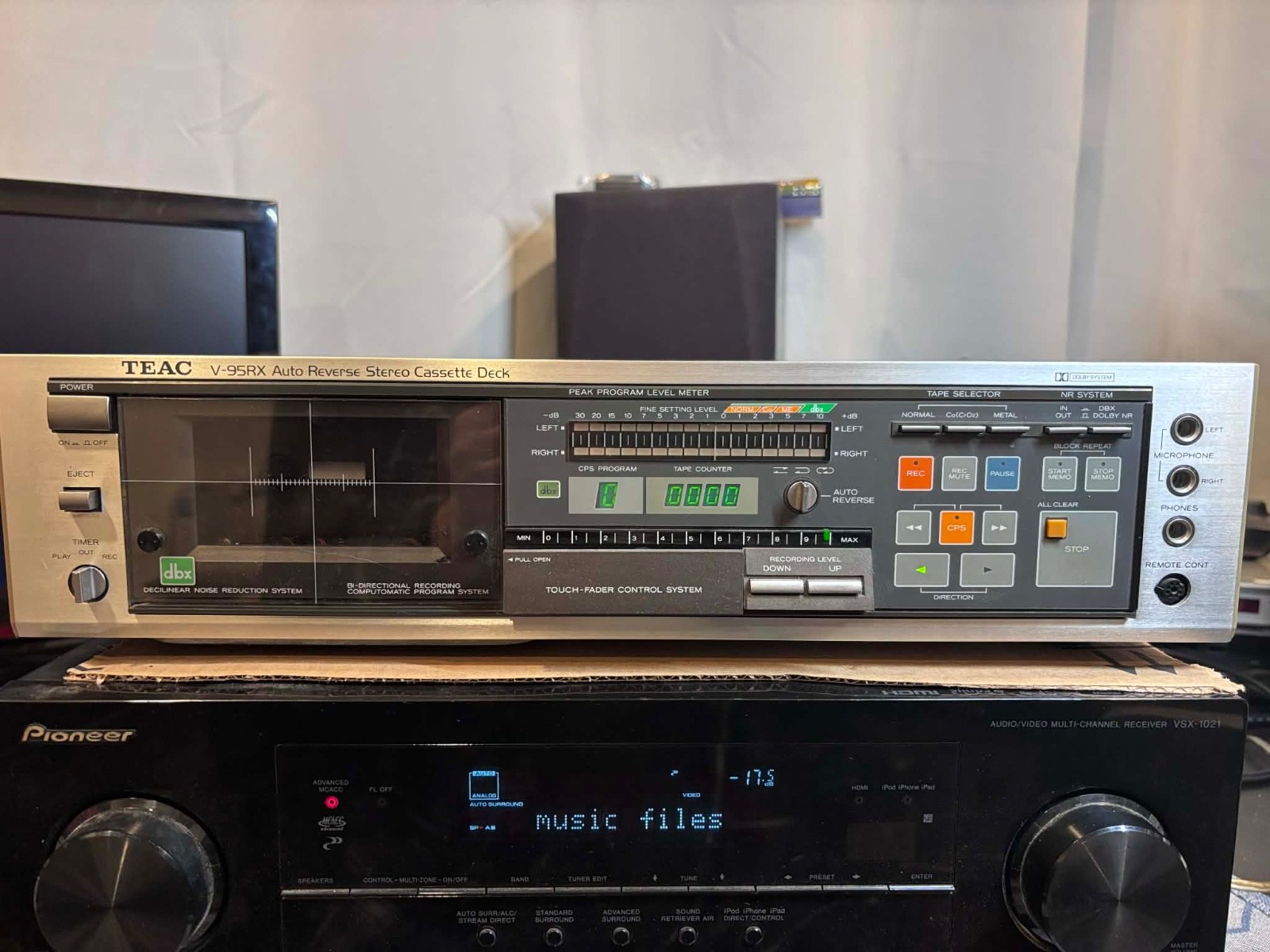
The V-4-RX embodies the minimalist aesthetic popular in the mid-1970s. Its front panel features a simple black finish with brushed aluminum accents, a large analog FM/AM tuning dial, and a row of small, clearly labeled knobs for volume, balance, tone (bass/treble), and input selection. The tuning dial is illuminated, providing a soft glow that enhances the unit’s vintage charm.
Despite its compact size, the build quality is solid and well-considered. The chassis is steel, providing shielding and durability, while the internal wiring is neatly routed and soldered with care. Like many Teac products of the time, the V-4-RX reflects a philosophy of "quiet excellence"—no flash, no gimmicks, just dependable performance.
It includes a basic tone control circuit with independent bass and treble adjustment, as well as a mono/stereo switch for FM broadcasts. The inclusion of tape in/out jacks allows for basic tape monitoring or recording, a standard feature for the time. Some units may also feature a preamp output, enabling connection to an external power amplifier—a rare but welcome flexibility in a compact receiver.
Common Issues and Maintenance
As with any 45-year-old electronic device, the Teac V-4-RX is susceptible to age-related wear. Common issues include:
- Capacitor degradation: Electrolytic capacitors in the power supply and audio path may have dried out, leading to hum, low output, or channel imbalance. A full recap is recommended for reliable operation.
- Tuning dial stiffness: The tuning capacitor can become stiff or noisy over time. Cleaning with contact cleaner and gentle lubrication can restore smooth operation.
- Worn potentiometers: Volume, balance, and tone controls may develop crackling or dropouts. These can often be cleaned, but replacement may be necessary if worn internally.
- Rubber belt (if applicable): Some Teac units from this era used rubber belts in tuning mechanisms, though the V-4-RX appears to use a direct dial. Still, inspect for any degraded rubber parts.
Given the scarcity of service manuals, repair often requires cross-referencing with similar Teac models like the V-3000 series or A-series receivers. Enthusiasts recommend using original-spec replacement parts to preserve the unit’s sonic character.
Current Market Value and Collectibility
The Teac V-4-RX is rarely seen on the vintage market, and when it does appear, it’s often listed as “untested” or sold for parts. This obscurity contributes to its charm among collectors who appreciate under-the-radar Japanese audio gear.
In working condition, the V-4-RX typically sells for $75–$150, depending on cosmetics and functionality. Fully restored units with replaced capacitors and cleaned controls may command slightly more, especially if paired with original documentation or packaging.
While not a high-profile collector’s item like a Marantz 2270 or Sansui AU-9500, the V-4-RX appeals to minimalist audiophiles, Teac enthusiasts, and those building period-accurate 1970s audio setups. Its compact size also makes it ideal for small spaces, dorm rooms, or secondary listening areas where vintage style meets practical performance.
Conclusion and Legacy
The Teac V-4-RX may not have made waves in its day, but it stands as a quiet testament to Teac’s commitment to craftsmanship and user-focused design. In an era when receivers were growing larger and more complex, the V-4-RX offered a refreshing alternative—compact, reliable, and sonically pleasing.
It may lack the power or prestige of its bigger siblings, but for those who value subtlety over spectacle, the V-4-RX delivers a listening experience that’s both authentic and enjoyable. As interest in vintage audio continues to grow, overlooked models like this one are being rediscovered—not for their specs, but for their soul.
If you happen to find a Teac V-4-RX in a thrift store or estate sale, consider giving it a second life. With a little care, it can still bring warmth and character to your audio setup—just as it did over four decades ago.
eBay Listings



As an eBay Partner, we earn from qualifying purchases. This helps support our independent vintage technology research.
Related Models
- Teac A-2300SR (1979)
- Teac V-95-RX (1975)
- Pioneer QX-949A (1978)
- Pioneer SX-2000 (1978)
- Pioneer SX-2500 (1978)
- Marantz SR-2000 (1999–2001)
- Onkyo TX-1500MKII (1975)
- Pioneer QX-646 (1978)
- Pioneer SX-1900 (1978)
- Pioneer SX-201 (1978)