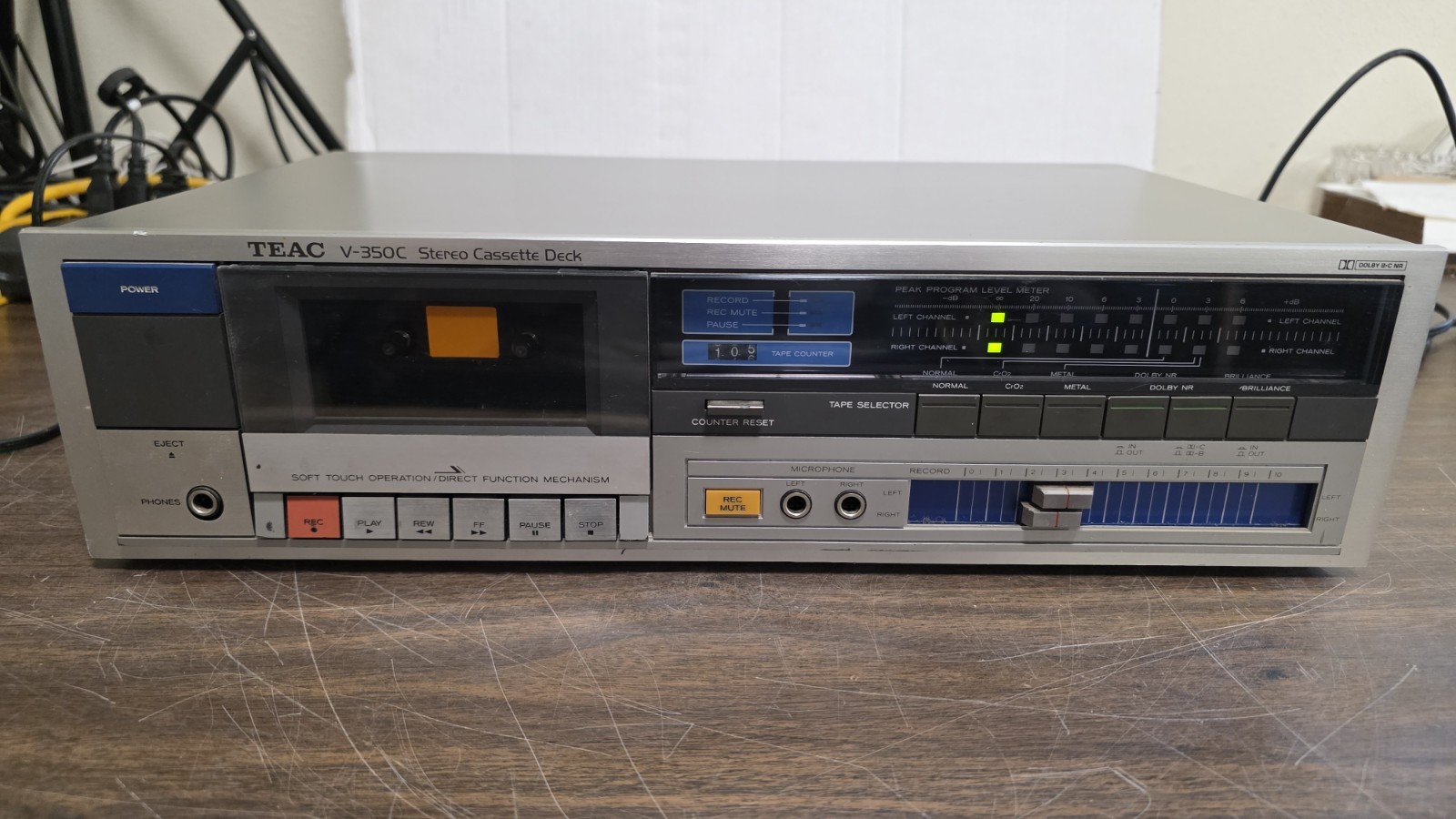
Teac V-350-C: The Analog Tape Enthusiast’s Hidden Gem
In the mid-1970s, when high-fidelity audio was undergoing a golden renaissance, Teac Corporation emerged as a dominant force in the world of consumer and semi-professional reel-to-reel tape recorders. Among their most respected models from this era stands the Teac V-350-C, a compact yet powerful open-reel tape machine that bridged the gap between home audiophile use and studio-grade performance. Though not as widely recognized today as some of its contemporaries, the V-350-C has quietly earned a loyal following among analog purists, tape restoration engineers, and vintage gear collectors who appreciate its precision engineering, elegant design, and exceptional sound quality.
Historical Context: Teac’s Rise in the Reel-to-Reel Era
Teac (Tokyo Electro-Acoustic Company) began making waves in the 1960s with affordable, high-performance reel-to-reel recorders aimed at both hobbyists and professionals. By the 1970s, the company had refined its manufacturing techniques and introduced a series of compact, three-head tape decks that offered features previously found only in much more expensive studio equipment. The V-350-C, introduced in 1975, was part of this golden generation—a time when magnetic tape was the pinnacle of audio fidelity, and home recording enthusiasts could achieve near-broadcast quality from their living rooms.
Unlike mass-market cassette decks that followed, the V-350-C used ¼-inch open-reel tape at speeds of 7.5 and 15 inches per second (ips), allowing for a dynamic range and frequency response that rivaled early digital recordings. It was marketed as a high-end consumer model, but its build quality and sonic performance made it a favorite in small project studios and radio stations where budget constraints ruled but audio quality still mattered.
Technical Specifications
| Feature | Specification |
| Model | Teac V-350-C |
| Year Introduced | 1975 |
| Format | ¼-inch open-reel tape |
| Tape Speeds | 7.5 ips, 15 ips |
| Heads | 3-head system (separate record, playback, erase) |
| Track Configuration | 4-track, 2-channel stereo (full-track mono compatible) |
| Motor System | Dual capstan direct-drive with servo control |
| Frequency Response | 30 Hz – 20 kHz (±3 dB at 15 ips) |
| Signal-to-Noise Ratio | 68 dB (Dolby B NR enabled) |
| Total Harmonic Distortion | <0.7% at 0 dB, 1 kHz |
| Wow and Flutter | <0.15% (WRMS) |
| Inputs | Line-level RCA (stereo), microphone XLR/RCA |
| Outputs | RCA line out, headphone jack (¼") |
| Equalization Settings | 120 µs (15 ips), 180 µs (7.5 ips) |
| Power Requirements | 120V AC, 60 Hz (110–130V compatible) |
| Dimensions | 430 mm × 140 mm × 330 mm (W×H×D) |
| Weight | 11.5 kg (25.3 lbs) |
| Included Features | Dolby B noise reduction, level meters, pitch control (±6%) |
Sound Characteristics and Performance
The Teac V-350-C delivers a sound signature that modern digital enthusiasts often describe as “musical” and “organic.” Thanks to its three-head design and precision tape transport, it offers excellent channel separation, low crosstalk, and a wide frequency response—especially when operating at 15 ips. The machine captures the warmth and depth of analog tape with a smooth high end and a rich, well-defined midrange.
One of the V-350-C’s standout qualities is its low wow and flutter, a testament to its servo-controlled dual capstan system. This stability ensures that pitch remains consistent, making it ideal for music recording and archival transfers. The inclusion of Dolby B noise reduction further enhances its dynamic range, reducing tape hiss without the “breathing” artifacts common in lesser NR implementations.
Users often praise the V-350-C for its ability to produce studio-quality recordings on consumer-grade tape stock, a hallmark of Teac’s engineering philosophy: delivering professional performance at accessible prices.
Notable Features and Innovations
While compact in size, the V-350-C is packed with features that were advanced for its time:
- Three-Head Configuration: Unlike many consumer decks that used a combined record/play head, the V-350-C features separate heads for record, playback, and erase. This allows for real-time monitoring of the recorded signal and ensures optimal alignment for each function.
- Dual Capstan Transport: This design minimizes tape slippage and provides exceptional speed stability, critical for maintaining pitch accuracy and reducing distortion.
- Dolby B Noise Reduction: Integrated directly into the signal path, Dolby B significantly improves the signal-to-noise ratio, especially at 7.5 ips—making it practical for long recordings without sacrificing fidelity.
- Front-Panel Level Meters: Large VU meters provide accurate visual feedback for input and output levels, essential for preventing distortion during recording.
- Pitch Control: A ±6% variable speed control allows for fine-tuning of playback speed, useful for matching tape sources or correcting minor speed discrepancies.
- Solid Build Quality: Encased in a heavy-gauge steel chassis with a brushed aluminum front panel, the V-350-C feels substantial and durable—a far cry from the plastic-heavy decks that dominated the late 1980s.
Common Issues and Maintenance
Like all vintage tape machines, the Teac V-350-C requires regular maintenance to perform at its best. The most common issues include:
- Deteriorated Rubber Components: The pinch roller, capstan tires, and idler wheels can harden or crack over time. These should be replaced during a full servicing.
- Dirty or Worn Heads: Tape heads accumulate oxide buildup and may become misaligned. Professional demagnetization and cleaning are recommended every 10–20 hours of use.
- Capacitor Aging: Electrolytic capacitors in the power supply and audio circuits may dry out, leading to hum, distortion, or power failure. A recap by a qualified technician can restore reliability.
- Belt-Driven Mechanics: While the capstan is direct-drive, some internal mechanisms use rubber belts that degrade. Replacement with modern equivalents is often necessary.
For optimal performance, the V-350-C should be aligned using a calibration tape and adjusted for azimuth, sensitivity, and bias—especially if used for critical recording or archiving.
Current Market Value and Collectibility
The Teac V-350-C is not as commonly seen on the vintage market as some of Teac’s later cassette decks, but it has been gaining attention in recent years due to the resurgence of analog tape culture. Well-maintained units typically sell for $400–$700, depending on condition, completeness (including original manuals and accessories), and operational status.
Fully restored models with fresh tape paths and recalibrated electronics can command higher prices, particularly among musicians using analog tape for its saturation characteristics. While not yet a “blue-chip” collectible like a Studer or Revox, the V-350-C is increasingly recognized as a high-value workhorse from Teac’s most innovative period.
Conclusion: A Legacy of Analog Excellence
The Teac V-350-C may not have the name recognition of a Nakamichi Dragon or a Sony TC-800B, but it represents the quiet excellence of Japanese engineering during the 1970s analog boom. It combines professional-grade features with user-friendly operation, making it one of the most capable open-reel recorders ever offered at its price point.
Today, the V-350-C appeals to a niche but passionate audience: archivists preserving old tapes, musicians seeking analog warmth, and collectors who appreciate the craftsmanship of an era when audio gear was built to last. With proper care, it remains a fully functional, sonically rewarding machine—one that continues to prove that true high fidelity never goes out of style.
For those discovering the magic of reel-to-reel audio, the Teac V-350-C is not just a vintage curiosity—it’s a living piece of audio history that still has something meaningful to say.
eBay Listings



As an eBay Partner, we earn from qualifying purchases. This helps support our independent vintage technology research.
Related Models
- Teac A-2340R (1975)
- Teac V-30 (1975)
- Teac W-416 (1975)
- Teac A-108-SYNC (1978)
- Teac A-110 (1978)
- Akai AM-2850 (1975)
- Akai AP-206 (1975)
- Nakamichi BX-1 (1985)
- Acoustic Research research-ar-17 (1978)
- Acoustic Research AR-19 (1994)