Teac V-285-CHX: The Quiet Innovator in High-End Cassette Reproduction
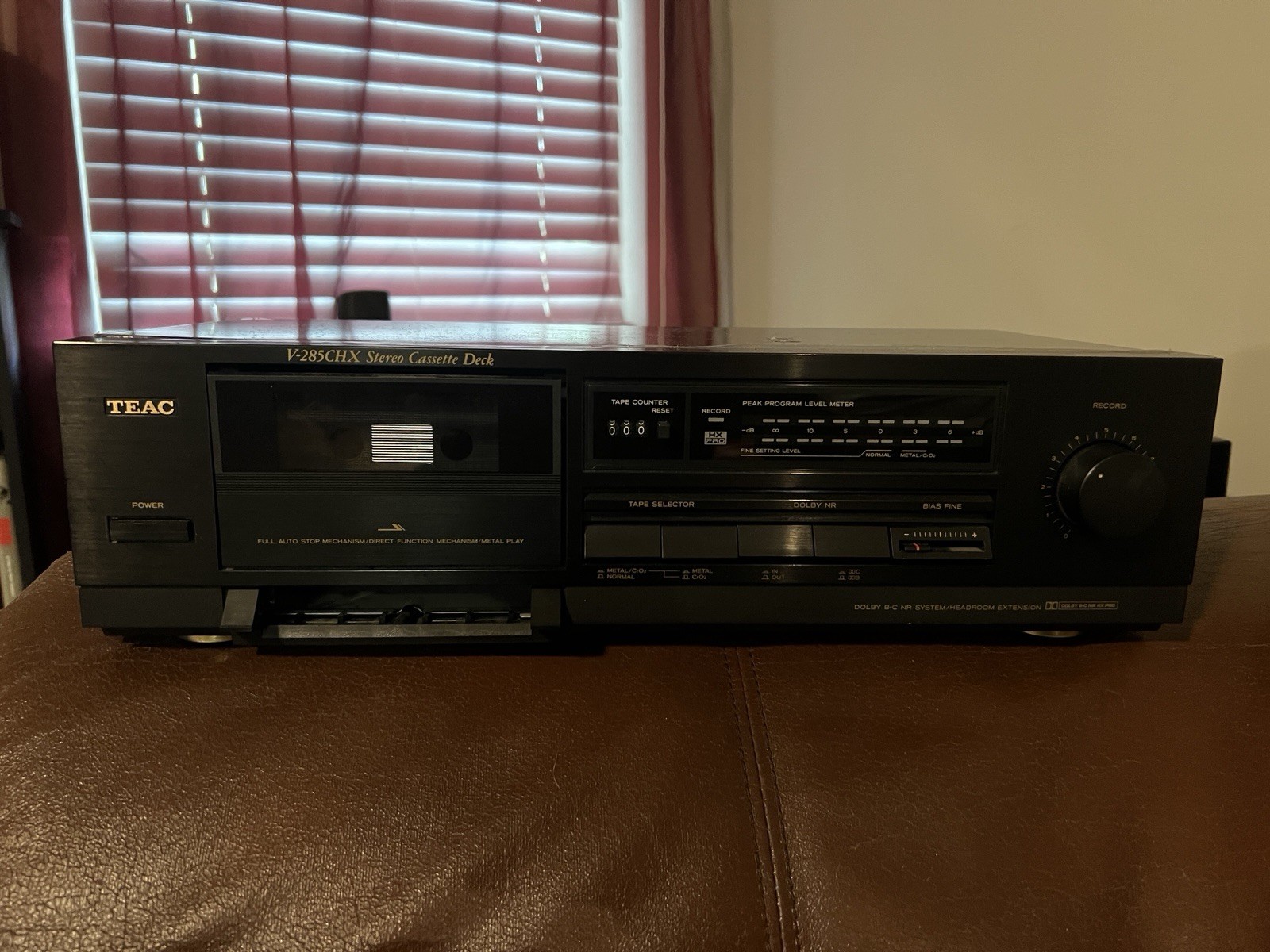
In the golden era of analog audio, when the cassette format was rapidly evolving from a portable convenience to a serious medium for high-fidelity music reproduction, Teac stood as one of the most respected Japanese manufacturers pushing the boundaries of what compact tape could achieve. Among their elite lineup of the late 1970s and early 1980s, the Teac V-285-CHX emerged as a benchmark-level cassette deck that combined meticulous engineering, premium materials, and cutting-edge noise reduction technology. Though less widely celebrated than some of its contemporaries from Nakamichi or Revox, the V-285-CHX earned a loyal following among audiophiles and studio engineers for its reliability, precision, and transparent sound.
Released in 1979, the V-285-CHX was part of Teac’s high-end “V-series” of cassette decks—models designed not for casual listeners but for critical home listeners and semi-professional users who demanded tape performance that could rival open-reel recorders. At a time when the battle for tape fidelity was heating up, Teac responded with a machine that balanced innovation with practicality, making the V-285-CHX a sleeper hit in the world of vintage audio.
Technical Specifications
The V-285-CHX was engineered to deliver professional-grade performance through a combination of robust mechanics, precision tape transport, and advanced electronics. Its specifications reflect the priorities of high-end cassette design in the early 1980s.
| Specification | Detail |
| Year Introduced | 1979 |
| Format | 4-Track, 2-Channel Stereo (¼” tape) |
| Tape Speeds | 1⅞ ips (4.76 cm/s) |
| Head Configuration | Separate Record/Playback, Chrome Dioxide |
| Erase Method | AC Erase |
| Wow and Flutter | < 0.065% (WRMS) |
| Frequency Response | 30Hz – 18kHz (with CrO₂ tape) |
| Signal-to-Noise Ratio | 66 dB (Dolby B), 72 dB (Dolby C) |
| Total Harmonic Distortion | < 1.5% |
| Input/Output Levels | Line In: 150mV, Line Out: 150mV |
| Input/Output Impedance | 50kΩ Input, 10kΩ Output |
| HX Pro Support | Yes – Teac’s implementation of Dolby HX Pro |
| Noise Reduction | Dolby B and C, dbx Type I (switchable) |
| Motor System | Dual direct-drive capstan motors |
| Display | VU meters for level monitoring |
| Dimensions | 440 mm × 140 mm × 330 mm (W×H×D) |
| Weight | 11.5 kg (25.3 lbs) |
Sound Characteristics and Performance
The sonic signature of the Teac V-285-CHX is best described as clean, neutral, and highly detailed—a hallmark of Teac’s engineering philosophy during this period. Unlike some competitors that leaned into a warmer or more colored sound, the V-285-CHX aimed for accuracy, making it an excellent choice for critical listening and archival transfers.
Equipped with separate record and playback heads, the V-285-CHX avoided the compromises inherent in combined heads, resulting in superior channel separation and reduced crosstalk. The use of chrome dioxide (CrO₂) tape biasing allowed for extended high-frequency response and improved dynamic range, essential for capturing the nuances of orchestral music and complex rock recordings.
One of the deck’s standout features was its early adoption of Dolby HX Pro (Headroom Extension), a technology that dynamically adjusted the tape’s bias during recording to prevent saturation on high-frequency transients. While Dolby B and C reduced noise during playback, HX Pro worked during recording to increase headroom—especially beneficial with metal and high-output tapes. Teac’s implementation was among the most effective of its time, contributing to the V-285-CHX’s reputation for clarity and dynamic realism.
The dual direct-drive capstan system ensured rock-solid speed stability, minimizing wow and flutter to levels that rivaled much more expensive machines. This precision translated into tight bass response and stable stereo imaging—qualities that made the V-285-CHX a favorite for duplicating master tapes in small studios and broadcast environments.
Notable Features and Innovations
The V-285-CHX was packed with features that set it apart from mid-tier cassette decks:
- Dolby HX Pro Integration: One of the first consumer decks to offer full HX Pro support, allowing users to get the most from high-performance tapes.
- dbx Type I Compatibility: In addition to Dolby B and C, the V-285-CHX supported dbx noise reduction, offering an alternative path to ultra-low noise at the cost of compatibility.
- Precision VU Meters: Large, well-damped VU meters provided accurate visual feedback for level setting—critical for avoiding distortion during recording.
- Metal Tape Capability: Though optimized for CrO₂, the deck could be switched for metal tape use, future-proofing it as tape technology evolved.
- Solid Chassis Construction: A heavy, rigid chassis with internal damping reduced vibration and external interference, contributing to its low noise floor.
Teac also paid attention to user experience: the front panel was logically laid out, with clearly labeled switches and smooth-operating transport controls. The build quality—featuring metal casework, high-grade potentiometers, and reliable relays—ensured longevity, a trait that still benefits collectors today.
Common Issues and Maintenance
Like all high-performance analog tape decks from this era, the Teac V-285-CHX requires regular maintenance to perform at its best. The most common issues encountered today include:
- Deteriorated Rubber Components: The pinch roller and capstan tires can harden or become sticky over time. Replacement with modern equivalents is essential for proper tape tension and speed accuracy.
- Dirty or Worn Tape Heads: Oxide buildup and wear can degrade frequency response. Regular cleaning with isopropyl alcohol and demagnetizing are recommended.
- Capstan Bearing Dryness: After decades of use, the capstan bearings may dry out, leading to speed instability. Lubrication by a qualified technician can restore performance.
- Capacitor Aging: Electrolytic capacitors in the power supply and signal path may leak or lose capacitance, potentially causing hum or channel dropouts. A full recapping is advisable for long-term reliability.
Fortunately, the V-285-CHX’s modular design makes servicing relatively straightforward. Replacement parts, while not always easy to find, are available through specialized vintage audio suppliers and enthusiast communities.
Current Market Value and Collectibility
While not as iconic as the Nakamichi Dragon or the Revox B77, the Teac V-285-CHX has seen a steady rise in collector interest over the past decade. Its reputation for durability, advanced features, and understated elegance appeals to audiophiles who value substance over flash.
In today’s market (2024), a fully serviced and operational V-285-CHX typically sells for $400–$700, depending on condition, provenance, and completeness (including original packaging and manuals). Units with verified HX Pro functionality and low usage hours command premiums, especially among those building high-end analog rigs.
Its collectibility is bolstered by its relative rarity—Teac produced fewer V-285-CHX units compared to mass-market models—and its status as a technological bridge between consumer and professional gear. It’s also a favorite among cassette restoration specialists, who appreciate its accurate reproduction and compatibility with a wide range of tape types.
Conclusion and Legacy
The Teac V-285-CHX may not have the name recognition of some of its flashier contemporaries, but it represents the quiet excellence of Japanese engineering at its finest. It was a machine built for those who cared more about sound than status—engineers, musicians, and audiophiles who demanded precision, reliability, and transparency.
Today, the V-285-CHX stands as a testament to a time when the cassette format was taken seriously as a high-fidelity medium. In an age of digital perfection, its analog warmth, mechanical charm, and technical sophistication continue to captivate a new generation of tape enthusiasts.
For collectors and users alike, the Teac V-285-CHX is more than just a vintage deck—it’s a finely tuned instrument for experiencing music as it was meant to be heard.
eBay Listings


As an eBay Partner, we earn from qualifying purchases. This helps support our independent vintage technology research.
Related Models
- Teac A-6700DX (1980)
- Teac A-105 (1975)
- Teac A-106 (1975)
- Teac A-170 (1976)
- Teac A-2300 (1978)
- Sony TC-2050SD (1978)
- Aiwa AD-F990 (1993)
- Kenwood KX-3060 (1982)
- Sony TC-2130A (1974)
- Sony TC-2220 (1972)