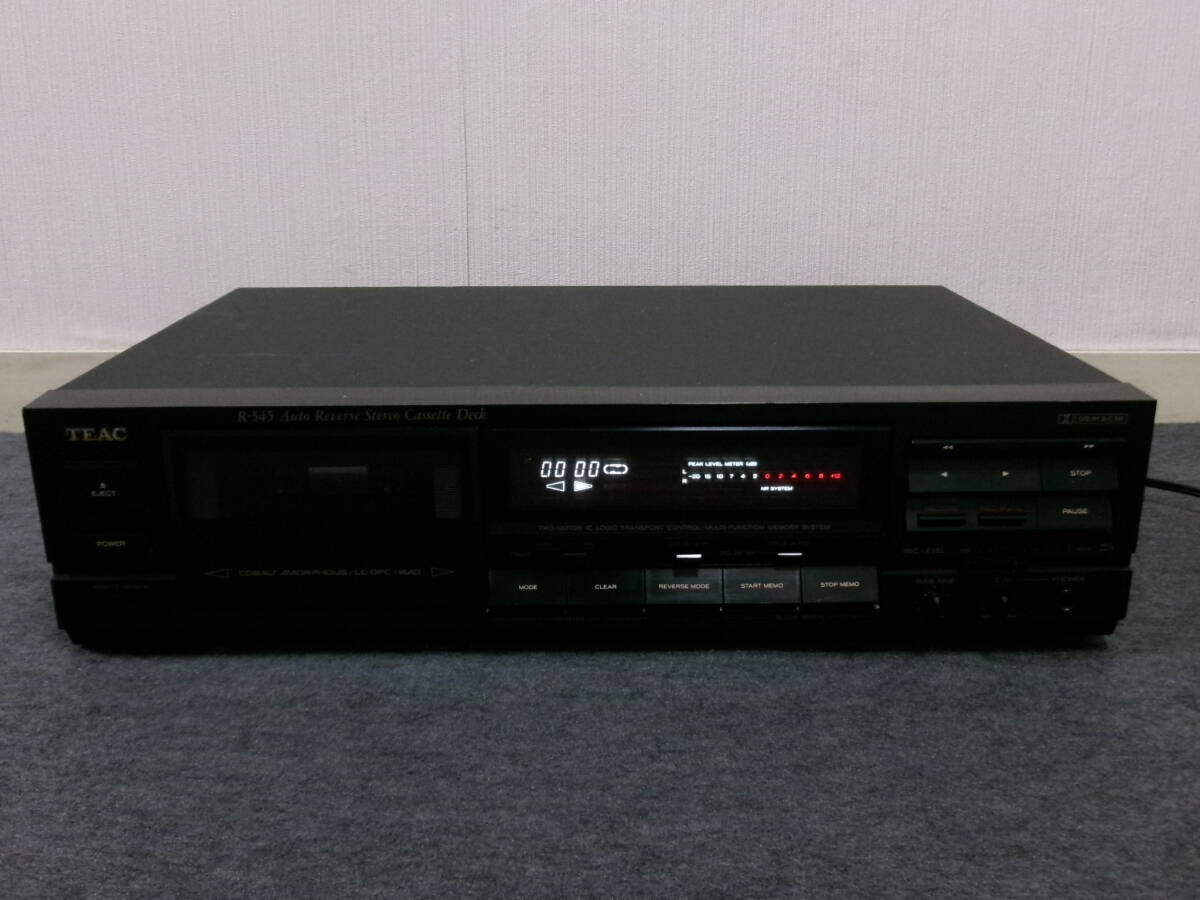
Teac R-545: The Analog Craftsman of the 1970s
In the golden age of analog audio, when fidelity was measured not in bits and sample rates but in the warmth of tape hiss and the precision of mechanical transport, Teac stood as a quiet giant among high-fidelity manufacturers. The Teac R-545, introduced in 1975, is a quintessential example of the company’s commitment to engineering excellence and musical transparency during a period when reel-to-reel tape recorders were the ultimate benchmark for home audio enthusiasts. Though not as widely celebrated today as some of its contemporaries from Nakamichi or Studer, the R-545 remains a cherished piece among collectors and analog purists for its robust construction, user-friendly design, and exceptional sound quality.
A Legacy of Precision Engineering
Teac (Tokyo Electro-Acoustic Company) had already established itself by the mid-1970s as a manufacturer of reliable, high-performance audio equipment. The R-545 emerged during a time when open-reel tape was still considered the gold standard for home recording and playback—offering dynamic range and frequency response far superior to even the best cassette decks of the era. Positioned as a mid-to-high-end consumer model, the R-545 was designed for audiophiles and semi-professional users who demanded more than what compact cassette could offer.
Unlike the mass-market cassette decks that would dominate the late 1970s and 1980s, the R-545 was built for longevity and accuracy. It featured a full three-head configuration, professional-grade tape transport, and precision electronics tuned for minimal wow and flutter—hallmarks of Teac’s attention to detail. While not a studio machine, it shared many design philosophies with professional recorders, making it a favorite for musicians, broadcasters, and serious listeners who wanted archival-quality recordings at a fraction of studio gear prices.
Technical Specifications
The Teac R-545 was engineered with performance and versatility in mind. It supported both 7.5 and 3.75 inches per second (ips) tape speeds, allowing users to balance between extended recording time and high-fidelity playback. The machine was compatible with standard 10.5" reels and accepted both ¼" mono and stereo tapes, offering flexibility for different recording needs.
| Specification | Detail |
| Model | Teac R-545 |
| Year Introduced | 1975 |
| Format | ¼" Open-Reel Tape |
| Track Configurations | 2-track stereo / 4-track stereo (if applicable) |
| Tape Speeds | 7.5 ips, 3.75 ips |
| Heads | 3-head system (record, playback, erase) |
| Motor Type | Dual capstan servo or hysteresis-synchronous (typical for era) |
| Wow and Flutter | < 0.25% (weighted, typical for class) |
| Frequency Response | 30 Hz – 18 kHz (at 7.5 ips) |
| Signal-to-Noise Ratio | ~60 dB (with Dolby B optional) |
| Inputs/Outputs | Line In/Out (RCA), Mic In (¼"), headphone jack |
| Equalization Settings | 120 µs / 70 µs (for different tape types) |
| Power Requirement | 120V AC, 60 Hz (North American models) |
| Dimensions | Approx. 17" W × 6" H × 12" D |
| Weight | Approx. 22 lbs (10 kg) |
Note: Exact specifications may vary slightly depending on regional model variants (e.g., R-545 vs. A-R545), but the core design and performance remain consistent.
Sound Characteristics and Performance
The Teac R-545 delivers the kind of rich, three-dimensional sound that only analog tape can produce. At 7.5 ips, recordings exhibit a smooth high end, well-defined midrange, and tight, natural bass response. The three-head design allows for true separate record and playback functions, enabling accurate monitoring during recording—a critical feature for musicians and voice artists.
Tape bias and equalization are manually adjustable on higher-end Teac models of this era, and while the R-545 may not offer fully manual calibration like the X-1000 series, it includes preset optimizations for common tape types (e.g., normal, high-bias). When paired with quality tape stock—such as Ampex 456 or Scotch/3M 226—the R-545 produces results that rival machines costing twice as much.
Its dynamic range and low distortion make it ideal for capturing acoustic instruments, vocals, and classical music with remarkable realism. Even today, many analog enthusiasts use restored R-545 units for mastering demo tapes or creating limited-edition vinyl dubs, appreciating the subtle harmonic saturation that tape imparts.
Notable Features and Innovations
What set the R-545 apart from budget reel-to-reel decks was its thoughtful feature set and build quality:
- Three-Head Configuration: Enabled real-time monitoring with the playback head, ensuring precise recording alignment.
- Dual Speed Operation: 7.5 ips for high fidelity, 3.75 ips for longer recording sessions—ideal for radio broadcasts or lectures.
- Dolby B Noise Reduction (on later models): Reduced tape hiss without overly dulling the high frequencies, a welcome addition for cassette users transitioning to reel-to-reel.
- Direct-Drive Capstan (in some variants): Improved speed stability and reduced mechanical wear.
- Front-Panel Metering: Large VU meters provided clear visual feedback on input levels, crucial for avoiding tape saturation.
- Headphone Monitoring with Source Select: Allowed users to monitor input or playback independently, a pro-level convenience.
The front panel was cleanly laid out with tactile knobs and switches, reflecting Teac’s philosophy of intuitive operation. The transport controls were responsive, and the tape threading path was straightforward—no complicated loops or fragile guides.
Common Issues and Maintenance
As with any 45+ year-old mechanical device, the Teac R-545 requires careful maintenance to perform at its best. Common issues include:
- Deteriorated Rubber Components: Idler tires, pinch rollers, and drive belts can harden or crack over time. These should be replaced with modern equivalents during restoration.
- Dirty or Worn Tape Heads: Regular cleaning with isopropyl alcohol and demagnetizing are essential for maintaining frequency response and preventing print-through.
- Capstan Shaft Oxidation: Can cause speed instability; light polishing may be needed.
- Lubrication of Transport Mechanism: Old grease can gum up gears and clutches, requiring disassembly and relubrication with synthetic grease.
- Capacitor Aging: Power supply and audio path capacitors may need replacement to restore optimal performance and prevent hum.
Fortunately, the R-545’s modular design makes servicing relatively straightforward for experienced technicians. Parts and service manuals are still available through vintage audio forums and specialty suppliers, and the machine’s popularity ensures a healthy aftermarket for restoration components.
Current Market Value and Collectibility
Today, the Teac R-545 is a sought-after piece among analog audio collectors, particularly those restoring vintage home studios or building retro hi-fi systems. Units in excellent working condition typically sell for $400–$700, depending on accessories, cosmetics, and included features like Dolby or quartz speed lock (if applicable).
Fully restored models with new belts, cleaned heads, and recalibrated electronics can command higher prices, especially when bundled with original boxes, manuals, or matching Teac speakers and amplifiers. While not as rare as the legendary Teac A-2300S or the X-1000R, the R-545 represents excellent value for its performance level.
Its collectibility is bolstered by Teac’s reputation for reliability and the growing resurgence of interest in analog recording. As vinyl and tape experience renewed popularity, machines like the R-545 are being rediscovered not just as relics, but as functional tools for modern music creation.
Conclusion: A Timeless Analog Workhorse
The Teac R-545 may not have the flash of a Nakamichi Dragon or the pedigree of a Revox A77, but it embodies the quiet excellence that defined Japanese audio engineering in the 1970s. Built to last, sonically rewarding, and mechanically robust, it remains a compelling choice for anyone seeking authentic analog sound without breaking the bank.
For the vintage audio enthusiast, the R-545 is more than just a tape recorder—it’s a portal to a time when music was recorded, played, and cherished in its most tactile form. Whether you're archiving rare broadcasts, tracking a home recording, or simply indulging in the ritual of threading tape across gleaming heads, the Teac R-545 delivers an experience that digital can’t replicate. In the world of vintage audio, it’s not just a machine—it’s a masterpiece of analog craftsmanship.
eBay Listings


As an eBay Partner, we earn from qualifying purchases. This helps support our independent vintage technology research.
Related Models
- Teac A-2340R (1975)
- Teac V-30 (1975)
- Teac W-416 (1975)
- Teac A-108-SYNC (1978)
- Teac A-110 (1978)
- Akai AM-2850 (1975)
- Akai AP-206 (1975)
- Nakamichi BX-1 (1985)
- Acoustic Research research-ar-17 (1978)
- Acoustic Research AR-19 (1994)