Teac A-360: The Audiophile's Open-Reel Workhorse
In the mid-1970s, when cassette tapes were still finding their footing and vinyl reigned supreme, a different kind of audio fidelity was being pursued by serious enthusiasts and semi-professional engineers: the open-reel tape recorder. Among the most respected names in this niche was TEAC (originally Tokyo Electro-Acoustic Company), a Japanese manufacturer that built a formidable reputation for combining professional-grade engineering with consumer-friendly pricing. The Teac A-360, introduced in 1975, stands as one of the company’s most celebrated reel-to-reel tape decks—a machine that bridged the gap between home audiophile use and studio-grade performance.
Though not as widely known today as some of its contemporaries from Nakamichi or Revox, the A-360 has quietly earned a cult following among analog tape aficionados. It represents the peak of TEAC’s commitment to high-fidelity magnetic recording, offering features and sound quality that rival equipment costing far more. For collectors and vintage audio enthusiasts, the A-360 is not just a nostalgic curiosity—it’s a fully functional, sonically rewarding machine that continues to deliver stunning analog warmth and detail.
Technical Specifications
The Teac A-360 was designed as a 1/4-inch, 3-head, dual-motor open-reel recorder capable of operating at three tape speeds: 3¾, 7½, and 15 inches per second (ips). Its three-head configuration—separate record, playback, and erase heads—allowed for precise monitoring of the recorded signal, a feature typically found in professional studio decks. The dual-capstan drive system minimized tape flutter and ensured stable, consistent transport.
| Specification | Detail |
| Format | 1/4-inch open-reel tape |
| Tracks | 2-track, ½-track, or 4-track (switchable) |
| Tape Speeds | 3¾, 7½, 15 ips |
| Heads | 3-head system (erase, record, playback) |
| Motors | Dual direct-drive capstan motors |
| Frequency Response | 30Hz – 20kHz (15 ips, ±3dB) |
| Wow and Flutter | < 0.15% (WRMS) |
| Signal-to-Noise Ratio | > 60 dB (Dolby B) |
| Input/Output | Line In/Out (RCA), Mic In (RCA) |
| Equalization | 120μs / 70μs (switchable) |
| Bias Adjustment | Manual (via front-panel knob) |
| Recording Modes | Stereo, Mono, 4-track |
| Power Requirement | 120V AC, 60Hz (North American models) |
| Dimensions | 440 × 145 × 355 mm (W×H×D) |
| Weight | 12.5 kg (approx. 27.5 lbs) |
One of the standout features of the A-360 was its flexibility in recording formats. With the flip of a switch, users could toggle between 2-track stereo, ½-track mono, and 4-track multi-track modes—making it a favorite among home recordists who wanted to experiment with overdubbing and layering. This versatility, combined with its robust build, made the A-360 a go-to choice for musicians, broadcasters, and audiophiles alike.
Sound Characteristics and Performance
The Teac A-360 is renowned for its smooth, warm, and highly detailed sound signature. At 15 ips, the deck delivers an expansive frequency response and excellent transient reproduction, capturing the full dynamic range of acoustic instruments and vocal performances. Even at 7½ ips, the A-360 maintains impressive clarity, making it ideal for high-fidelity home recordings of LPs or live concerts.
The three-head design ensures that what you hear during recording is an accurate representation of the signal being laid to tape—critical for achieving optimal levels and tonal balance. The separate playback head allows for precise alignment, and experienced users often report that a well-calibrated A-360 can outperform many modern digital recordings in terms of spatial depth and analog realism.
When paired with high-quality tape stock (such as Ampex 456 or BASF SM468) and used with Dolby B noise reduction, the A-360 achieves a remarkably low noise floor and a lush, three-dimensional soundstage. Its ability to preserve the natural timbre of voices and instruments makes it a favorite for transferring vintage vinyl collections or archiving rare recordings.
Notable Features and Innovations
The A-360 was packed with features that were advanced for its time:
- Dual Direct-Drive Capstans: Unlike belt-driven systems, the A-360 uses two precision capstan motors for superior speed stability and reduced mechanical wear.
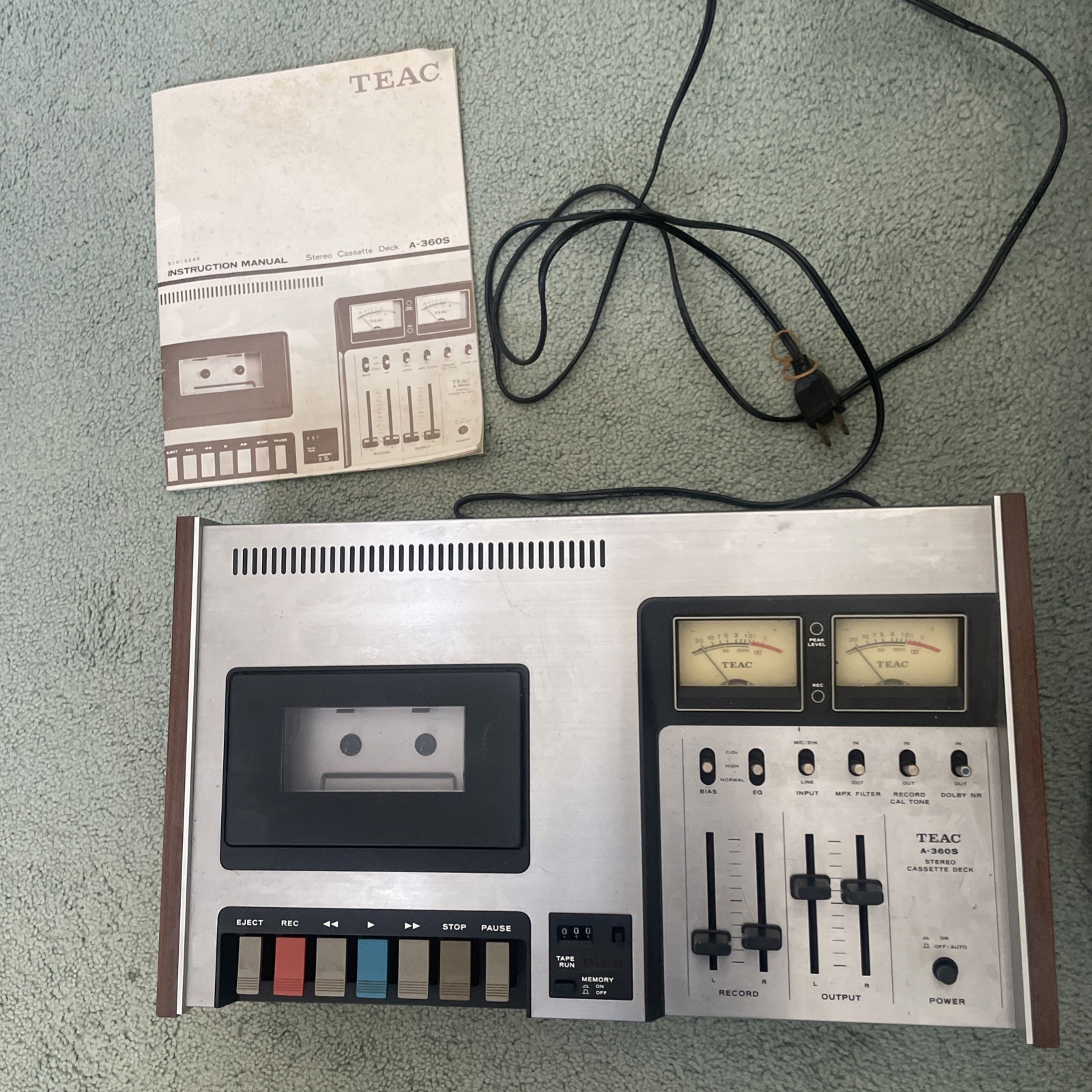
- Manual Bias and Equalization Controls: Allows users to fine-tune recording performance based on tape formulation—essential for maximizing fidelity with different tape brands.
- 4-Track Capability: A rare feature in consumer decks, enabling multi-track recording and overdubbing for home studios.
- Front-Panel Level Meters: Large VU meters provide real-time monitoring of input and output levels, crucial for avoiding distortion.
- Tape Selector Switch: Lets users choose between normal, high-bias, or CrO₂ tapes, ensuring optimal recording calibration.
- Remote Control Option: Some models supported optional remote control units for transport functions, adding convenience in studio setups.
These features made the A-360 not just a playback machine, but a true recording instrument—one that empowered users to create professional-quality tapes in their own homes.
Common Issues and Maintenance
Like all vintage reel-to-reel decks, the Teac A-360 requires careful maintenance to perform at its best. Common issues include:
- Deteriorated Rubber Components: Idler tires, pinch rollers, and belts (if present in certain subassemblies) can harden or crack over time. Replacement with modern equivalents is essential.
- Dirty or Worn Heads: Tape heads should be cleaned regularly with isopropyl alcohol and demagnetized to preserve frequency response.
- Capstan and Pinch Roller Wear: These critical drive components can lose grip or develop flat spots, leading to speed fluctuations.
- Oxidized Pots and Switches: The bias, level, and mode controls may develop crackling noises due to oxidation. Contact cleaner or pot replacement can resolve this.
- Tape Path Misalignment: Over time, guides can shift, affecting tracking and head-to-tape contact. Professional alignment is recommended for critical use.
Despite these potential issues, the A-360 is known for its robust construction and serviceability. Many units still function reliably today, especially those stored in dry, temperature-controlled environments. With a thorough cleaning, demagnetization, and recalibration, a vintage A-360 can deliver performance that rivals modern digital recorders in terms of musicality.
Current Market Value and Collectibility
The Teac A-360 is increasingly sought after by analog enthusiasts and collectors. While not as expensive as a Nakamichi Dragon, a fully serviced A-360 in excellent condition typically sells for $600–$1,200, depending on functionality, cosmetics, and included accessories.
Units with original packaging, manuals, or rare modifications (such as upgraded heads or external power supplies) command higher prices. The 4-track capability significantly enhances desirability, as few consumer decks offered this feature with such high fidelity.
Its collectibility stems not just from nostalgia, but from real usability. Unlike many vintage electronics that are now museum pieces, the A-360 remains a practical tool for recording and archiving. With the resurgence of interest in analog tape—fueled by artists and audiophiles seeking "tape warmth"—the A-360 is more relevant than ever.
Conclusion and Legacy
The Teac A-360 is a testament to the golden age of analog audio engineering. It combines precision mechanics, flexible recording options, and a rich, musical sound that continues to captivate listeners over 45 years after its release. More than just a tape deck, it’s a handcrafted instrument that invites user engagement—from bias calibration to tape selection—offering a tactile, immersive experience that digital formats often lack.
For the vintage audio collector, the A-360 represents excellent value and enduring performance. For the home recording enthusiast, it’s a gateway to the art of analog tape. And for the audiophile, it’s a reminder that sometimes, the best technology isn’t the newest—it’s the one that makes music feel alive.
If you’re lucky enough to find a well-maintained Teac A-360, don’t let it pass you by. Plug it in, thread up a reel of tape, and rediscover what high-fidelity really sounds like.
eBay Listings



As an eBay Partner, we earn from qualifying purchases. This helps support our independent vintage technology research.
Related Models
- Teac A-6700DX (1980)
- Teac A-105 (1975)
- Teac A-106 (1975)
- Teac A-170 (1976)
- Teac A-2300 (1978)
- Sony TC-2050SD (1978)
- Aiwa AD-F990 (1993)
- Kenwood KX-3060 (1982)
- Sony TC-2130A (1974)
- Sony TC-2220 (1972)