Teac A-2340: The Precision Cassette Deck from the Golden Age of Analog
In the mid-1970s, as high-fidelity audio reached new heights of popularity, cassette technology was undergoing a quiet revolution. No longer seen merely as a medium for voice recording or portable music, the compact cassette began to emerge as a serious contender in the audiophile world—thanks in large part to advanced machines like the Teac A-2340. Though not as widely celebrated as some of its contemporaries from Nakamichi or Revox, the Teac A-2340 stands as a testament to Japanese engineering excellence and a commitment to precision that defined the era.
Released in 1975, the A-2340 was part of Teac’s professional-grade cassette deck lineup, designed for both studio use and discerning home audiophiles. At a time when open-reel tape was still the gold standard for sound quality, Teac pushed the boundaries of what was possible with the compact cassette format. The A-2340 was engineered to deliver near-reference playback and recording performance, making it a favorite among engineers, broadcasters, and tape enthusiasts who demanded accuracy and reliability.
Technical Specifications
The Teac A-2340 was built with broadcast and studio applications in mind, and its specifications reflect that professional orientation. It featured a dual-capstan transport system, a hallmark of high-end cassette decks that ensures consistent tape-to-head contact and minimizes wow and flutter. Combined with a three-motor design, this allowed for precise tape handling and superior speed stability.
| Specification | Detail |
| Year Introduced | 1975 |
| Format | Compact Cassette |
| Transport Type | Dual Capstan, Three-Motor |
| Tape Speed | 1⅞ ips (4.76 cm/s) |
| Frequency Response | 30 Hz – 18 kHz (Type I), 30 Hz – 19 kHz (CrO₂) |
| Signal-to-Noise Ratio | 66 dB (Dolby B), 72 dB (Dolby C) |
| Wow and Flutter | < 0.055% (weighted) |
| Head Configuration | Separate Record, Playback, and Erase Heads |
| Recording Equalization | 120 µs / 70 µs (switchable) |
| Input/Output | Line In/Out (RCA), Mic In (¼"), Headphone Out |
| Noise Reduction | Dolby B and C (switchable) |
| Dimensions | 440 mm × 140 mm × 330 mm (W×H×D) |
| Weight | 11.5 kg (25.3 lbs) |
| Power Requirement | 120V AC, 60 Hz (or 220–240V via transformer) |
The A-2340 supported both Type I (ferric) and Type IV (metal) tapes, with selectable bias and equalization settings for optimal performance across tape types. Its ability to handle CrO₂ (chrome) and metal tapes with precision made it forward-compatible with evolving tape formulations, a rare feature at the time.
Sound Characteristics and Performance
The sonic signature of the Teac A-2340 is best described as transparent, detailed, and neutral—a hallmark of professional monitoring equipment. Unlike many consumer decks that colored the sound with excessive warmth or brightness, the A-2340 aimed for accuracy above all else. Its separate record and playback heads allowed for true monitoring of recordings in real time, a critical feature for studio use.
With a frequency response extending to 19 kHz on chrome tapes and a remarkably low wow and flutter of under 0.055%, the A-2340 delivered a level of clarity and stability that rivaled open-reel machines costing far more. The inclusion of Dolby B and C noise reduction helped suppress tape hiss without introducing the "breathing" artifacts common in lesser implementations.
Listeners often praise the A-2340 for its tight bass response, crisp midrange, and airy highs, especially when paired with high-quality metal tapes. It excels at capturing the dynamics of acoustic instruments and vocals, making it a favorite for field recording and music archiving.
Notable Features and Innovations
What set the Teac A-2340 apart from its peers was its broadcast-grade build quality and thoughtful engineering:
- Dual Capstan Transport: Ensured constant tape tension and minimized speed fluctuations, crucial for voice logging and music duplication.
- Three-Motor System: Dedicated motors for capstans and pinch rollers reduced mechanical interference and improved reliability.
- Separate Record and Playback Heads: Enabled real-time monitoring without generational loss, a must for professional recording.
- Selectable Equalization and Bias: Allowed users to optimize performance for different tape types, enhancing fidelity and headroom.
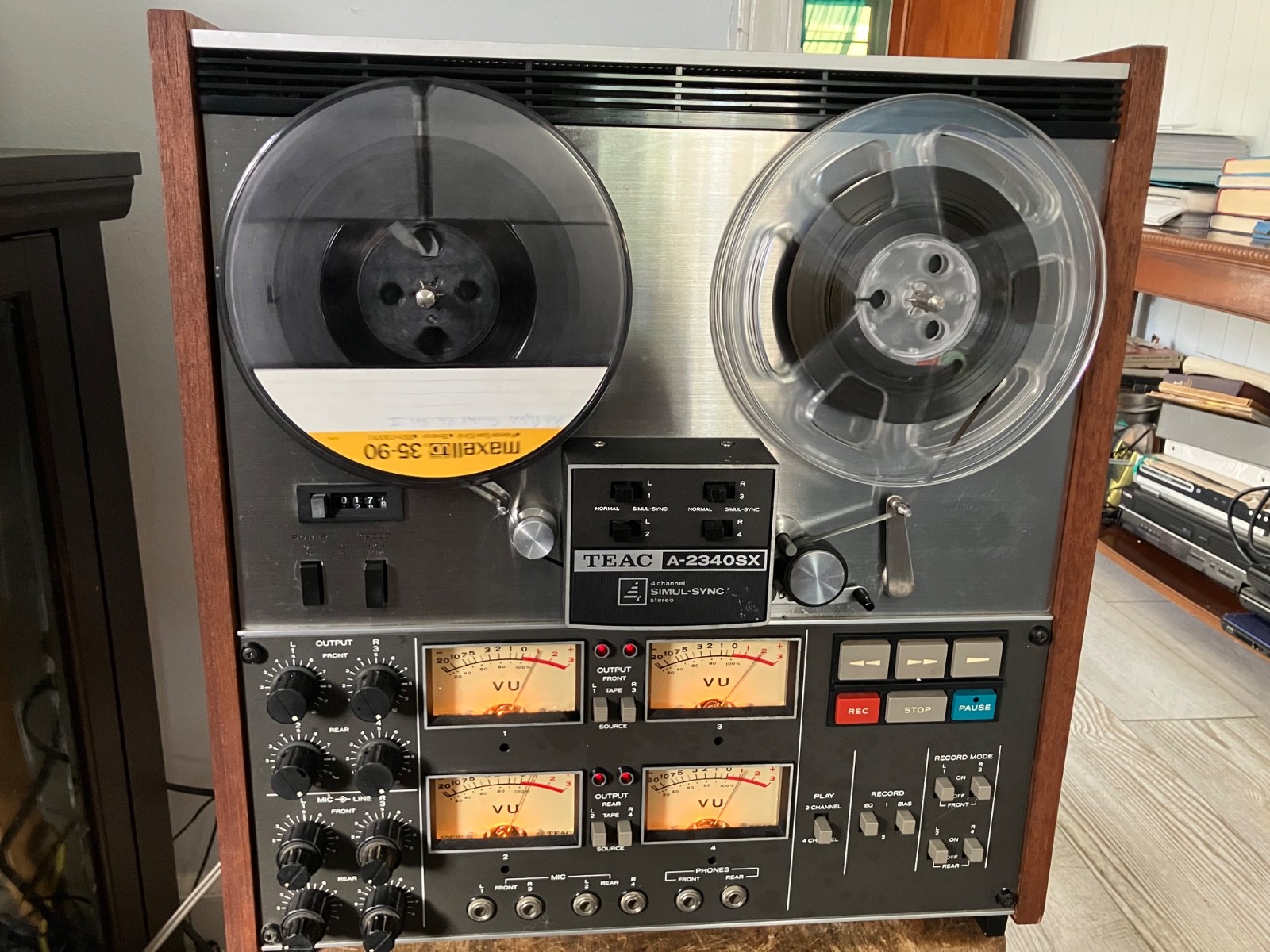
- VU Meters and Level Controls: Large, easy-to-read VU meters provided accurate level monitoring, while independent left/right gain controls allowed for precise calibration.
- Direct Drive Capstan Motors: Improved speed accuracy and reduced mechanical wear over time.
The front panel was clean and functional, with a minimalist aesthetic that emphasized usability over flash. The cassette compartment was top-loading with a motorized door, and the overall construction used heavy-gauge steel and high-quality components throughout.
Common Issues and Maintenance
Like all vintage tape decks, the Teac A-2340 requires careful maintenance to perform at its best. Over time, the rubber drive belts and idler tires can harden or crack, leading to speed instability or transport failure. These should be replaced with high-quality silicone equivalents during restoration.
The capstan shafts and pinch rollers should be cleaned regularly with isopropyl alcohol to prevent tape drag and head clogging. The record and playback heads, typically made of permalloy or ferrite, may require demagnetization every few dozen hours of use to maintain clarity and frequency response.
Another common issue is worn motor brushes in the capstan motors, which can cause speed fluctuations. Replacing these and ensuring proper motor alignment is essential for maintaining the deck’s legendary low wow and flutter.
Due to its professional heritage, many A-2340 units were used heavily in broadcast environments, so finding one in excellent cosmetic condition can be challenging. However, functionally, these machines were built to last, and with proper care, they can still perform exceptionally well today.
Current Market Value and Collectibility
The Teac A-2340 is not as widely collected as some of its flashier contemporaries, but it has a loyal following among tape purists, archivists, and analog enthusiasts. Its value has been steadily rising in recent years, particularly for fully serviced units with documented maintenance.
As of 2024, a fully restored and calibrated Teac A-2340 can fetch between $600 and $900, depending on condition, accessories, and provenance. Units with original packaging, manuals, and calibration tools command a premium. Non-working units typically sell for $200–$300, reflecting the cost of professional restoration.
While not a "trophy" deck like the Nakamichi Dragon, the A-2340 is increasingly recognized for its engineering integrity and sonic neutrality, making it a smart acquisition for those building a high-performance analog tape setup.
Conclusion and Legacy
The Teac A-2340 may not have the name recognition of some high-end cassette decks, but it represents the quiet excellence of Japanese engineering during analog audio’s golden age. Built for accuracy, durability, and professional use, it remains one of the most capable cassette decks ever made.
Today, as vinyl and analog media enjoy a resurgence, the A-2340 stands as a reminder that the cassette format, when treated with respect and precision, is capable of extraordinary fidelity. For collectors, restorers, and audiophiles who appreciate understated excellence, the Teac A-2340 is a hidden gem—one that continues to deliver exceptional sound, decades after its debut.
eBay Listings



As an eBay Partner, we earn from qualifying purchases. This helps support our independent vintage technology research.
Service Manuals & Schematics
- Manual — archive.org
Related Models
- Teac A-6700DX (1980)
- Teac A-105 (1975)
- Teac A-106 (1975)
- Teac A-170 (1976)
- Teac A-2300 (1978)
- Sony TC-2050SD (1978)
- Aiwa AD-F990 (1993)
- Kenwood KX-3060 (1982)
- Sony TC-2130A (1974)
- Sony TC-2220 (1972)