Tannoy GRF Memory (1982–1987)
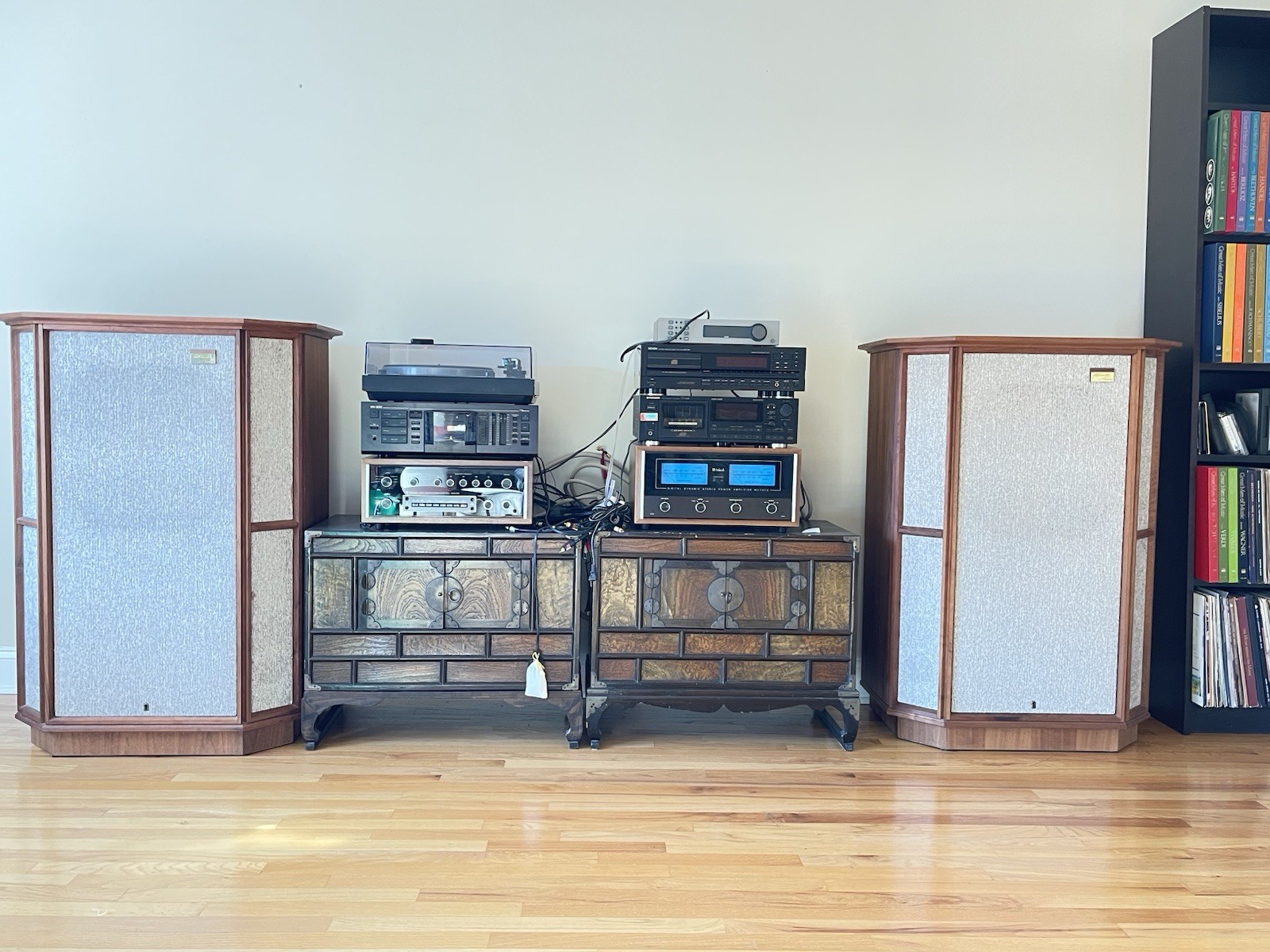
At 62 kilograms and nearly a meter tall, these wooden monoliths don’t just fill a room — they command it.
Overview
The Tannoy GRF Memory isn’t just another floorstanding speaker; it’s a full-scale resurrection of a G.R. Fountain design, reissued in the early 1980s as a direct descendant of Tannoy’s most revered engineering lineage. Marketed as a "fantastic recreation" of the original concept, the GRF Memory arrived in 1982 with a mission: to deliver uncompromised point-source coherence through the brand’s signature Dual Concentric driver architecture. Standing 1100mm tall with a broad 800mm footprint, these passive loudspeakers are physically imposing, built around a wooden cabinet that houses a single 15" Dual Concentric driver — technically a 38cm coaxial cone unit designated 3839M — responsible for handling all audio bands. Unlike back-loaded horn designs seen in some contemporaries, the GRF Memory relies on a sealed cabinet augmented by quadruple ducted ports, a rare configuration aimed at deep, controlled bass extension without flabby resonance.
Owners report a speaker that defies its era’s trends, favoring a minimal crossover network built with high-quality components to preserve signal integrity. The crossover operates at 1kHz with a 12dB/octave slope, and includes a unique control network offering five selectable positions for adjusting output between 1kHz and 20kHz (±6dB/oct), plus a secondary trim from 5kHz to 20kHz ranging from +3dB to -6dB. This level of tonal shaping was uncommon for production speakers at the time, suggesting Tannoy targeted a discerning, possibly professional, audience. The speaker’s high sensitivity — reportedly 95 dB — makes it an ideal match for low-powered valve amplifiers, though it performs equally well with high-current solid-state designs.
Despite their mass and complexity, the GRF Memory speakers were never marketed as mere showpieces. They earned the prestigious Stereo Sound 'State-of-the-Art' award, a rare honor that cemented their reputation in high-end audio circles. Collectors note that while the original run lasted until 1987, the model’s influence extended well into the 1990s, with some claiming it "dominated the world" in high-fidelity listening rooms during that period. Variants such as the GRF Memory HE, TW, and (RW) emerged over time, indicating ongoing demand and subtle refinements, though core design principles remained unchanged.
Specifications
| Manufacturer | Tannoy |
| Product type | Loudspeaker, Passive, Floorstanding |
| Production years | 1982–1987 |
| Driver | 15" Dual Concentric Drivers |
| Unit used | For all bands: 38cm coaxial cone type (3839M) |
| Port design | quadruple ducted ports |
| Frequency Response | 29Hz - 20kHz ± 3dB |
| Sensitivity | 95 dB |
| Minimum Impedance | 5.5 Ohm |
| Crossover frequency | 1kHz, 12dB/octave |
| Control network | 1kHz to 20kHz (±6dB/oct, 5 positions); 5kHz to 20kHz (+3dB to -6dB) |
| Dimensions | 1100 x 800 x 480mm |
| Weight | 62 kg |
Key Features
15" Dual Concentric Driver (3839M)
At the heart of the GRF Memory lies the 38cm coaxial cone unit, model 3839M, a true Dual Concentric driver where the high-frequency compression driver is mounted directly behind the center of the 15" bass cone. This configuration ensures time-aligned wavefronts from a single point source, a hallmark of Tannoy’s design philosophy. Unlike multi-driver arrays that can suffer from phase misalignment, the GRF Memory delivers a coherent soundstage with precise imaging, even off-axis. The driver handles the full frequency range, eliminating the need for complex multi-way crossovers that can color the sound.
Quadruple Ducted Ports
The bass reflex system employs four distinct ducted ports, a design choice that distinguishes the GRF Memory from typical ported cabinets. These ports are engineered to reduce turbulence and port noise, allowing the speaker to achieve deep bass extension down to 29Hz without chuffing or distortion. The multi-port layout also helps manage internal pressure and damping, contributing to tighter, more articulate low-end response than might be expected from a speaker of this era.
Minimal Crossover with Adjustable Control Network
Despite being a two-way system in function, the crossover is remarkably simple, operating at 1kHz with a 12dB/octave slope. What sets it apart is the inclusion of a user-adjustable control network. With five selectable positions affecting the 1kHz–20kHz range and a secondary trim for 5kHz–20kHz, listeners can tailor the speaker’s tonal balance to room acoustics or personal preference. This level of fine-tuning was rare in production speakers and reflects Tannoy’s intent to deliver a reference-grade tool rather than a one-size-fits-all consumer product.
Wooden Cabinet with Non-Horn Loading
Contrary to some assumptions based on Tannoy’s horn-loaded models, the GRF Memory cabinet is not a back-loaded horn. Instead, it uses a large, sealed wooden enclosure that supports the Dual Concentric driver while minimizing internal reflections. The cabinet’s substantial size and weight — 62kg per pair, according to most sources — contribute to mechanical stability, reducing cabinet resonance and enhancing low-frequency control.
Historical Context
Produced from 1982 to 1987, the GRF Memory emerged during a golden period for British high-fidelity engineering. Positioned as a flagship model, it followed in the lineage of the Westminster and Arden, earning its place under the "Legendary Products" banner in the VTA Brand Index. The speaker’s design pays direct homage to the original work of G.R. Fountain, a key figure in Tannoy’s development of point-source monitoring systems. Its reception was immediate and enthusiastic: it won the prestigious Stereo Sound 'State-of-the-Art' award, a testament to its performance in critical listening environments. Some accounts suggest it remained a dominant force in audiophile circles well into the 1990s, with enthusiasts calling it one of the best Tannoy speakers ever made.
Collectibility & Value
The GRF Memory commands serious attention in the vintage audio market. An asking price of $8,500 was listed in 2014, and a 2024 listing in South Korea asked 3,500,000 won (approximately $2,600 USD at the time), though the latter may reflect regional or condition-based variables. No verified recent sale prices are available, and original MSRP remains undocumented. Spare parts, particularly the 3839M driver and crossover components, are scarce, making fully operational units highly desirable. There is no documented data on common failures or maintenance requirements, but given the age and complexity, owners are advised to inspect foam surrounds and internal wiring for degradation.
eBay Listings
As an eBay Partner, we earn from qualifying purchases. This helps support our independent vintage technology research.