Tannoy Arden (1978–1983)
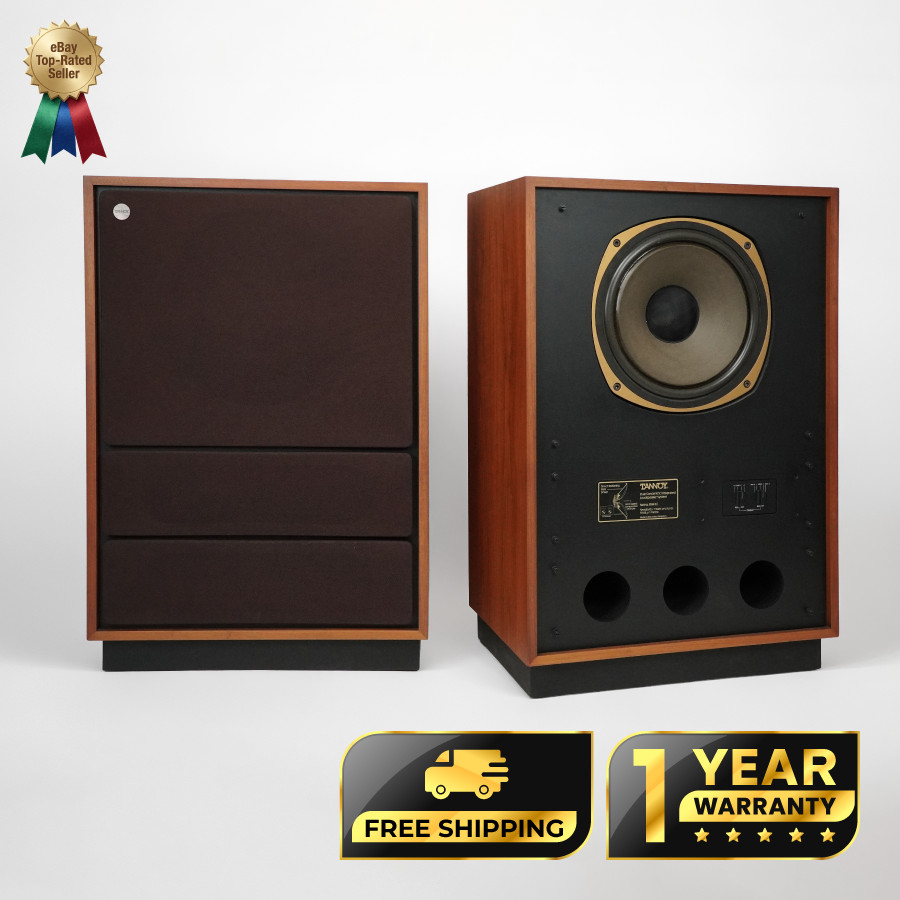
At 56kg, the Arden has a single point-source driver that puts the listener in the center of the performance.
Overview
The Tannoy Arden is not a small speaker. Built between 1978 and 1983 as part of the Arden MK II line, it was Tannoy's answer to the demand for a speaker with the sound of the Westminster that didn't need an entire wall of the living room. It stands 990mm tall and weighs 56kg, so it's still a presence, but it was designed to live in a home rather than dominate it like its larger sibling. What sets the Arden apart, and what fans still swear by, is the Dual Concentric driver. The high-frequency compression driver sits at the acoustic center of the bass cone. All frequencies come from a single point, which gives a coherent, time-aligned wavefront that locks instruments into place. Owners report a soundstage that feels more holographic than layered, with vocals and solo instruments occupying a tangible space in the room.
It isn't the largest speaker Tannoy ever made, but the Arden MK II has been described as the biggest model in its series from what some call the "golden era" of the brand, when British hi-fi was balancing raw performance with artisanal build quality. It was positioned a step below the Westminster, with much of the same DNA: the same point-source philosophy, the same commitment to wide bandwidth and low distortion. The large ported enclosure extends bass response down to 30Hz, which gives it authority on orchestral and organ works. The recommended amplifier power range is 20-300W, so it can be driven by anything from modest tube amps to high-current solid-state units. There's no sensitivity spec on record, but experienced listeners note these are not easy loads. They demand current and control, and they reward capable electronics with scale and clarity.
Specifications
| Manufacturer | Tannoy |
| Product type | Floorstanding loudspeaker |
| Production years | 1978–1983 (Arden MK II) |
| Driver | 12" Dual Concentric driver |
| Cabinet type | Large ported enclosure |
| Frequency Response | 30 Hz - 20 kHz, ±4 dB |
| Power handling | Recommended Amplifier Power: 20–300 W |
| Dimensions | 990 x 660 x 370mm |
| Weight | 56kg |
| Crossover | Crossover network features 2 independent channels |
Key Features
12" Dual Concentric Driver as True Point Source
The heart of the Arden is Tannoy's Dual Concentric driver, which acts as a point source. The high-frequency horn is mounted concentrically at the center of the bass cone, so all sound waves originate from the same physical location. That eliminates the time and phase discrepancies common in multi-driver systems, where tweeters and woofers are spaced apart. According to owners, the image is startlingly cohesive. Singers appear as full-body figures, not disembodied heads, and instruments keep their harmonic integrity across volume levels. The design favors realism over brightness, with a midband that feels organic and unforced.
Large Ported Enclosure for Extended Bass
The Arden sits in a large ported enclosure and its frequency response dips to 30Hz, an impressive figure for a speaker of its era not explicitly marketed as a subwoofer. The port is tuned to reinforce low-end output without bloating the lower mids, so the speaker can handle pipe organ, double bass, and timpani with authority. However,
Two-Channel Crossover Network
The crossover network in the Arden has two independent channels, which suggests careful attention to driver isolation and signal integrity. The exact crossover frequency is undocumented. The separate pathways imply a focus on minimizing intermodulation distortion between high and low frequencies. This is not a simple first-order filter, and the complexity supports the driver's wide bandwidth and the system's dynamic capability. Given the age, replacement or refurbishment of capacitors and inductors may be necessary in unrestored units.
Historical Context
The Arden emerged when Tannoy was expanding its consumer line to bring professional-grade sound to home listeners. Introduced in the late 1970s and continuing into the early 1980s, the Arden MK II represented the top of a new tier, below the monumental Westminster but engineered to deliver a significant portion of its performance in a more manageable form. It was part of a broader shift in high-fidelity design, where point-source imaging began to gain favor over traditional multi-way arrays. Positioned as a "more domestically sized floorstander," it appealed to audiophiles who wanted reference-level clarity without giving up living room functionality. Its release coincided with what some describe as the golden era of Tannoy, when the brand's British engineering ethos was at its peak.
Collectibility & Value
Today the Tannoy Arden gets serious attention in the vintage audio market. A pair listed as "Tannoy Arden Vintage Loudspeakers (1972)" sold for $3,995.00 on audio-exchange.com, while audiotehnika.lv lists a single unit at 4199.00 €, a figure that may reflect restoration status or regional pricing. On Facebook, a set of Tannoy Arden Legacy Series speakers fetched £3,500.00. Despite the lack of official sensitivity or impedance data, the Arden's reputation for musical coherence keeps values high. Maintenance is a known consideration: one forum user noted having their speakers re-coned by Lockwood. Original condition is prized, but serviceability extends usable life. These are not plug-and-play relics, since they require investment in upkeep and amplification.
eBay Listings



As an eBay Partner, we earn from qualifying purchases. This helps support our independent vintage technology research.