Tandberg TR 2075 (1975-1977)
There is a particular kind of confidence that comes from turning the heavy flywheel tuner on a Norwegian receiver—it doesn't click, it flows.
Overview
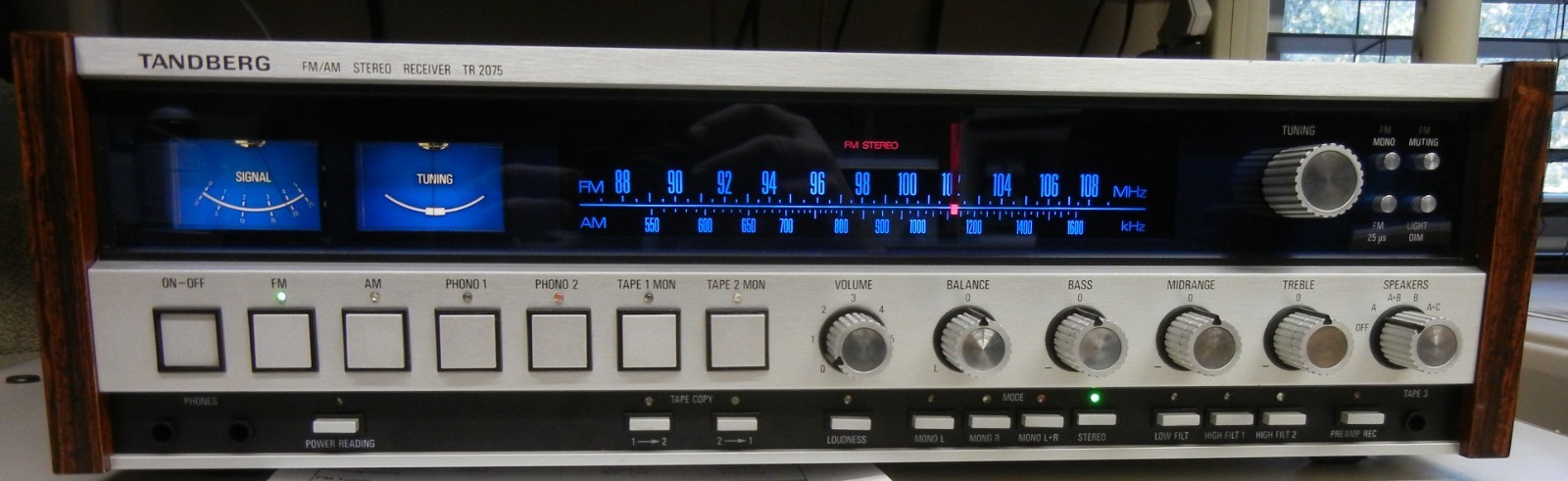
If you have spent your life surrounded by the flashy chrome and aggressive wattage claims of Japanese receivers from the 1970s, the Tandberg TR 2075 feels like a quiet conversation in a crowded room. It does not shout. It does not need to. When you lift the lid of this chassis, you are not looking at a circuit board designed for mass production efficiency; you are looking at a layout designed for signal integrity. The TR 2075 was Tandberg's flagship receiver during its production run from 1975 to 1977, occupying the sweet spot above the TR 2050 and below the later MKII revisions. It represents the peak of Norwegian hi-fi engineering before the industry shifted toward integrated circuits and plastic casings.
There is a tactile satisfaction in operating this unit that modern gear simply cannot replicate. The volume control is not a cheap potentiometer that develops channel imbalance after a decade; it is a stepped attenuator, a mechanical precision tool that ensures your left and right channels remain perfectly matched forever. The tuning mechanism uses a heavy flywheel that smooths out the jittery hand movements of the user, allowing you to land exactly on the carrier wave of an FM station without drift. This is not just a receiver; it is a statement of engineering integrity. While its contemporaries like the Pioneer SX-1980 were boasting massive power supplies and glowing frequency scopes, the TR 2075 was focusing on transparency, low noise, and a build quality that assumes the unit will outlive its owner.
Sonically, the TR 2075 rewards careful system matching. It is not a brute-force amplifier designed to drive low-efficiency speakers with reckless abandon. It delivers 75 watts per channel into 8 ohms, which was considered considerable power in 1975, but it achieves this through a fully discrete amplifier circuit that prioritizes dynamic headroom over raw thermal output. The sound is balanced, detailed, and dynamic. It maintains a neutral tonal balance, avoiding the excessive warmth of some American designs or the brittle brightness of early Japanese solid-state gear. It is equally at home with classical orchestral works, where the low distortion reveals subtle spatial cues, or with rock recordings, where the tight bass control keeps the kick drum defined. This receiver assumes you care about the music, not just the volume.
Specifications
| Manufacturer | Tandberg Radio, Oslo, Norway |
| Production Years | 1975-1977 |
| Power Output | 75W per channel @ 8Ω (20Hz-20kHz), 95W @ 1kHz |
| Impedance | 4Ω / 8Ω |
| Frequency Response | 6Hz - 80kHz (Linear Input) |
| Total Harmonic Distortion | 0.15% (Full Band), 0.08% (1kHz) |
| Signal-to-Noise Ratio | 60dB (Phono), 62dB (Tape) |
| Dimensions | 515mm x 155mm x 353mm (W x H x D) |
| Weight | 12.5kg (27.5 lbs) |
| Original Retail Price | $999.00 (USA), 5,700 NKr (Norway) |
Key Features
The Toroidal Power Supply
In the mid-1970s, finding a toroidal transformer in a consumer audio product was like finding a diamond in a gravel pit. Most manufacturers used standard EI laminated transformers because they were cheaper and easier to mount. Tandberg went with the toroidal design for the TR 2075, and the difference is audible. The toroidal transformer minimizes magnetic flux leakage, which means less hum induction into the sensitive tuner and preamplifier sections. It also offers superior stability during dynamic musical passages. When you push the volume on a TR 2075, the power supply does not sag; it holds the voltage steady. This is part of why the receiver feels so confident driving speakers. The power supply feeds two powerful amplifiers with true complementary, direct-coupled circuits, ensuring ample overload margin for low distortion. It is an expensive device not usually found in consumer products, but Tandberg included it because they believed performance mattered more than cost savings.
Diode Switching and Signal Path
One of the most enduring quirks of the TR 2075 is the input selection system. Instead of mechanical switches that scratch and wear out after forty years of toggling, Tandberg implemented electronic time-delayed diode switching. This provides noise-free blends when changing program sources. You press a button, and the signal path changes without the pop or crackle associated with worn contacts. Furthermore, the TR 2075 features separate preamplifiers for each input to keep low-level signals noise-free. The first stages of amplification occur within millimeters of the signal input, an expensive but effective way to achieve low noise and clean sound. This architecture means that even if you are using a low-output magnetic cartridge, the signal is boosted before it travels through the chassis, reducing the chance of interference picking up along the way.
The Tuner Section
The FM section is where the TR 2075 truly distinguishes itself from the mass-market Japanese receivers of the era. It features MOSFET transistors in the RF stage, 4-pole ceramic filters, and integrated circuits for stability. The tuning experience is mediated by a heavy flywheel that makes tuning a pleasure rather than a task. There are two tuning meters: a signal strength meter that gives full-scale deflection for strong aerial signals, and a center-zero meter that makes it easy to tune in FM stations spot-on, which is particularly important for stereo transmissions. The capture ratio is 0.9 dB, and the image frequency rejection ratio is greater than 90 dB. For the vinyl enthusiast, the phono stage includes switchable equalization for both MM and MC cartridges, though some collectors note the phono section is a little weak compared to dedicated preamps. However, for a receiver, it is remarkably versatile, offering two inputs for transcription units and two inputs for tape recorders with adjustable sensitivity.
Build Quality and Quirks
Mechanically, the TR 2075 is built to last. Its 12.5kg weight speaks to the heavy-gauge steel chassis and thick aluminum faceplate. The unit was delivered in Teak, Rosewood, or Walnut cases, giving it a furniture-like quality that Japanese black vinyl cases could not match. However, there are quirks you must know before buying. The headphone jack is a 3-pole 1/4-inch standard, but some users report that modern headphones do not seat completely in the port. There is a debate in the community about whether Tandberg used a different jack dimension or if it is simply a tight tolerance issue. Do not force it. Additionally, the rubber drive belts in the tuning mechanism degrade over time, and if the tuning feels sluggish, a belt replacement is a Saturday project. The foam surrounds on the original speakers paired with this unit often crumble, but for the receiver itself, the main failure points are dried-up electrolytic capacitors and worn selector switches if the diode system has been bypassed or modified.
Historical Context
The TR 2075 was built during a specific moment in audio history when the receiver format was king. In 1975, the industry was transitioning from separate amplifiers and tuners to all-in-one units, but high-end manufacturers still demanded performance that matched separates. Tandberg, based in Oslo, was competing not just with local European brands like Grundig or Philips, but with the invading Japanese giants like Pioneer, Sansui, and Kenwood. The Japanese models often won on power specs and feature lists, offering multiple speaker outputs and glowing displays. Tandberg won on refinement and precision. The TR 2075 traded raw wattage for clarity, channel separation, and long-term reliability. It was priced at $999.00 in the USA, positioning it as a luxury item for the serious audiophile. This was a time when receivers were expected to deliver both performance and longevity, and the TR 2075 exemplifies this ethos. It was not just a receiver; it was a statement of engineering integrity that resisted the trend toward integrated circuits and plastic casings.
The model sits in a specific hierarchy within the Tandberg family. It is above the TR 2050, which offered 50W per channel and a simpler tuner section. It is below the TR 2080, which was released after the TR 2075 with updated cosmetics and minor circuit refinements, serving as a transitional model before Tandberg's shift in design direction. There was also a later MKII model produced from 1978 to 1980, which offered similar power but with updated cosmetics. The TR 2075 hit the sweet spot those siblings never replicated, balancing the raw power of the later models with the analog purity of the earlier designs. For collectors, the TR 2075 is often preferred over the MKII because it represents the purest iteration of the 1975 engineering philosophy before cost pressures began to alter the component selection.
Collectibility & Value
Today, the Tandberg TR 2075 is highly sought after by vintage audio collectors and purists, particularly in Europe where the brand remains a household name. In North America, it is a rare find, which adds to its allure. Units in good working condition typically command prices between $800 and $1,500. Fully restored examples featuring recapped power supplies and cleaned controls can reach the higher end of the range, sometimes exceeding $2,000 if the original wood case is flawless. eBay listings show a wide range from $9.50 for parts machines to $4,000 for mint specimens, but realistic market value for a functional unit is around $1,000.
When purchasing a TR 2075, buyers should look for a unit with responsive controls, stable tuning, and balanced channel output. Bring a flashlight and examine the faceplate at a raking angle to check for scratches in the aluminum. Common issues include dried-up electrolytic capacitors, which can cause hum or instability in the power supply. Worn selector switches are less common due to the diode switching system, but if the unit has been modified, check for continuity. The tuning mechanism belts are a common failure; if the tuning knob spins freely without moving the dial, the belt is likely shattered. Maintenance budgets should include a full recapping and cleaning service to restore the receiver to optimal performance. Originality is highly valued, so modifications—especially to the amplifier or power supply—can reduce collector appeal unless professionally executed.
The relative rarity compared to mass-market Japanese receivers adds to its value. Tandberg's production volumes were modest, and many units remain in Europe. A well-preserved example in North America is particularly desirable. If you find one with the original wood case (Teak, Rosewood, or Walnut), hold onto it. The cosmetic condition of the wood is often the first thing to degrade, and refinishing it requires skill to match the original grain. The TR 2075's reputation for build quality, musical accuracy, and understated elegance has only grown over time. It is a receiver that rewards careful system matching—ideally paired with efficient, well-designed speakers such as Tannoy, Spendor, or vintage KEF models. If you want a receiver that sounds like it was built by engineers who listened to music rather than marketing managers, this is the one.
eBay Listings


As an eBay Partner, we earn from qualifying purchases. This helps support our independent vintage technology research.
Related Models
- Tandberg TR 2040 (1975-1977)
- Pioneer QX-949A (1978)
- Pioneer SX-2000 (1978)
- Pioneer SX-2500 (1978)
- Marantz SR-2000 (1999–2001)
- Onkyo TX-1500MKII (1975)
- Pioneer QX-646 (1978)
- Pioneer SX-1900 (1978)
- Pioneer SX-201 (1978)
- Pioneer SX-251R (1976)