Tandberg TR 2040: The Pinnacle of Scandinavian Hi-Fi Engineering
Introduction
The Tandberg TR 2040, produced between 1975 and 1977, stands as a hallmark of Norwegian precision and audiophile excellence in the world of vintage stereo receivers. Released during the golden era of analog audio, the TR 2040 was designed to deliver both high-fidelity sound and robust functionality in a single, elegantly engineered unit. As part of Tandberg’s premium receiver lineup, the TR 2040 was positioned as a serious component for discerning listeners who valued musicality, build quality, and technical refinement. With its 40 watts per channel output, precision FM stereo tuner, and discrete circuitry, the TR 2040 offered performance that rivaled far more expensive separates of its time. Its relatively short production run—just two years—adds to its allure among collectors and vintage audio enthusiasts today.
Technical Specifications
| Specification | Value |
| Model | TR 2040 |
| Category | Receiver |
| Years Produced | 1975-1977 |
| Power Output | 40W per channel @ 8Ω |
| Impedance | 8 ohms |
| Frequency Response | 20Hz - 20kHz |
| Total Harmonic Distortion | < 0.1% |
| Signal-to-Noise Ratio | 86dB |
| Dimensions | 440x145x350 mm |
| Weight | 14.5 kg |
Design & Engineering
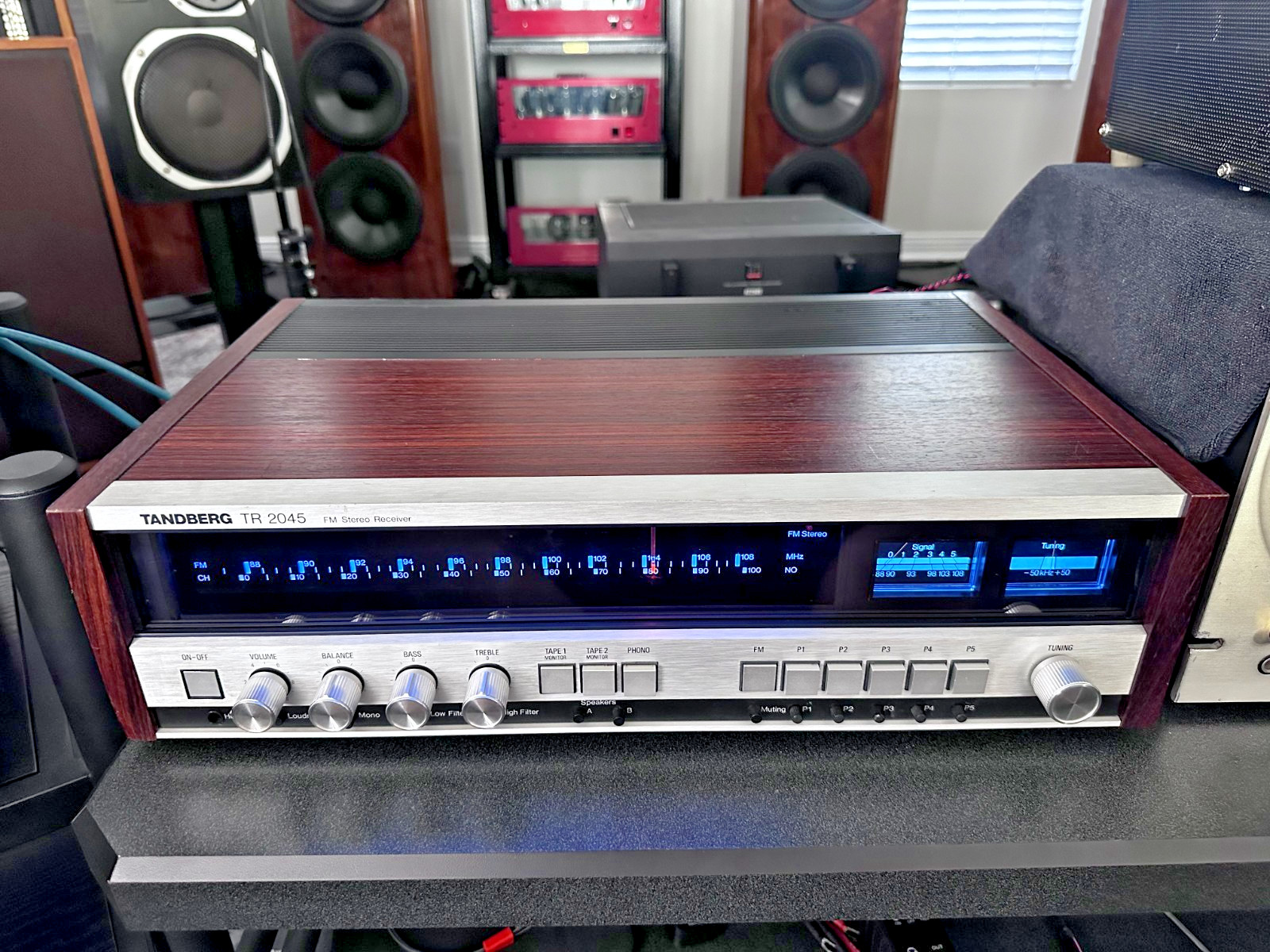
The Tandberg TR 2040 exemplifies the Scandinavian design philosophy: minimalist, functional, and built to last. Housed in a sturdy steel chassis with a brushed aluminum front panel, the receiver exudes quality from the moment you lay eyes on it. The front panel features a large, centrally located tuning dial with a clear analog scale, flanked by blue-backlit VU meters that provide a visual representation of output levels—a signature Tandberg aesthetic that is both practical and visually striking.
Under the hood, the TR 2040 is a fully discrete design, meaning it uses individual transistors and components rather than integrated circuits, which was a hallmark of high-end audio equipment in the 1970s. This approach allowed Tandberg engineers to fine-tune every stage of the audio path for optimal performance. The amplifier section is based on a dual-mono configuration with a robust toroidal power transformer, delivering clean, stable power to both channels. This design minimizes crosstalk and enhances dynamic headroom, contributing to the receiver’s authoritative and controlled sound.
The FM tuner section is equally impressive, featuring a high-precision phase-locked loop (PLL) system with excellent sensitivity and selectivity. It was capable of receiving stereo broadcasts with clarity and depth, making it a favorite among FM enthusiasts during the rise of stereo radio in the mid-1970s. The tuner includes a digital frequency display (a novelty at the time), along with manual tuning and station presets, offering a blend of modern convenience and analog warmth.
Input selection includes multiple line-level inputs, a dedicated tape loop, and a high-quality phono stage for MM cartridges, making the TR 2040 a versatile hub for turntables, tape decks, and other analog sources. The rear panel is thoughtfully laid out with gold-plated RCA jacks and sturdy speaker terminals, ensuring reliable connections over decades of use.
Sound Characteristics
The sonic signature of the Tandberg TR 2040 is best described as warm, detailed, and musically engaging. It doesn’t aim for clinical neutrality; instead, it presents music with a natural tonal balance, rich midrange, and smooth high frequencies. The bass is tight and well-controlled, thanks to the toroidal power supply and robust output stage, allowing the receiver to drive a wide range of speakers with authority.
Classical and jazz recordings benefit particularly from the TR 2040’s ability to render spatial cues and instrument textures with realism. Vocals are rendered with presence and clarity, never harsh or fatiguing. While not as aggressively detailed as some Japanese contemporaries like the Sansui or Pioneer receivers, the TR 2040 excels in creating a cohesive, immersive soundstage that invites long listening sessions.
Its discrete amplifier design contributes to a dynamic and expressive presentation, with excellent transient response and low background noise. The < 0.1% THD figure is impressive for its era and reflects Tandberg’s commitment to high fidelity. When paired with efficient speakers—such as vintage Tannoy, Spendor, or even modern high-sensitivity models—the TR 2040 delivers a listening experience that remains compelling by today’s standards.
Market & Collectibility
Today, the Tandberg TR 2040 is highly sought after by vintage audio collectors and enthusiasts, particularly those who appreciate European engineering and understated design. Its relatively short production run and reputation for reliability have contributed to its status as a cult classic. Units in good working condition typically fetch between $600 and $1,200 on the secondary market, with fully restored models commanding higher prices.
When purchasing a TR 2040, it’s important to verify the condition of the electrolytic capacitors, which may need replacement after nearly 50 years. The blue VU meters, while iconic, can suffer from dimming or failure, and sourcing replacements can be challenging. However, the modular design of the unit makes servicing more accessible than many of its contemporaries.
Originality is highly valued—collectors look for units with intact faceplates, unmodified circuitry, and original knobs. Refurbished examples with recapped power supplies and cleaned controls are often preferred for daily use, as they combine vintage charm with modern reliability.
eBay Listings



As an eBay Partner, we earn from qualifying purchases. This helps support our independent vintage technology research.
Related Models
- Tandberg TR 2075 (1975-1977)
- Pioneer QX-949A (1978)
- Pioneer SX-2000 (1978)
- Pioneer SX-2500 (1978)
- Marantz SR-2000 (1999–2001)
- Onkyo TX-1500MKII (1975)
- Pioneer QX-646 (1978)
- Pioneer SX-1900 (1978)
- Pioneer SX-201 (1978)
- Pioneer SX-251R (1976)