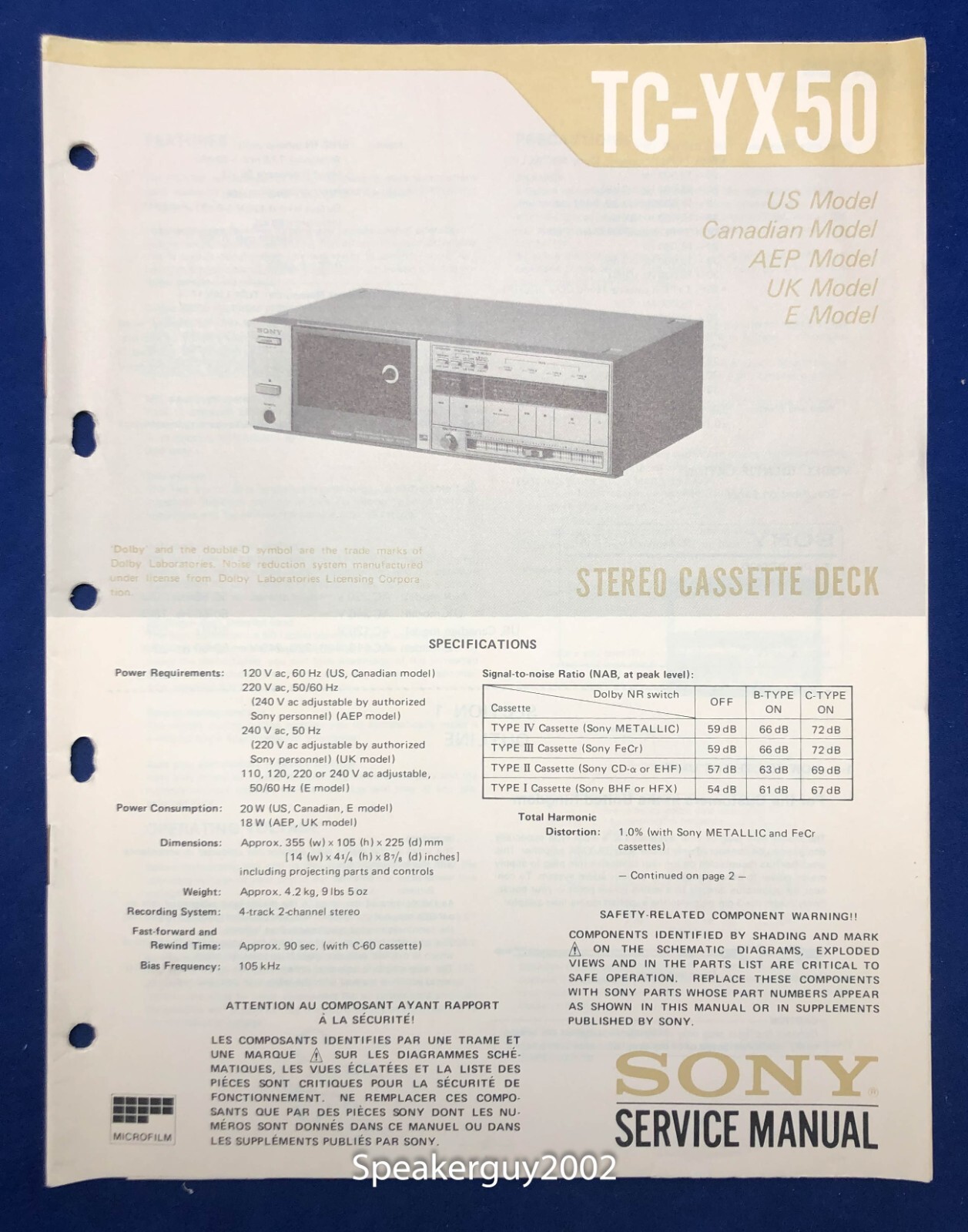
Sony TC-YX50 Cassette Deck (1989)
The Sony TC-YX50 is a mid-tier cassette deck released in 1989 as part of Sony's consumer-focused lineup during the final peak years of cassette tape popularity. Designed with convenience and user-friendly operation in mind, the TC-YX50 offers a blend of automation features and solid build quality typical of Sony's engineering standards in the late 1980s. While not positioned as a high-fidelity audiophile model, it represents an accessible yet capable option for everyday cassette use, including recording from radio, vinyl, or other sources.
Key Features
- Dolby B/C Noise Reduction: Reduces tape hiss during playback for cleaner audio.
- Auto Tape Selector: Automatically detects tape type (Normal, CrO2, Metal) and adjusts bias and equalization accordingly.
- Auto-Reverse Playback: Enables continuous playback of both sides of a cassette without manual flipping.
- Music Sensor Track Search: Allows fast forward or rewind to detect silent gaps between tracks, enabling semi-automated track navigation.
- Soft-Touch Controls: Tactile front-panel buttons for transport functions with a premium feel.
- Fluorescent Level Meters: Bright, responsive VU meters for monitoring recording levels.
- Bias Fine Adjustment: Manual control for optimizing recording performance with different tape types.
Specifications
| Specification | Detail |
| Year of Production | 1989–1990 |
| Frequency Response | 20Hz – 20kHz (typical, varies by tape type) |
| Wow and Flutter | ≤ 0.08% (weighted, auto-reverse mode) |
| Signal-to-Noise Ratio | 68 dB (Dolby C), 56 dB (Dolby B) |
| Total Harmonic Distortion | < 1.5% |
| Input Sensitivity | Line: 50mV, Mic: 0.25mV |
| Input Impedance | 50k ohms (line), high impedance (mic) |
| Output Level | Line: 150mV (max), headphone: 12mW + 12mW |
| Output Impedance | 1k ohms (unbalanced line), 8–32 ohms (headphones) |
| Power Consumption | 18W |
| Dimensions (W×H×D) | 430 × 140 × 320 mm |
| Weight | 7.5 kg |
| Tape Speed | 4.76 cm/s (standard) |
| Recording System | AC bias, auto-selectable (Normal/CrO2/Metal) |
| Playback Equalization | 120 μs (Normal), 70 μs (CrO2/Metal) |
Historical Context
The TC-YX50 was introduced at a time when cassette decks were transitioning from high-end audiophile components to more convenience-oriented consumer electronics. By the late 1980s, CD players were gaining traction, and manufacturers like Sony began emphasizing automation and ease of use over ultimate sound quality in mid-range models.
The TC-YX50 reflects this shift with its focus on features like auto-reverse, music sensor search, and automatic tape type detection—all designed to make cassette operation more seamless for the average user. Positioned below flagship models like the TC-K665ES or TC-8555, the YX50 offered a balance of functionality and affordability, making it a common component in home stereo systems and entertainment centers of the era.
While it lacks the precision mechanics and discrete circuitry of Sony’s higher-end decks, the TC-YX50 remains a representative example of mainstream cassette technology at the end of the analog audio era.
Sound Signature
The TC-YX50 delivers a clean, neutral sound profile typical of Sony’s mid-fi cassette decks. Its frequency response is well-balanced, with decent treble extension and solid midrange clarity. Bass response is tight but not overly emphasized, making it suitable for a wide range of music genres.
With Dolby C engaged, noise is well-controlled, though some tape hiss remains noticeable during quiet passages. The auto-reverse mechanism introduces a slight degradation in channel balance and frequency response compared to one-directional decks, but the difference is generally acceptable for casual listening.
Overall, the TC-YX50 performs reliably for its class—offering good, consistent playback and recording quality without reaching audiophile standards.
Maintenance and Common Issues
Like many cassette decks of its age, the Sony TC-YX50 is prone to several age-related issues. Regular maintenance is essential for reliable operation:
Common Problems:
- Belt Degradation: The rubber belts driving the capstan and auto-reverse mechanism can dry out and crack over time. Replacement with fresh belts is often necessary.
- Idler Tire Wear: The idler wheel that engages the auto-reverse system can harden or lose grip, leading to sluggish or failed tape flipping.
- Mode Switch Contamination: The tape type selector switch (Normal/CrO2/Metal) can develop oxidation, causing incorrect bias settings. Cleaning with contact cleaner is recommended.
- Fading Fluorescent Display: The VU meters and display may dim or flicker due to aging fluorescent tubes or failing driver circuits.
- Pinch Roller Glazing: The rubber pinch roller can become shiny and slick, reducing tape-to-capstan contact. Light cleaning with isopropyl alcohol helps restore grip.
Maintenance Tips:
- Clean tape heads and guides regularly with 99% isopropyl alcohol and a lint-free swab.
- Demagnetize the head and tape path every 50–100 hours of use using a non-powered tape demagnetizer.
- Use quality tapes—avoid heavily biased or worn cassettes that can affect auto-sensing accuracy.
- Exercise the auto-reverse mechanism periodically, even if not in use, to prevent mechanical sticking.
- Store in a dry, dust-free environment to minimize oxidation and contamination.
Collectibility and Market Value
The Sony TC-YX50 is not considered a high-collectibility model, earning a 4/10 on the collectibility scale. It lacks the prestige, build quality, or rarity of Sony’s ES or higher-end X-series decks. However, it remains sought after by enthusiasts restoring period-correct 1980s stereo systems or those seeking functional auto-reverse decks with music search capabilities.
Current Market Value (2024):
- Non-Working / Project Unit: $50–$75
- Fully Serviced & Functional: $100–$150
- Mint Condition with Box/Accessories: Rare; may reach $175 in exceptional cases
Value is highly dependent on mechanical condition and functionality, particularly of the auto-reverse and tape sensing features.
Conclusion
The Sony TC-YX50 is a solid representative of late-1980s cassette deck design, emphasizing user convenience and reliable performance. While not a high-end audio performer, it offers a compelling mix of automation, build quality, and classic Sony engineering. With proper maintenance, it can still serve as a functional and nostalgic part of a vintage audio setup—ideal for digitizing tapes or enjoying classic cassette recordings with authentic analog charm.
eBay Listings


As an eBay Partner, we earn from qualifying purchases. This helps support our independent vintage technology research.
Related Models
- Sony TC-2050SD (1978)
- Sony TC-2130A (1974)
- Sony TC-2220 (1972)
- Sony TC-FX6 (1982)
- Sony TC-K96R (1986)
- Aiwa AD-F990 (1993)
- Kenwood KX-3060 (1982)
- Stromberg-Carlson RS-404 (1975)
- Akai CS-F33R (1985)
- Akai DX-59 (1983)