Sony TC-WR905S Dual Cassette Deck
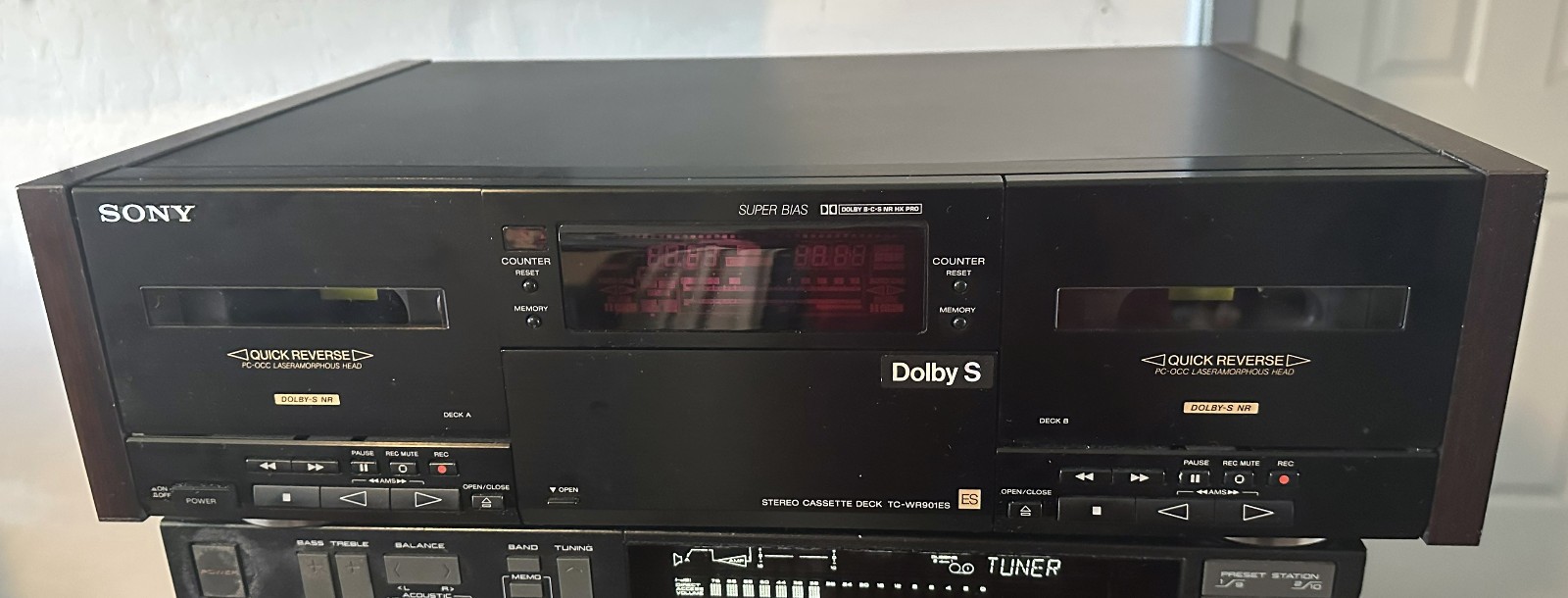
Meet the Sony TC-WR905S—a no-nonsense dual cassette deck that quietly powered through the final wave of analog home audio. Built between 1994 and 1997, it wasn’t chasing audiophile glory or breaking new ground. Instead, it delivered exactly what it promised: reliable, hassle-free tape dubbing, mixtape creation, and crisp playback. For anyone who ever spent an afternoon copying vinyl to cassette or compiling the perfect road-trip mix, this Sony workhorse was there—solid, unflashy, and always ready to roll.
With auto-reverse on both decks, Dolby B/C noise reduction, and intuitive features like music search and repeat play, the TC-WR905S was engineered for real-world use. It won’t dazzle with exotic components, but its clean sound, thoughtful layout, and durable construction make it a standout among mid-tier decks. If you're hunting for vintage gear that actually works—without emptying your wallet—the WR905S is a smart pick.
Key Features
- Dual cassette wells with auto-reverse playback and recording
- Dolby B and C noise reduction for improved tape fidelity
- Tape type selector: Normal, CrO₂, Metal
- Automatic tape bias calibration for optimal recording levels
- Music search and repeat play functions
- Soft-touch control panel with responsive feedback
- Fluorescent VU meters for level monitoring
- Line input/output and headphone jack for private listening
Specifications
| Specification | Detail |
| Model | TC-WR905S |
| Brand | Sony |
| Year of Release | 1994 |
| Production Period | 1994–1997 |
| Category | Dual Cassette Deck |
| Recording Capability | Yes (both decks) |
| Auto-Reverse | Yes (both sides) |
| Tape Types Supported | Normal (IEC I), CrO₂ (IEC II), Metal (IEC IV) |
| Noise Reduction | Dolby B, Dolby C |
| Line Input Sensitivity | 70mV (for 0dB recording level) |
| Line Output Impedance | 50k ohms (unbalanced) |
| Headphone Output Impedance | 32 ohms |
| Power Consumption | 30W |
| Dimensions (W×H×D) | 430 × 145 × 323 mm |
| Weight | 7.5 kg |
| Display | Fluorescent dual VU meters |
| Additional Features | Music search, repeat play, soft-touch controls, auto calibration |
Sound Quality and Performance
The TC-WR905S serves up a clean, balanced sound—faithful without being flashy. It’s the kind of deck that stays out of the music’s way, delivering clear highs, tight mids, and a surprisingly stable low end. Dolby C decoding tightens up tape hiss, especially on CrO₂ and Metal tapes, while the auto bias calibration ensures recordings stay consistent across tape types.
Wow and flutter are impressively low for a mid-range unit, keeping pitch steady and playback smooth. It won’t rival high-end models like the TC-K665ES, but for everyday use—copying tapes, reliving old mixtapes, or archiving records—it performs with quiet confidence.
Historical Context
By 1994, the cassette’s reign was waning. CDs were sleeker, cleaner, and digital. But in homes around the world, tape wasn’t dead—it was evolving. Dual decks like the TC-WR905S bridged the gap, offering analog convenience with a touch of digital logic. Music search, repeat play, auto-reverse—these weren’t just features, they were promises of control in a format that once demanded constant attention.
Sony didn’t design the WR905S to win awards. They built it to last, to simplify, to work. And in doing so, it became a quiet symbol of cassette maturity: refined, dependable, and perfectly suited to its moment. This was analog, grown up.
Maintenance and Common Issues
Like any vintage machine, the TC-WR905S thrives on care. After decades on the shelf, belts dry out, gears stiffen, and heads collect oxide like dust on a record. Keep an eye out for:
- Belt degradation: Rubber belts can dry out and crack over time, leading to transport malfunctions.
- Idler tire wear: The idler wheel may harden or lose grip, causing slow or uneven tape movement.
- Dirty heads and rollers: Oxide buildup can degrade sound quality and cause tape drag. Regular cleaning with isopropyl alcohol and a cotton swab is recommended.
- Auto-reverse mechanism issues: Sticky gears or worn sensors may prevent proper side switching.
- Capstan and pinch roller maintenance: These should be cleaned regularly to ensure proper tape speed and tension.
Tips for Owners
1. Clean the tape path before first use and every 20–30 hours of playback.
2. Use demagnetizer tools periodically to prevent head clogging and signal loss.
3. Replace worn belts with OEM or high-quality aftermarket equivalents.
4. Store tapes properly to avoid shedding, which can accelerate head contamination.
5. Test both sides of the auto-reverse function to ensure smooth operation.
Collectibility and Market Value
The Sony TC-WR905S isn’t a grail. It carries a collectibility rating of 3/10—solidly in the “functional vintage” tier rather than the “museum piece” category. No exotic parts, no legendary sound, no limited run. But that’s not a flaw. It’s a feature.
For under $80 USD, you can own a fully operational dual deck from one of the last great eras of cassette design. Prices vary—typically $30 to $80—based on condition and functionality. Well-maintained units with clean heads, responsive controls, and fresh belts go fast. This isn’t a deck to flip; it’s one to use.
Conclusion
The Sony TC-WR905S is a quiet achiever. Not flashy, not rare, but undeniably capable. It represents the peak of practical cassette engineering—where every feature serves a purpose, and every component feels like it was built to last. With a little care, it still holds its own in a modern setup, whether you’re digitizing old tapes or just savoring the warm, familiar hum of analog playback. For the hands-on listener, the mixtape maker, the analog archivist—it’s not just functional. It’s faithful.
eBay Listings



As an eBay Partner, we earn from qualifying purchases. This helps support our independent vintage technology research.
Related Models
- Sony TC-2050SD (1978)
- Sony TC-2130A (1974)
- Sony TC-2220 (1972)
- Sony TC-FX6 (1982)
- Sony TC-K96R (1986)
- Aiwa AD-F990 (1993)
- Kenwood KX-3060 (1982)
- Stromberg-Carlson RS-404 (1975)
- Akai CS-F33R (1985)
- Akai DX-59 (1983)