Sony TC-WR900 Dual Cassette Deck
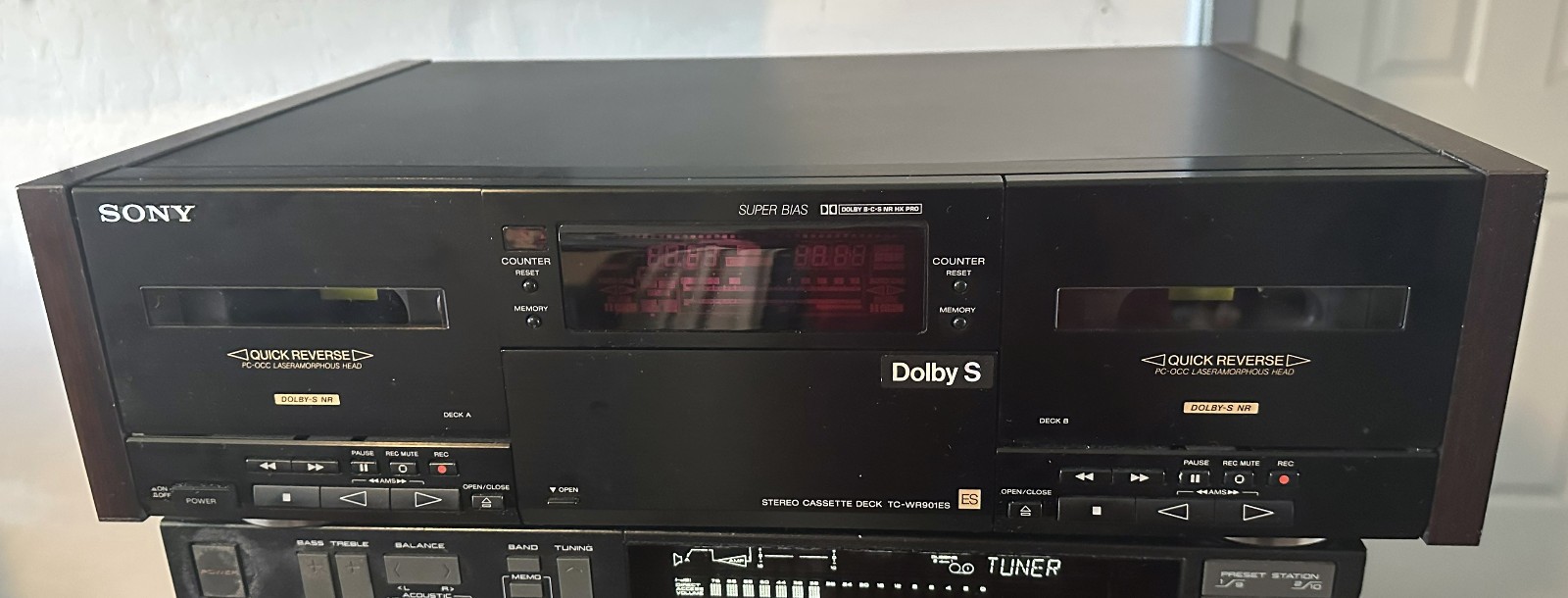
By 1997, the cassette was on borrowed time. CDs had taken over the mainstream, and MP3s loomed on the horizon. Yet Sony wasn’t ready to let analog go quietly. Enter the TC-WR900—a no-nonsense, dual-cassette workhorse built for the last wave of tape loyalists. This wasn’t a luxury deck for purists, but a smartly engineered machine for real-world use: copying mixtapes at double speed, recording late-night radio shows, or archiving vinyl without breaking a sweat. With its 3-head system, auto-calibration, and soft-touch controls, the TC-WR900 delivered polished performance just as the format’s curtain was coming down.
Key Features
- Dual Cassette Design: Enables direct C-60 to C-90 tape copying at 2x speed.
- Auto Reverse Playback/Recording: Play or record on both sides of a cassette without manual flipping.
- Dolby B and C Noise Reduction: Reduces tape hiss significantly, especially on Type I tapes.
- Tape Selector (Type I/II/IV): Optimizes bias and equalization for Normal, Chrome, and Metal tapes.
- Auto Tape Calibration: Automatically adjusts recording levels for optimal sound quality.
- Music Search: Fast forward or rewind with audible playback to quickly locate tracks.
- Timer Recording and Playback: Schedule recordings or playback sessions up to 7 days in advance.
- Soft-Touch Controls: Sleek, responsive button interface with illuminated display.
Specifications
| Parameter | Specification |
| Year of Production | 1997–2000 |
| Power Consumption | 21W |
| Input Impedance | 50k ohms (line) |
| Output Impedance | 2.2k ohms (line) |
| Input Sensitivity | 200mV (line, for 0dB output) |
| Output Level | 0.5V (line, at 0dB) |
| Wow and Flutter | 0.08% WRMS |
| Frequency Response | Type I: 40Hz–13kHz, Type II: 40Hz–15kHz, Type IV: 40Hz–17kHz |
| Signal-to-Noise Ratio | >68dB (Dolby Off), >80dB (Dolby C On) |
| Head Configuration | 3-head system (separate record, playback, erase) |
| Motor System | Dual capstan, direct drive (record/play), belt-driven (transport) |
| Tape Speed | 4.76 cm/s (standard) |
| Dimensions (W×H×D) | 430 × 142 × 325 mm |
| Weight | 8.5 kg |
Historical Context
The late '90s were a twilight zone for cassettes. Sony itself had helped kill the format it once championed, yet continued refining it for those who weren’t ready to go digital. The TC-WR900 arrived in 1997 as part of that final push—aimed not at audiophiles, but at practical users who still relied on tapes for mixtapes, radio recordings, or preserving vinyl rips. It shared DNA with higher-end models but stripped away the boutique touches, focusing instead on reliability and ease of use.
This was a machine built for tasks, not trophies. Timer recording let you capture shows overnight. Dual cassettes meant fast, one-touch dubbing. Auto-reverse spared you the hassle of flipping tapes. And with Dolby B and C, even budget ferric tapes sounded clean. Its front panel—clean lines, digital display, soft-touch buttons—felt modern, even as the mechanics beneath remained firmly analog. It was Sony’s way of saying: the cassette might be fading, but it’s not obsolete yet.
Sound Signature
The TC-WR900 doesn’t shout. It speaks clearly, without embellishment. That’s the Sony hallmark of the era—precision over personality. The 3-head design ensures recording and playback happen on dedicated heads, minimizing crosstalk and maximizing fidelity. Wow and flutter sit at a rock-solid 0.08% WRMS, so pitch stays steady even on long plays.
Engage Dolby C and the noise floor drops dramatically, especially on Type I tapes where hiss used to be a dealbreaker. Chrome and Metal tapes unlock the full potential: frequency response stretches to 17kHz, and dynamic range tightens up, delivering results that flirt with CD quality when conditions are right. It’s not warm or nostalgic in tone—just honest, clean, and consistent.
Maintenance and Tips
After 25 years, no TC-WR900 runs like new without attention. These decks are robust, but time takes its toll—especially on rubber and electrical contacts.
- Belt Replacement: The rubber belts and idler tire degrade over time, leading to speed instability or transport failure. Replace every 15–20 years or as needed.
- Capstan and Pinch Roller Cleaning: Use isopropyl alcohol and a cleaning tape regularly to prevent speed fluctuations and tape drag.
- Mode Switch Maintenance: The auto-reverse mechanism relies on a mode switch that can oxidize. Contact cleaner may restore functionality if switching becomes erratic.
- Head Alignment: If recordings or playback sound muffled or lack stereo separation, professional head alignment may be necessary.
- Capstan Motor Issues: Some units may develop motor noise or speed drift. Listen for unusual whining or inconsistent tape speed.
Pro Tip: Always use a demagnetizer (tape head degausser) every few months to prevent magnetic buildup, which can dull high frequencies and degrade recording quality.
Collectibility and Market Value
The TC-WR900 lands at a solid 4/10 on the collectibility scale—not rare, not exotic, but respected. It’s the kind of deck you buy because it works, not because it’s a museum piece. Yet its reputation for durability and feature completeness has earned it a quiet following. Enthusiasts use it for digitizing tapes, making new dubs, or anchoring a retro setup with real functionality.
- Market Value: $50–$100 USD, depending on condition, functionality, and cosmetic state.
- Best Use Today: Tape dubbing, analog archiving, or as a nostalgic centerpiece in a retro audio setup.
Conclusion
The Sony TC-WR900 stands as a competent and user-focused dual cassette deck from the final chapter of the analog era. While overshadowed by digital formats, it remains a practical and enjoyable device for cassette enthusiasts, offering solid performance, thoughtful features, and the tactile satisfaction of analog tape. With proper care, it continues to serve as a reliable bridge between past and present audio worlds.
eBay Listings


As an eBay Partner, we earn from qualifying purchases. This helps support our independent vintage technology research.
Related Models
- Sony TC-2050SD (1978)
- Sony TC-2130A (1974)
- Sony TC-2220 (1972)
- Sony TC-FX6 (1982)
- Sony TC-K96R (1986)
- Aiwa AD-F990 (1993)
- Kenwood KX-3060 (1982)
- Stromberg-Carlson RS-404 (1975)
- Akai CS-F33R (1985)
- Akai DX-59 (1983)